
OnceHub vs Calendly: Detailed Comparison for 2026


If you’re trying to find the perfect scheduling tool to save time and impress your clients, you might have come across these two. The truth is that the comparison between OnceHub vs Calendly is a very specific one, as both platforms keep developing new features to streamline appointment booking. Our article breaks down everything you need to know about such popular scheduling solutions, from pricing to features and integrations.
And since we're here, we'll also show you Zeeg as an alternative, and why you should opt for our AI voice agent and scheduling software instead. But more on that later. Let’s compare OnceHub and Calendly now.
OnceHub vs Calendly at a glance
Calendly

Calendly stands as one of the most recognized names in the scheduling space, serving more than 20 million users across 230 countries. Since its founding in 2013 by, the platform has focused on creating an intuitive scheduling experience that works for teams of all types. With a simple interface and many integration capabilities, it's has gained significant traction in various industries, including in the financial services sector where 14 of the top 15 Fortune 500 financial companies now use the platform. But it's not the only one out there anymore, and you'll see in this article that nowadays there are plenty of alternatives.
For more information, check the basics on how Calendly works, and the best tips when using Calendly.
OnceHub
Formerly known as ScheduleOnce, OnceHub has positioned itself as a comprehensive scheduling solution with a focus on sales teams and lead engagement. The platform combines booking capabilities with conversation tools like AI-powered chatbots and instant meetings. Founded with a commitment to self-sufficiency, OnceHub has operated for over a decade solely on customer revenue without external funding, creating a stable platform for businesses that need advanced routing and qualification features.
OnceHub vs Calendly: key features compared
Both scheduling platforms share many of their capabilities, but it’s also good to say they each have unique strengths that set them apart. Let's examine how OnceHub vs Calendly stack up across essential scheduling features.
Booking page and link creation: It’s a tie
OnceHub: It provides a "Theme designer" for creating branded booking pages and notifications. Users can customize everything from colors to messaging, ensuring a consistent experience. The booking page creation process is intuitive but offers deeper customization options for businesses wanting to maintain brand identity.
Calendly: Known for its clean, modern interface, Calendly makes creating booking pages straightforward. While customization options exist, they're more limited on the free plan. The platform excels at simplicity, letting users create and share professional-looking scheduling links in minutes rather than focusing on extensive customization.
The difference: Calendly wins for ease of use and modern design, while OnceHub offers more customization options for businesses concerned with maintaining brand consistency.
Engagement and conversation tools: OnceHub wins
OnceHub: Takes the lead with extensive conversation tools including AI-powered chatbots, live chat functionality, and instant meeting capabilities. These features make OnceHub particularly valuable for sales teams wanting to engage leads the moment they express interest.
Calendly: Focuses more on streamlining the scheduling process rather than facilitating conversations. While it offers excellent notification systems and meeting polls, it lacks the robust conversational tools found in OnceHub.
The difference: OnceHub is clearly superior for teams needing to engage leads through multiple channels, with its chatbot functionality being a standout feature for qualifying prospects before they book.
Calendar integrations: OnceHub is more complete
Both platforms connect with some of the major calendar services: Google Calendar, Microsoft Office 365, or Microsoft Exchange. But, unlike Calendly, OnceHub (as well as Zeeg) can also connect to your Apple Calendar.
Team scheduling capabilities: Once winning again
OnceHub: Offers more flexible team scheduling features even on its free plan, including group meetings. Its routing capabilities are particularly strong, allowing for sophisticated distribution of meetings based on team member expertise, availability, or other criteria.
Calendly: Restricts team scheduling features to paid plans. While its round-robin feature works well, it lacks some of the advanced routing intelligence found in OnceHub. The Teams plan ($16/user/month) is required for collaborative scheduling features.
The difference: OnceHub provides more team scheduling capabilities at lower price points, making it a better choice for teams on a budget who need sophisticated meeting distribution.
Mobile accessibility: Calendly has an app, OnceHub doesn’t
OnceHub: Currently lacks dedicated mobile apps, meaning users must rely on mobile web browsers to manage their scheduling.
Calendly: Offers dedicated iOS and Android apps that allow users to manage their availability, create and share scheduling links, and monitor upcoming meetings from their mobile devices.
The difference: Calendly has a clear advantage for users who need to manage their scheduling on the go.
OnceHub vs Calendly: pricing comparison
Both platforms offer similar pricing structures with a free plan and various paid tiers. But let's look at the main differences between Calendly and OnceHub pricing
Free plan comparison
OnceHub's free plan offers more functionality than Calendly's. With OnceHub, you get group session management, PayPal payment processing, and automated workflows—all features that Calendly restricts to paid plans. For solo entrepreneurs or coaches just starting out, OnceHub's free tier provides significantly more value.
Paid plan comparison
At the entry level ($10/user/month), both platforms offer similar core features. The main difference emerges in the team-focused tiers:
- OnceHub's Route plan ($19/user/month) emphasizes lead qualification and sophisticated routing
- Calendly's Teams plan ($16/user/month) focuses on team collaboration and administration
For larger organizations, Calendly's Enterprise pricing (starting at $15,000/year) is more standardized, while OnceHub takes a custom approach to enterprise pricing.
Pricing verdict
If you want a more budget-conscious choice, OnceHub wins for solo users and small teams with its more feature-rich free plan:
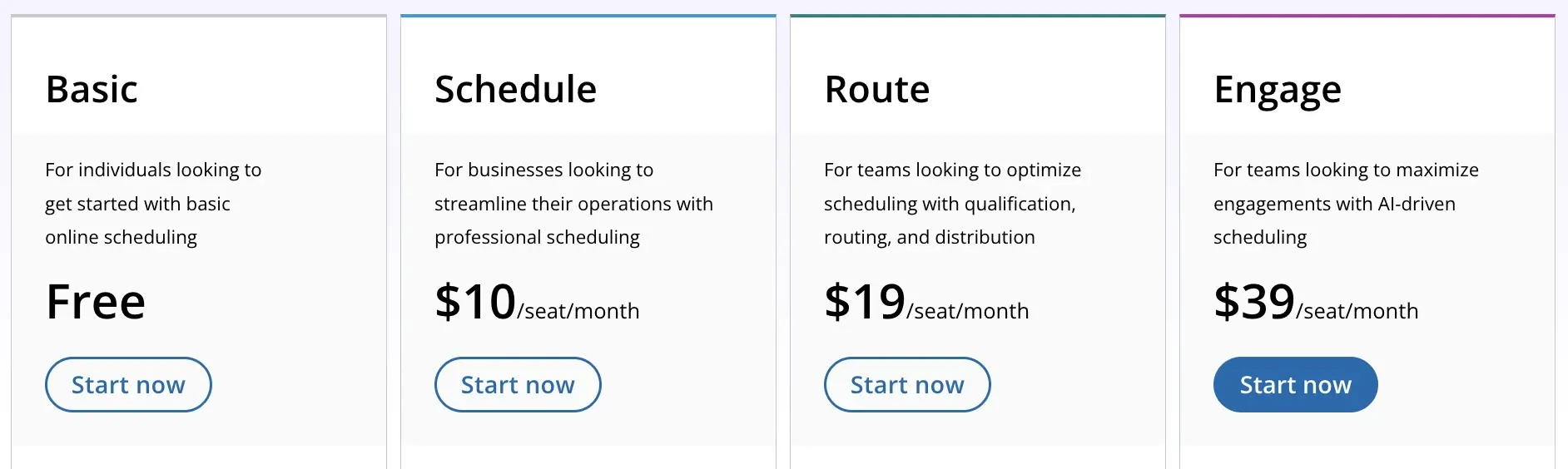
But if you're looking for value at scale, then Calendly offers better pricing for growing teams, with its Teams plan ($16/user/month) providing a good balance of features at a lower price than OnceHub's comparable tier ($19/user/month):

OnceHub vs Calendly: Integration capabilities
The ability to connect with your existing tech stack is crucial when selecting a scheduling tool. Here's how these platforms compare:
CRM integrations
OnceHub: Offers strong native integrations with Salesforce and HubSpot. The Salesforce integration is particularly robust, allowing detailed mapping of booking data and chatbot interactions to your CRM records.
Calendly: Supports more CRM platforms (32+ in total) but may not offer the same depth of integration that OnceHub provides with Salesforce. For teams using less common CRMs, Calendly is more likely to have a native connection.
Video conferencing
Both platforms integrate with the major video conferencing tools:
- Zoom
- Google Meet
- Microsoft Teams
- GoToMeeting
- Webex
There's little difference in how they handle video integration, with both automatically generating meeting links when appointments are booked.
Payment processing
OnceHub: Supports PayPal for payment processing, even on the free plan.
Calendly: Offers integrations with Stripe, PayPal, and Stax Payments, but only on paid plans.
Marketing automation
OnceHub: Limited native marketing automation integrations, relying more on Zapier connections.
Calendly: Excels with native integrations for marketing platforms including Mailchimp, Marketo, Pardot, and more.
Extension ecosystem
Calendly: Provides browser extensions for Chrome, Firefox, and Edge, plus mobile apps for iOS and Android.
OnceHub: Limited to fewer browser extensions and lacks mobile apps entirely.
Integration verdict
Calendly is the clear winner for integration capabilities with 100+ native connections compared to OnceHub's more limited selection. For businesses with complex tech stacks, Calendly offers better connectivity to your existing tools. However, for Salesforce-centric organizations, OnceHub's deeper CRM integration may outweigh the need for broader connectivity.
OnceHub vs Calendly: pros and cons
OnceHub
✓ Better free plan, with group scheduling and payment processing
✓ Advanced AI-powered chatbots and lead qualification tools
✓ Superior Salesforce integration with detailed data mapping
✓ Live engagement options including instant meetings and chat
✓ Strong routing capabilities for complex team structures
✓ Theme designer for complete branding customization
✗ No mobile apps for on-the-go management
✗ Fewer native integrations than Calendly
✗ More complex user interface with steeper learning curve
✗ Higher cost for team features ($19/user/month vs Calendly's $16/user/month)
✗ Less modern design aesthetic compared to Calendly
Calendly
✓ Clean, intuitive user interface with minimal learning curve
✓ Extensive integration ecosystem (100+ native connections)
✓ Mobile apps for iOS and Android
✓ Meeting polls for coordinating group availability
✓ More affordable team plan ($16/user/month)
✗ Limited free plan with just one event type
✗ No payment processing on free plan
✗ No group scheduling features without upgrading
✗ Fewer lead engagement tools compared to OnceHub
✗ Less customization for booking pages on lower tiers
Interested to compare Calendly to more scheduling tools?
Zeeg: a better alternative to both OnceHub and Calendly
While comparing OnceHub vs Calendly, you might wonder if there's other solutions. Zeeg offers advanced scheduling capabilities, with an AI voice agent that also streamlines your phone call booking.
Why choose Zeeg over OnceHub or Calendly?
- Fair pricing: Starting at just $10/month with a more generous free plan
- Full GDPR compliance: European data hosting with end-to-end encryption
- AI phone answering service: Have your customers answered, routed and booked automatically
- Native Apple Calendar integration: Unlike Calendly, which discontinued this feature for new users
- Advanced routing: Smart lead qualification forms with conditional logic
- Team scheduling: Round-robin distribution and collective appointments
- White-label experience: Complete customization for your brand
- Comprehensive analytics: Track meeting metrics and team performance
Zeeg combines OnceHub's advanced routing capabilities with Calendly's clean interface, all while offering better data security and more affordable pricing.
Final verdict: OnceHub vs Calendly (and why Zeeg beats both)
After a thorough comparison of OnceHub vs Calendly, it's clear that each platform serves different scheduling needs. Both tools excel in specific areas while falling short in others.
OnceHub strengths:
- Sales-focused features with AI-powered chatbots and lead qualification
- More generous free plan with group scheduling and payment processing
- Sophisticated routing capabilities for complex team structures
- Superior Salesforce integration for sales-driven organizations
However, OnceHub lacks mobile apps and presents a steeper learning curve for new users.
Calendly strengths:
- Clean, intuitive interface requiring minimal training
- Extensive integration ecosystem with 100+ connections
- Mobile apps for iOS and Android
- Widespread recognition and trust among users
Yet Calendly restricts essential features like group scheduling to paid plans and has discontinued Apple Calendar integration for new users.
This gap in the market is precisely where Zeeg enters as a compelling alternative. Zeeg combines the strengths of both platforms while addressing their limitations:
Why consider Zeeg instead:
- Full GDPR compliance with European data hosting for enhanced privacy
- Native Apple Calendar integration that Calendly no longer offers
- More affordable pricing with better feature distribution across plans
- Advanced team scheduling with round-robin and routing rules
- Online schedulig AND phone scheduling for inbound and outbound calls
- Clean interface with deep customization options
For businesses that need the powerful lead engagement tools of OnceHub, the clean interface of Calendly, and enhanced data security without breaking the bank, Zeeg represents the best of all worlds. But the right choice ultimately depends on your specific requirements, but if you're looking for a secure, affordable scheduling solution that works seamlessly across all calendar platforms, Zeeg deserves serious consideration alongside the more established players.
Zeeg is Europe's leading AI voice agent and appointment scheduling software in one solution — GDPR-compliant, made in Germany. Start for free →


