How AI Appointment Scheduling Works: Phone vs. Online


Most businesses treat AI appointment scheduling as a single thing — usually whichever channel they happened to automate first. A clinic bolts a booking widget onto its website. A law firm adds a voice agent to its phone line. Almost nobody asks whether their scheduling problem is actually a phone problem, an online problem, or both at once, and that gap is where bookings quietly leak away.
This article breaks down how AI appointment scheduling actually works — on the phone and online — what changes when the calendar behind each channel doesn't talk to the other, and how to tell a genuinely capable AI booking system from one that just moves the friction somewhere else.
No Zapier, no separate contact management, no booking tool to wire up. Zeeg handles the entire flow natively — from the first ring to a confirmed calendar invite. Try it free for 14 days.
Book Demo Now →What is AI appointment scheduling?
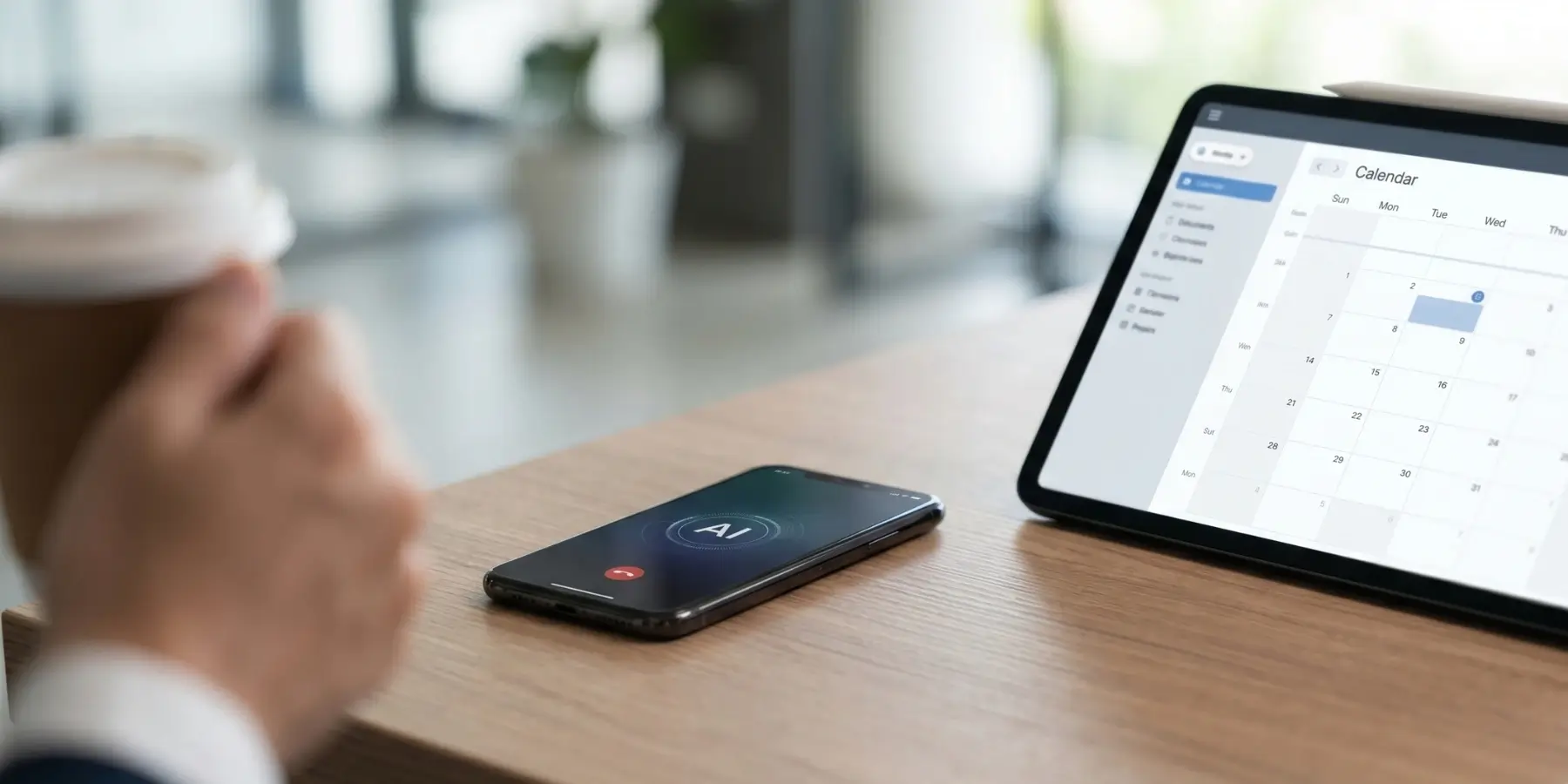
AI appointment scheduling (also called AI appointment booking) is the use of an AI agent to handle the full booking flow — answering an inquiry, qualifying the person, checking real-time calendar availability, and confirming a meeting — without a human getting involved at any stage. It's not a chatbot that collects a name and emails a link. The booking happens inside the interaction itself, whatever channel that interaction is on, and a confirmation goes out immediately.
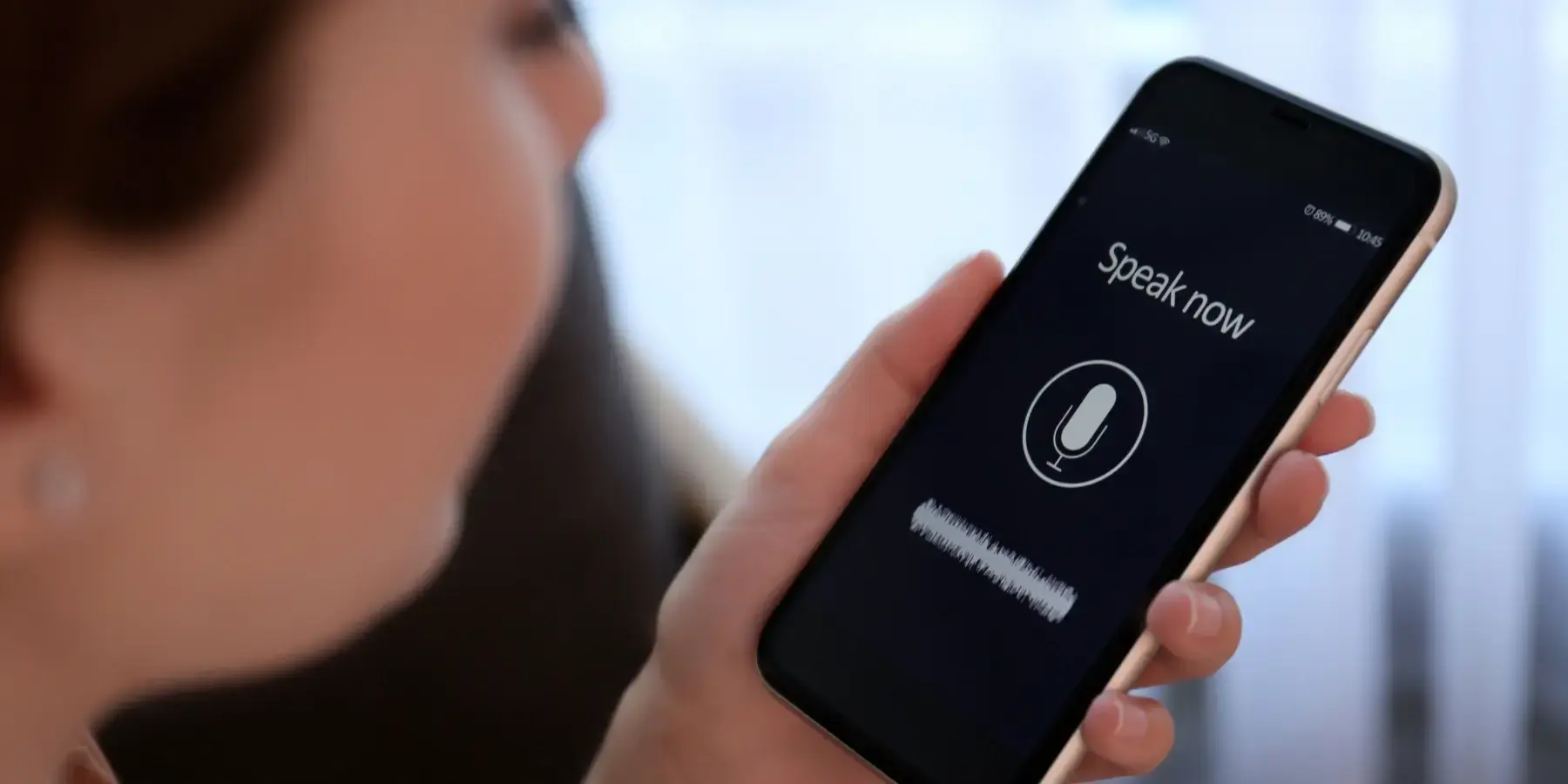
Depending on the channel, the underlying technology differs slightly. On the phone, it combines speech-to-text, a large language model that decides how to respond, and text-to-speech, all fast enough that callers don't notice the processing behind it. Online, the same reasoning layer runs against a live calendar and a booking page instead of a voice pipeline. Either way, the job is identical: turn "I need an appointment" into a confirmed slot on a calendar, in one continuous interaction.
Adoption is accelerating fastest on the voice side specifically. The global AI voice agent market was valued at $2.54 billion in 2025 and is projected to reach $35.24 billion by 2033, a compound annual growth rate of 39%.¹ That's a faster growth curve than online scheduling software has ever posted, and it reflects a simple fact: phone is the one booking channel that, until recently, couldn't be automated without sounding robotic.
The three types of AI booking — and why they're not equal
Not all tools that advertise "AI booking" work the same way, regardless of channel. There are three distinct approaches, and the conversion difference between them is significant.
— Zenoti, 2025 Salon & Spa Consumer Survey
This holds true whether the AI is answering a phone call or running an online booking flow. A caller who gets a callback promise instead of a confirmed slot behaves the same way a website visitor does when a form says "someone will reach out": most don't wait around. Friction is friction, no matter which channel it shows up on.²
Phone vs. online AI appointment scheduling
This is the part most guides skip, because most AI booking vendors only build for one channel. But the way people try to book an appointment varies enormously by who they are, what they're booking, and how urgent it is — which means a scheduling strategy built around a single channel is, by definition, turning away everyone who prefers the other.
Both read from the same calendar when they're part of the same platform — a slot confirmed on one channel is instantly gone from the other.
Phone-based AI scheduling
Phone remains the highest-friction channel to automate well, and also the one businesses can least afford to get wrong. Only 35% of customers who last resolved something over the phone were willing to switch to a GenAI digital assistant instead — people who reach for the phone tend to want the directness of a phone call, not a redirect to a form.³ An AI voice agent that can hold that same conversation — and still book the appointment natively, without transferring the caller anywhere — captures that preference instead of fighting it.
The cost of getting phone wrong is concrete and industry-specific. A 2025 small-business benchmarking report found missed-call rates of 32% in healthcare, 28% in legal services, 14% in home services, and 9% in real estate — and separately, that up to 85% of people whose calls go unanswered simply don't call back.⁴
Online self-service booking
For a large share of routine, low-urgency bookings — a haircut, a follow-up consultation, a recurring service — people would rather not talk to anyone at all, AI or human. A public booking page with AI-assisted routing removes the back-and-forth of "what times do you have" email threads entirely.
Here's the pattern: phone still dominates for anything that feels urgent or complex — the same 2025 survey found 77% of regular customers still consider calling the easiest way to change an existing appointment — while online dominates for anything routine, especially outside business hours.² Building AI scheduling for only one of these channels doesn't reduce the problem; it just picks which half of your customers get a good experience and which half get turned away.
Zeeg's own booking data points the same way: roughly a third of meetings are booked outside office hours, and Sunday alone accounts for 6.6% of bookings.
Why response speed is the core problem
Before getting into the mechanics of AI appointment scheduling, it helps to understand why the timing of a booking matters as much as whether one happens at all — on either channel.
— MIT & InsideSales.com, via Harvard Business Review
Research from MIT and InsideSales.com, published in Harvard Business Review, analyzed over 15,000 leads and 100,000 call attempts across six companies. Firms that contacted leads within an hour of a query were nearly 7 times more likely to qualify that lead than those who waited even one additional hour — and more than 60 times more likely than companies waiting 24 hours or longer.⁵
Despite this, most businesses fall far short in practice. RevenueHero's 2024 study of 1,000 B2B companies found that 635 of them — over 63% — never responded to a demo request at all, and among those that did, the average response time was 1 day, 5 hours, and 17 minutes.⁶ An AI scheduling assistant operating 24/7, on either channel, closes that gap entirely.
Read more: Our AI voice agent pricing guide covers what that full stack typically costs across the major platforms.
The full AI appointment scheduling flow, step by step
Here's what an end-to-end AI appointment scheduling flow looks like in a natively integrated platform, whether it starts on the phone or online.
- The interaction comes in. A call, or a visit to a booking page. The AI responds immediately — no hold music, no "someone will get back to you."
- The agent qualifies the person. Based on routing rules defined in plain language — for example, "if this is a new client, book a consultation" — the AI asks relevant questions, identifies intent, and determines which team member or meeting type fits.
- Availability is checked in real time. Because the scheduling system is part of the same platform, the agent has live access to calendar data and can offer specific time slots inside the conversation, not after it.
- The meeting is confirmed on the spot. The person picks a time, the agent books it, sends confirmations to both parties, and the event appears in the relevant calendar immediately.
- The contact record is created automatically. Everything — name, contact details, intent, which meeting was booked, and which channel it came through — is logged without manual entry.
That entire sequence runs without human involvement, whether it's 2 PM on a Tuesday phone line or 11 PM on a Sunday booking page.
Industry use cases: who benefits most, and on which channel
The value of AI appointment scheduling scales with how much of a business's inbound volume comes through a channel it hasn't automated yet.
Source: CallRail, 2025 Small Business Marketing Report.⁴ Up to 85% of callers who reach no one simply don't call back.
Sales teams running inbound-led motions face a related problem: qualifying leads fast enough that interest doesn't cool. The MIT/Harvard research makes the stakes concrete — the odds of qualifying a lead drop 400% when contact time goes from 5 minutes to just 10 minutes.⁵ An AI agent that qualifies someone and puts a meeting on a rep's calendar before the rep is even aware of the lead — whether that lead called in or filled out a form — eliminates that decay entirely.
Legal intake teams deal with a phone-heavy version of this problem: a prospective client calls at a moment of urgency, and a slow or missed response often means they've already called two other firms. An AI agent that handles the intake call directly and books a consultation with the right attorney captures those leads before they cool.
Trades and home services businesses (HVAC, plumbing, electrical) frequently miss calls when technicians are on a job. Every missed call is a lost booking from a customer who needed the service now and will simply call the next number on the list.
Dental and medical practices often see the clearest return from combining channels: healthcare had the highest missed-call rate of any sector measured (32%),⁴ but a meaningful share of patients also actively prefer booking routine visits online rather than calling during office hours. Covering both — an AI phone agent for urgent or after-hours calls, and a self-service booking page for routine visits — captures both sides of that split.
No-shows, reminders, and cancellations
AI appointment scheduling doesn't end when the booking is confirmed.
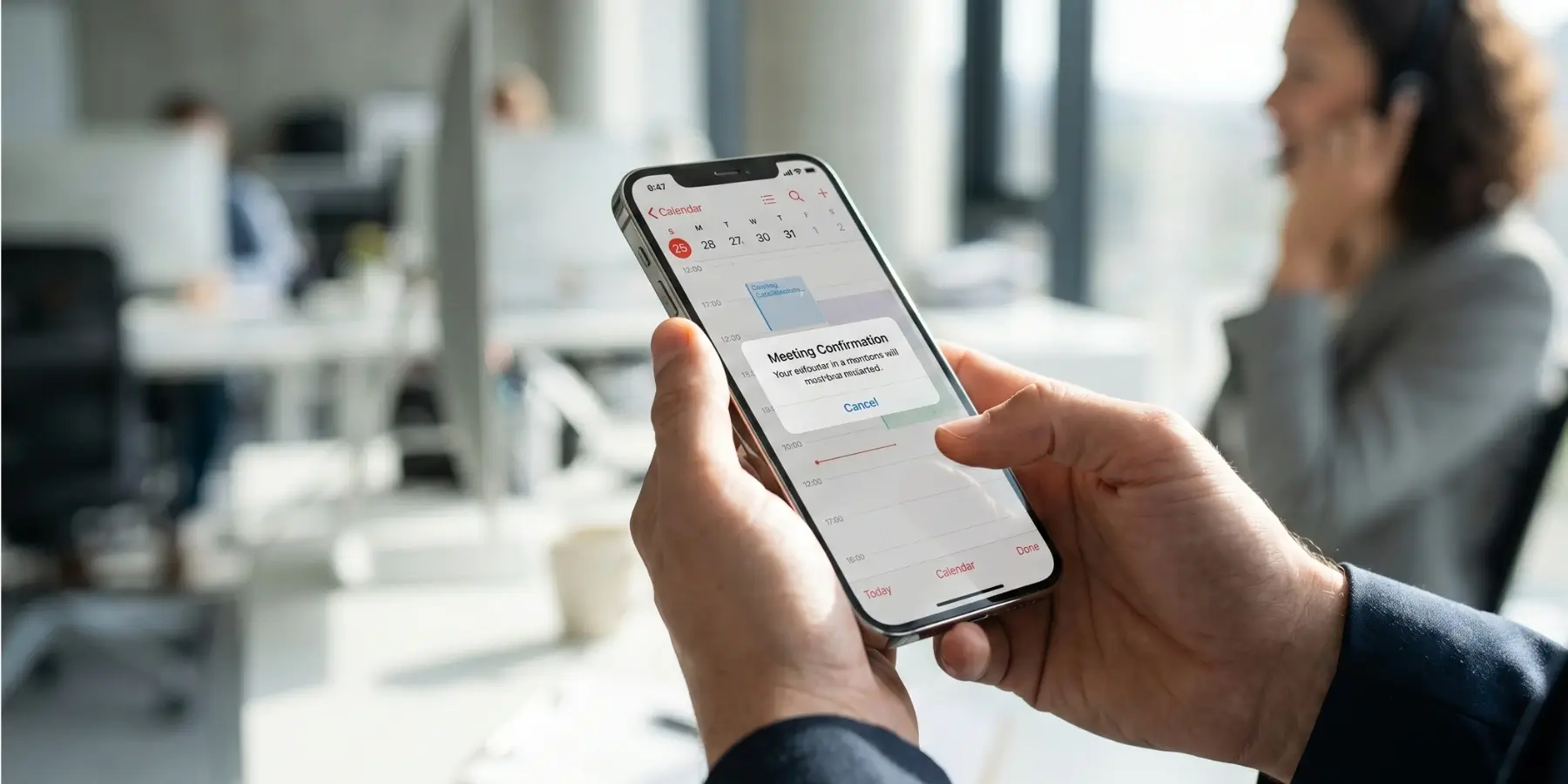
One of the most consistent problems across appointment-driven businesses is no-shows: people who booked but don't appear, leaving a slot empty and revenue on the table. The evidence for automated reminders is strong and long-standing: a systematic review and meta-analysis of 26 studies covering more than 16,000 patients found that people who received electronic reminders were 23% more likely to attend their appointment, and 25% less likely to no-show, compared with those who received no reminder at all.⁷
Beyond reminders, the handling of reschedules and cancellations matters just as much. A person who wants to move an appointment shouldn't have to wait for a human to call back, and shouldn't have to use a different channel than the one they booked on. An AI agent that can look up an existing booking, modify or cancel it, and update the calendar in real time — over the phone or through a self-service link — closes the loop cleanly. Moving a meeting is also far more common than most teams plan for: nearly half of invitees who can't make their slot move it instead of cancelling.
What breaks when phone and online don't share a calendar
Running phone and online scheduling as two separate tools — a voice agent and a scheduling page, usually from two different vendors — is the most common setup today. It can work, but several failure points appear consistently over time.
Double-booked or lost slots. When the phone system and the online booking page don't check the same live calendar, a slot can be filled twice, or an agent can quote availability that's already gone.
Data loss at handoff points. Every time a booking crosses from one channel's system into another, there's a risk it doesn't arrive intact, and a lead disappears without anyone noticing.
Inconsistent experience across channels. A caller gets a confirmed booking in the moment; the same business's website visitor gets a "we'll follow up" form.
Cost stacking. A voice agent platform, a scheduling tool, and a contact management system each carry their own subscription, and the combined total adds up considerably compared to a single integrated platform.
Zeeg merges Online + AI phone appointment scheduling
Most businesses end up running phone, online booking, and lead routing as separate problems — each with its own vendor, its own dashboard, and they link to a CRM, increasing the risk of missing leads in the handoff between them. Zeeg exists to close that gap: one account, one scheduling system linked to your calendars, and one set of rules governing every appointment a business books, whether it came in by phone or online.
That consolidation is what actually moves the needle on conversion and cost. A booking made over the phone and one made through a public link can never double-book the same slot, because they're reading from the same calendar. A lead doesn't go cold waiting for someone to reconcile two different tools after the fact. And a team paying for a voice platform, a scheduling tool, and a separate CRM collapses that into a single subscription, a single login, and a single place to see what's actually converting. Here's what that looks like in practice.
AI Answering Service
Greets every caller, holds a natural, human-like conversation, checks real-time availability, and books the appointment before the call ends — no hold music, no voicemail.
Outbound Call Automation
Calls leads and past customers in bulk to re-engage cold leads, remind no-shows, or win back lapsed clients — all without a human dialing a single number.
AI Call Transfer
Hands the call off to a live team member the moment a conversation needs a human touch — no dead air, no repeating yourself, no starting over.
Knowledge Base Answers
Pulls directly from your knowledge base to answer caller questions on the spot — pricing, policies, hours — not just book meetings and hang up.
Calendar Connection
Your public booking pages and phone calls connect to whichever calendar tool your team already runs on, and book meetings directly according to real-time availability.
Lead Routing
Sends both phone calls and online bookings to the right employee automatically, based on rules you define — new clients, existing clients, or specific services.
Every Booking Scenario
1:1, round robin, group, collective, and flexible time-slot meetings — Zeeg handles whichever format the appointment or team structure calls for, on either channel.
Privacy & Compliance Controls
Per-agent privacy toggles — save transcript & PII, record voice, recognize callbacks — plus consent-ready booking pages, EU server hosting, and a signed DPA.
That's the shift Zeeg makes: phone and online aren't two separate products bolted together. They're one system, from day one.
Pricing works in two different ways, and they're independent from each other — you can get one or both:
- AI voice agent: Inbound calls cost approximately from €0.111 per minute, outbound approximately from €0.155 per minute, with bundles available on call volumes. The AI agent is available on all plans, and a built-in Test Agent panel lets teams run the agent from a browser before going live. When you create your account, you get 5 minutes for free to properly test it.
- Online scheduling: the free forever Starter plan has unlimited bookings; and paid plans start at €10/month
Note: Made in Germany and fully GDPR compliant, Zeeg runs on EU servers, includes a signed DPA, and gives you full control over your data privacy settings.
Read more: For a broader look at how Zeeg sits within the voice AI landscape, the Retell AI alternatives and Vapi AI alternatives guides both cover how native scheduling compares to standalone voice platforms.
Phone and online booking, routing, and reminders — all reading from the same calendar, GDPR-compliant, and made in Germany.
Start Free for 14 Days →Sources
- Grand View Research — AI Voice Agents Market Size, Share & Industry Report, 2033
- Zenoti — 2025 Survey Data: 5 Key Salon and Spa Consumer Trends Shaping Appointment Management in 2026
- Gartner via Business Wire — Gartner Survey Finds 60% of Customer Service Agents Fail to Promote Self-Service (2025)
- CallRail via Business Wire — CallRail Releases Report Benchmarking Marketing Efforts for Small Businesses (2025)
- Harvard Business Review — The Short Life of Online Sales Leads (Oldroyd, McElheran, Elkington, 2011)
- RevenueHero — We Tested Lead Response Times of 1,000 B2B Sales Teams (2024)
- PMC/NCBI — Using digital notifications to improve attendance in clinic: systematic review and meta-analysis
Zeeg is Europe's leading AI voice agent and appointment scheduling software in one solution — GDPR-compliant, made in Germany. Start for free →
Frequently Asked Questions
What does native integration mean in practice?
It means the AI calling, the booking system, and the contact management functionalities are part of one product — not three tools connected by automations. A call results in a confirmed meeting and an updated contact record with no manual steps, Zapier flows, or developer work involved.
How does GDPR apply to AI phone booking?
Any AI agent handling calls from European contacts is processing personal data and must meet GDPR requirements — including a valid legal basis, data subject rights, and data residency considerations. European-hosted platforms like Zeeg address this at the infrastructure level, so data never crosses to US servers.
Can AI appointment booking handle outbound calls too?
Yes. Agents can be configured for outbound campaigns as well — following up with leads, confirming appointments, or reaching out to prospects. Outbound calls typically carry a higher per-minute rate than inbound.
What happens to call data after the booking is confirmed?
In a natively integrated platform, the call is logged automatically in the contact management system— transcript, booking outcome, caller details, and call cost. In a multi-tool stack, that data has to travel through webhooks or automations, creating more failure points and potential for data loss.
Do I need a developer to set up AI appointment scheduling?
It depends on the platform. Developer-first tools like Vapi or Retell AI require technical setup and ongoing engineering work. No-code platforms like Zeeg let you configure an agent through plain-language prompts, with no API knowledge or coding required.
Do AI booking tools reduce no-shows?
Yes. Most AI booking platforms send automated reminders by SMS or email before the appointment, which consistently reduces no-show rates. The AI can also handle reschedules and cancellations conversationally, so clients modify rather than ghost — keeping the calendar accurate without staff involvement.
What's the difference between an AI booking bot and a traditional IVR?
A traditional IVR routes callers through a numbered menu. An AI booking bot understands natural language, adapts to what the caller says, and completes actions — like booking a meeting or capturing lead details — within the conversation. No menu, no key presses required.
How does an AI appointment setter work?
An AI appointment setter answers inbound calls or messages, asks qualifying questions based on defined routing rules, checks real-time calendar availability, and books the meeting directly. In platforms where calling and scheduling are native to the same system, the booking is confirmed before the call ends.
What is AI appointment booking?
AI appointment booking is the use of an AI agent to handle the full scheduling process — answering an inquiry, qualifying the person, checking availability, and confirming a meeting — without human involvement at any step. In a natively integrated platform, the booking is confirmed during the conversation itself, not via a follow-up link.