Retell AI Review in 2026: Is This Voice Agent Platform Worth It?


Retell AI is one of the most-searched voice agent platforms right now and for good reason. It offers developer-grade infrastructure for building AI phone agents that handle inbound calls, qualify leads, book appointments, and run at high concurrency. But is it the right fit for your business?
This review covers what Retell AI does, how its pricing breaks down per minute, what real users say, and which alternatives stand out — including Zeeg, Europe's leading AI phone assistant and scheduling software, GDPR-compliant and made in Germany, built for teams who need voice and booking in one place.
What is Retell AI?
Retell AI is an infrastructure layer for voice automation: you bring your telephony (or use theirs), connect a large language model of your choice, configure your call flow, and deploy an agent that handles real phone conversations. The platform sits at the intersection of speech-to-text, LLM reasoning, and text-to-speech — stitched together into a single pipeline designed for production use.
The company was founded in 2023 by Bing Wu, Zexia Zhang, Todd Li, Weijia Yu and Evie Wang, went through Y Combinator's Winter 2024 batch, and launched publicly in February 2024.¹ It offers a drag-and-drop builder supporting IVR trees, dynamic transfers, real-time webhooks, and CRM integrations, and has seen adoption across industries like healthcare, logistics, and finance.
Typical jobs include support triage, lead qualification, appointment booking, follow-ups, and after-hours coverage. Best fit: teams with developers who want to launch fast, scale up without drama, and keep costs clear per minute.
While Retell markets itself as accessible, the honest picture is that it performs best in the hands of engineering teams with the resources to configure and maintain it properly. For a broader map of where voice agents fit in the sales stack, our guide to AI SDR tools covers how voice qualification compares to email-based SDR automation. For teams looking at a wider range of voice automation options, our best AI voice bots roundup also covers Retell in a side-by-side context.
What can Retell AI actually do?
Retell AI's feature set is built around developer control and production reliability. Here's what the platform actually includes:
Voice streaming API
Retell's core API connects real-time AI voice agents to phone or web using WebSocket-based audio streams. This low-latency audio transmission is what makes conversations feel natural rather than robotic. Developers can inject LLM prompts dynamically, route calls via custom webhooks, and run large numbers of concurrent sessions through the same API.
Interruption handling (barge-in)
The agent listens while it talks. If the caller cuts in, it stops immediately and responds. This eliminates the rigid, scripted feel of traditional IVR systems and is one of the most frequently praised features in user reviews.² Back-channeling — subtle acknowledgment cues — also helps calls feel more human and is configurable per use case.
LLM flexibility
LLM prompt chaining works across the frontier models Retell supports, or your own. Teams can choose and swap LLM providers to optimize for cost, speed, or response quality. A lighter model handles routine turns cost-effectively; a stronger one kicks in for complex flows. This is a core advantage over platforms with locked-in models.
Retell AI API
The Retell AI API is where the platform truly shines for developer teams. Calls are handled by LLM-native agents that support multi-turn logic and operate across a wide range of languages. Via the API, developers can handle warm call transfers, DTMF/IVR navigation, calendar booking, and batch outbound campaigns — all programmatically.
Latency is the metric this category competes on, so it is worth knowing what the target actually is. Human conversation runs on a tight clock: across ten languages, researchers at the Max Planck Institute for Psycholinguistics measured a mean gap of 208 milliseconds between one speaker finishing and the next beginning, with Japanese fastest at 7 milliseconds and Danish, the slowest language in the sample, still answering inside half a second.³ That is the bar every voice agent is implicitly judged against, and it explains why sub-second latency dominates vendor marketing.
The comparison is indicative rather than like-for-like. The study measured gaps after yes/no questions in unscripted conversation, and human speakers plan their reply while still listening. A voice agent's latency is the full speech-to-text, model and text-to-speech round trip. Retell targets sub-second responses; published and third-party figures put it somewhere in the 500–800 millisecond band, but no vendor in this category publishes an audited measurement, so treat all of these numbers as claims rather than benchmarks.
If you're evaluating developer-first voice platforms, our AI voice agent pricing guide breaks down what you actually pay across Retell, Vapi, Synthflow, and others, component by component.
Telephony options (BYOC)
BYOC support lets you integrate with Twilio, Telnyx, Vonage, or use Retell's built-in carrier — a major plus for teams with an existing telephony stack who don't want vendor lock-in. SIP trunking is available at no extra charge, and bringing your own trunk removes Retell's telephony charge entirely.
Post-call analytics & testing
Retell includes post-call analytics covering sentiment, success rates, and containment. You can A/B test call flows, monitor live call data, and track CSAT and latency in a unified dashboard. A web-based playground lets developers simulate and test agents before going live. Batch calls and outbound campaigns also have detailed per-dial analytics. If you're evaluating Retell specifically for scheduling use cases, our best AI scheduling assistants comparison shows how different platforms handle booking confirmation and calendar sync.
Knowledge base sync
AI agents stay current by auto-syncing directly with your company's knowledge base — no manual updates needed. The first 10 knowledge bases are free; usage costs $0.005/min beyond that.⁴
Warm call transfer
When a call needs to go to a human agent, Retell supports warm transfers with context messages already attached — the receiving agent knows the call history before picking up.
Compliance & security
Retell states that it is SOC 2 Type 1 and 2, HIPAA and GDPR compliant. Two caveats are worth checking before you rely on that. Several compliance controls — including HIPAA business associate agreements, SSO and role-based access — are tied to the Enterprise tier rather than pay-as-you-go, so confirm which entitlements apply to the plan you are actually buying. And "GDPR compliant" does not automatically mean European data hosting, which is a meaningful distinction for businesses operating under strict data sovereignty requirements (more on this in the alternatives section).
Multilingual support
Retell supports a wide range of languages with native-quality speech. However, localization quality varies by language — prompt tuning, fallback routing, and accent realism all need manual configuration. German voice quality has come up as a documented pain point in reviews.²
Batch calling & outbound scale
Launch hundreds of outbound calls at once without hitting concurrency caps. Combined with branded caller ID and verified numbers, this makes Retell a capable option for outbound campaigns at scale. The free tier includes 20 concurrent calls, with additional slots at $8 each per month and higher limits negotiated on Enterprise.⁴ For teams comparing Retell to more traditional outbound tools, our guide to outbound call center software compares more tools
📖 Read more: For a full comparison of AI voice platforms — including how they handle inbound call routing and lead qualification — see our guide to the best AI voice agents for meeting scheduling.
Retell AI pricing — how much does it cost per minute?
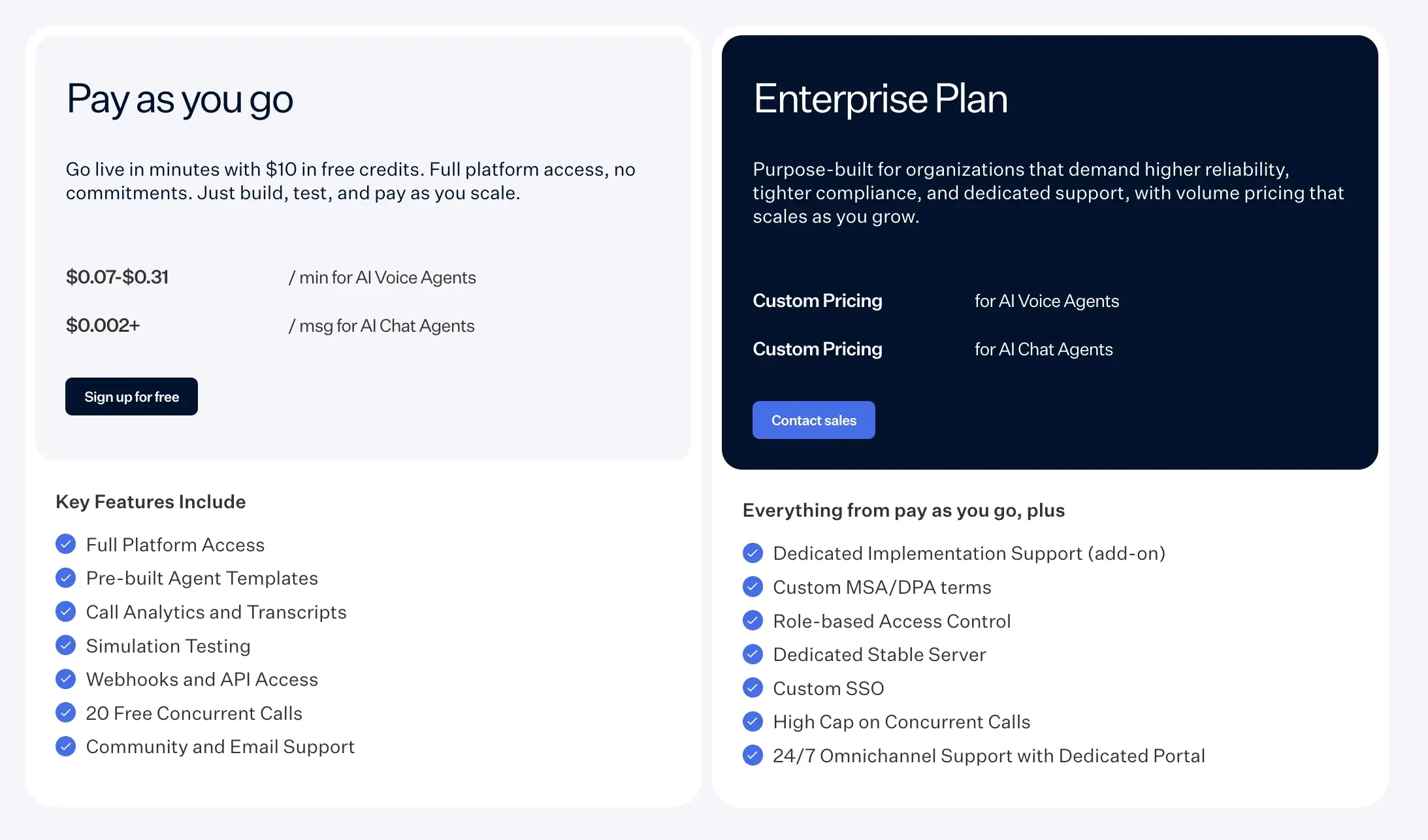
Retell AI uses a modular, pay-as-you-go model with no platform fees or forced bundles. This sounds attractive on the surface, but the actual per-minute cost depends on multiple stacked components: voice infrastructure, text-to-speech, the language model, and telephony.
Published rates
All users begin with $10 in free credits — roughly 65 to 90 minutes at typical configurations. Retell's published component rates:⁴
What does a real Retell AI call actually cost?
Retell publishes an envelope of $0.07 to $0.31 per minute for voice agents, and where you land inside it depends on three choices: the voice, the model, and how you handle telephony.⁴
A mid-range production call — Retell voice infrastructure, a standard platform voice, GPT-4.1 and Retell telephony — works out to $0.055 + $0.015 + $0.045 + $0.015 = $0.13 per minute. Switching to ElevenLabs voices takes that to $0.155 per minute. Retell's own pricing calculator returns $0.11 per minute for a comparable configuration. The $0.07 floor is real but narrow: it requires the cheapest model, a platform voice, and your own SIP trunk. The top of the range is equally real if you pair premium voices with a frontier model on the Fast Tier.
The honest summary is that the headline rate is a floor, not an estimate, and that budgeting requires modelling your actual configuration rather than multiplying minutes by $0.07.
Our AI voice agent pricing guide goes deeper on how all-in costs compare across Retell, Vapi, Synthflow, Bland AI, and Zeeg on equal footing. For a broader review of which voicebot tools offer the best value at different price points, see our best AI voice bots comparison.
Free trial
Pay-as-you-go starts at $0 with $10 free credits. The free tier includes 20 free concurrent calls, 10 free knowledge bases, pre-built functions, simulation testing, analytics, and Discord/email support.⁴
Enterprise plan
Enterprise pricing is not published and requires a sales conversation. Retell offers volume discounts alongside managed setup, higher concurrency, expanded limits, early beta access, and premium Slack support.⁴ Key compliance features are gated to this tier, with no intermediate option.
Retell AI user reviews: what are people saying?
The review picture for Retell AI is notably split between developer audiences and general business users.
Review platform scores
G2: what 1,755 users are saying
Retell AI holds a 4.8/5 rating on G2 with 1,755 reviews, with 93% five-star ratings.⁵ The quantitative breakdown by mention count tells a clear story:
Top praised areas (G2 mention counts):
- Ease of use and intuitive design: 284 mentions
- Simple and intuitive UI: 88 mentions
- Helpful features and easy-to-use interface: 85 mentions
- Seamless integration and high-quality voice services: 71 mentions
Top complaint areas (G2 mention counts):
- Limited voice options and flexibility, especially for international support: 67 mentions
- Steep learning curve and limited tutorials: 46 mentions
- Fewer integrations and no white label options: 44 mentions
- Pricing feels expensive for small teams: 41 mentions
- Issues with German voices and coding requirements: 37 mentions²
That last data point is particularly relevant for DACH market businesses: German voice quality is a documented pain point among G2 reviewers.
Trustpilot & Product Hunt
Retell AI is rated 4.9/5 on Trustpilot across 815 reviews.⁶ Developer-focused reviews are overwhelmingly positive — praising API design, production-readiness, and regular platform updates. Critical reviews mention slow customer support response times and latency issues during fast-paced conversations.
On Product Hunt, Retell AI holds a 4.7/5 rating.⁷ Reviewers praise easy setup, reliable call workflows, and useful reporting. A founder specifically cited low latency, interruption handling, and reliable telephony integrations as reasons for choosing Retell over Vapi.⁷
The developer vs. business user divide
When you dig into Retell AI reviews across platforms, two very different user experiences emerge. For developers, it's a powerful and well-liked tool. For non-technical business users, the platform is frequently described as overly complex, with recurring complaints about billing transparency and support access.⁵ Several reviewers report difficulty cancelling and unclear answers on compliance questions — worth weighing if you are buying without an engineering team behind you.
What are Retell AI's strengths and weaknesses?
Pros
Low latency and natural voice. Retell targets sub-second responses, and voice quality and latency are the two most consistently praised attributes across review platforms.² For most inbound use cases the conversation holds together well enough that callers engage with it normally.
Batch calling and outbound scale. 20 concurrent calls on the free plan, with additional slots at $8 per month and higher limits on Enterprise.⁴ For teams running high-volume inbound or outbound lines, this is a clear differentiator. Teams that want to combine Retell-style AI qualification with traditional power dialing should also explore our guide to auto dialers for sales reps, which covers how JustCall, Nooks, and Orum stack up against AI-native approaches.
Developer flexibility. The Retell AI API gives engineering teams access to nearly every parameter: LLM choice, voice provider, telephony, prompt logic, webhook triggers. If you want something highly custom, Retell provides the building blocks.
Compliance certifications. SOC 2, HIPAA and GDPR compliance are available, though not all of it on every tier — check what your plan actually includes.
Genuinely transparent component pricing. Retell publishes almost every component rate on its pricing page, including a calculator.⁴ That is unusual in this category and makes modelling possible, even if the headline number is a floor rather than an estimate.
Cons
Developer-first, not business-first. Retell is not designed for business users or teams seeking no-code deployment workflows. Teams without engineering resources will struggle to reach production independently.
Pricing complexity. The $0.07/min headline rate is a floor, not a forecast. Realistic production configurations land between $0.13 and $0.155 per minute, and premium voice plus a frontier model can push toward the $0.31 ceiling.⁴ Budgeting requires careful modelling before committing.
German voice quality limitations. 37 G2 reviewers specifically flag issues with German-language voice quality and coding requirements — a notable gap for businesses targeting DACH markets.²
GDPR compliance is not European data hosting — and it is no longer the only regulatory question. Retell is a US-based company, so businesses that require data to remain on European servers need to verify hosting arrangements carefully. Separately, Article 50 of the EU AI Act (Regulation (EU) 2024/1689) requires that people interacting directly with an AI system be informed that they are doing so, unless it is obvious from the circumstances, and that obligation applies from August 2026.⁸ Any voice agent placed in front of European callers falls inside its scope regardless of where the vendor hosts data, so buyers need an answer on disclosure behaviour as well as on hosting.
Support gaps for non-enterprise users. Support is via Discord and email only for pay-as-you-go users — adequate for developers, but not for business teams who need faster, dedicated channels. Enterprise-grade contact center platforms covered in our AI call center software roundup generally include dedicated onboarding and 24/7 support as standard.
What are the best Retell AI alternatives?
The AI voice agent space has grown significantly, and Retell has several notable competitors, each with a different angle. It's also worth noting that European-native enterprise alternatives like Parloa have emerged as relevant competitors for regulated industries — our Parloa guide covers how it differs from US-based platforms on compliance and enterprise deployment.
Retell AI vs Vapi
Vapi is the closest technical competitor to Retell AI. Both are developer-first, API-driven platforms with comparable architectural complexity. On latency, both target sub-second responses and neither publishes an audited figure, so the difference between them should be treated as unresolved rather than settled. Retell's clearer advantage is the depth of its calendar and appointment booking integrations.
Explore more options in our full guide to Vapi AI alternatives.
Synthflow
Synthflow is the no-code answer to Retell and Vapi. It offers a visual drag-and-drop builder accessible to non-technical teams. Synthflow advertises flat per-minute pricing from around $0.08 to $0.09 per minute, though effective all-in rates once model and telephony choices are made typically land closer to $0.15 to $0.24. The tradeoff against Retell is a lower customization ceiling. For a deeper look, see our Synthflow AI review and our list of Synthflow AI alternatives for teams considering no-code voice platforms.
Bland AI
Bland AI is designed for outbound campaign scale. If you need to run high-volume outbound campaigns at tens of thousands of dials, Bland is optimized for that workflow. Like Retell, it's developer-heavy and requires engineering investment. Pricing is plan-dependent — roughly $0.14 per minute on the free Start tier, $0.12 on Build and $0.11 on Scale, with monthly platform fees on the paid tiers — and Bland does not publish rates as consistently as Retell does, so confirm current pricing directly. Our Synthflow AI alternatives guide covers how Bland compares to no-code and integrated options for teams that want to move faster without engineering overhead. For teams focused on outbound prospecting specifically, our best AI cold calling software guide also compares Bland, JustCall, Dialpad, and others on dialing features and CRM sync.
Zeeg
Zeeg takes a fundamentally different approach: it's an AI voice agent and scheduling software in one, with the voice agent built natively into the platform. More in the dedicated section below.
📖 Read more: Our roundup of AI call center software covers enterprise-grade platforms — including where Retell AI fits compared to full contact center solutions like Genesys and Talkdesk.
How does Zeeg compare to Retell AI?
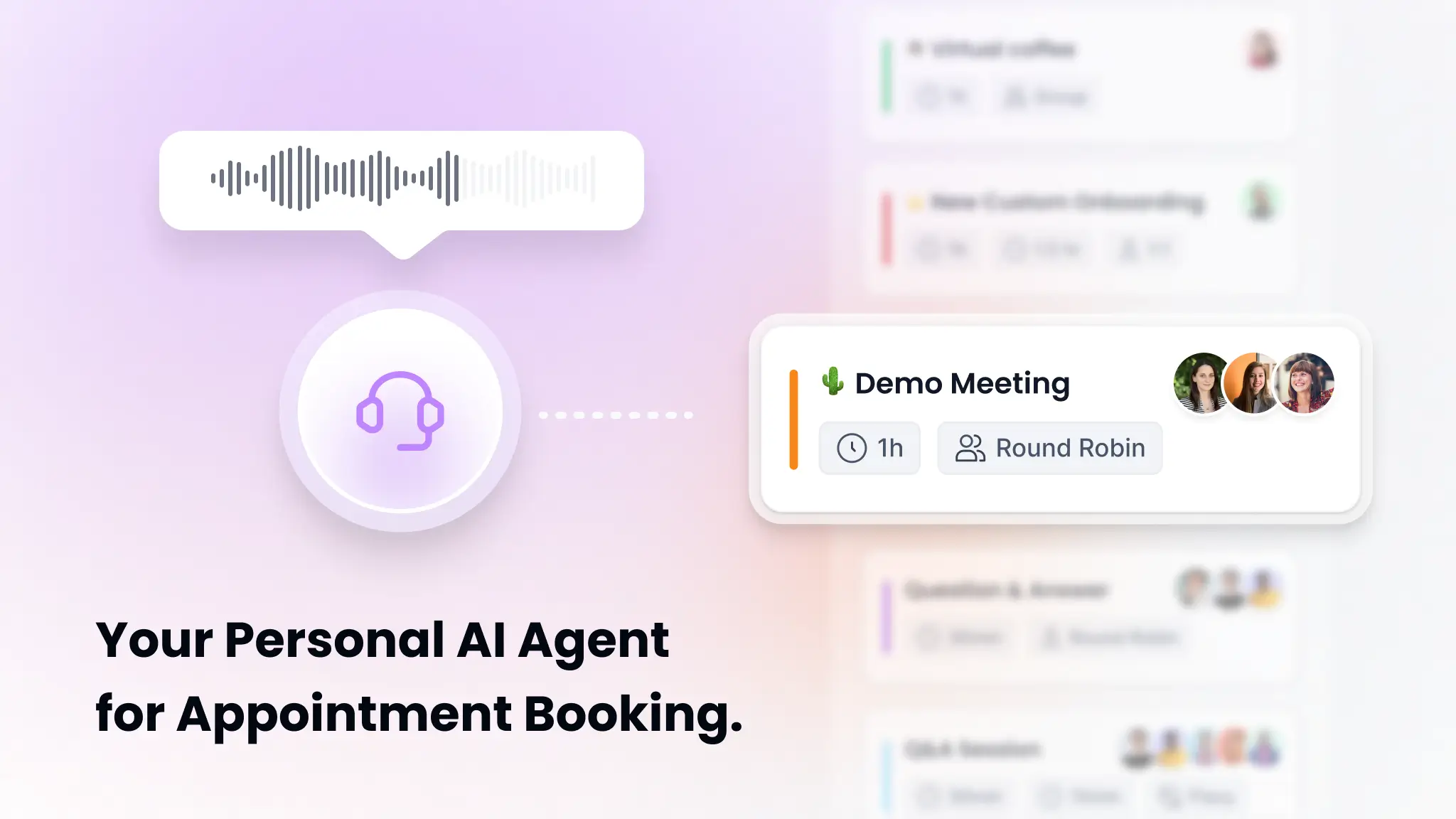
Zeeg is built in Europe, and its AI phone agent is part of the product itself rather than a third-party integration. The difference from Retell is architectural: Retell gives you the voice layer and expects you to build the scheduling and CRM layers around it, while Zeeg ships everything in one product.
If the end goal of your voice agent is to turn inbound calls and online interactions into booked appointments — and have that data create or update customers' records — then Retell requires you to build those layers yourself. You'd need to connect Retell to a scheduling tool, sync with a CRM, and manage the data flow between them. That's engineering work, ongoing maintenance, and additional cost.
With Zeeg, when a caller rings your number, the AI agent answers, qualifies the lead, checks your team's actual availability, and books the appointment directly into your calendar — all in one call, without any backend glue.
What makes Zeeg different from Retell AI
Native scheduling + voice in one platform. Unlike platforms that require you to connect a separate voice tool to a booking system via integrations, Zeeg handles the entire flow natively: call → qualification → booking → contact created on your CRM (whether you want to keep it at Zeeg or sync it with natively with another CRM). No Zapier, no webhooks to maintain.
GDPR-compliant by design, hosted in Germany. Zeeg is built and hosted in Germany. All call data, lead information, and appointment records stay on European servers. This goes beyond claiming GDPR compliance on paper — it means data sovereignty at the infrastructure level. For European businesses in industries with strict privacy obligations, this is a meaningful distinction from US-based platforms like Retell AI.
Round-robin and lead routing built in. Zeeg's round-robin system distributes qualified calls evenly across your team. The AI qualifies callers based on deal potential, company size, or any criteria you define — routing high-value prospects to senior reps automatically. This makes it a strong fit for AI SDR workflows, where the voice agent handles qualification. Teams looking for an AI-powered approach to the full meeting lifecycle can also see our best AI scheduling assistants guide for how scheduling tools compare when connected to voice agents.
Full calendar integration. Direct integration with Google Calendar, Apple Calendar, and Microsoft Exchange ensures appointments booked by the AI sync immediately. No risk of double-booking, no manual transfer of information.
Bundled pricing with minutes included. Zeeg's AI phone agent starts at €49 per month with call minutes included in the bundle — roughly €0.196 per minute inbound at the entry tier, falling to €0.111 per minute at the largest bundle, with outbound from around €0.274 per minute. Scheduling seats are priced separately.
It is worth being straightforward about how that compares. On per-minute rate alone, Zeeg is not the cheaper option against Retell's typical $0.13 to $0.155 per minute until you reach the higher bundles. The saving is not in the minute price — it is in what the minute price includes. Retell's rate covers the voice layer only; the scheduling tool, the CRM and the engineering time to connect them are additional line items. If you already run those systems and have developers to maintain the integration, Retell may well work out cheaper. If you don't, the comparison is not $0.13 against €0.196 — it is $0.13 plus a scheduling subscription.
No code required. Set up your AI agent with a plain-language prompt and a phone number — no developer needed, no LLM selection, no telephony configuration. You can be live in minutes.
Retell AI vs Zeeg: side-by-side
Who should choose Zeeg over Retell AI
Zeeg is the stronger choice if:
- Your primary goal is turning inbound calls into booked meetings
- You don't have an engineering team to maintain a multi-tool stack
- You want voice AI-powered scheduling, online scheduling and contact management to work as one system (native integrations are possible, but not needed by default)
- You want to automate simple and/or complex scheduling scenarios for your teams
- You want one predictable bill rather than four variable ones
- You need European data residency, not just GDPR certification
📖 Read more: See how Zeeg's AI phone answering service compares to developer-first platforms in a full feature and pricing breakdown.
Is Retell AI worth it?
Retell AI is a genuinely impressive piece of voice infrastructure, and for the right buyer it is one of the best options available. It delivers powerful capabilities for LLM-based phone agents — but it is not a turnkey solution, and teams without internal engineers will need external help to reach production.
For developer-led teams at US-based or globally-focused companies that need maximum flexibility, multilingual scale, and high concurrency, Retell is a strong choice. The voice quality is well reviewed, the API is well documented, the component pricing is unusually transparent for this category, and the G2 rating of 4.8/5 across more than 1,700 reviews reflects genuine user satisfaction, particularly among technical users.⁵
But Retell is not the right tool for every team. The pricing takes real modelling — the $0.07 headline is a floor, with realistic configurations at $0.13 to $0.155 per minute⁴ — and the steep learning curve for non-developers, the documented German voice quality issues,² and the absence of native scheduling make it a poor fit for European businesses that want an end-to-end voice-to-booking workflow without engineering overhead.
Who should choose Retell AI:
- Engineering teams building custom voice agent infrastructure
- US-based or global businesses with high call volumes and developer resources
- Companies in healthcare or finance that need HIPAA/SOC 2 compliance with LLM flexibility
- Teams running large-scale outbound campaigns
If you're in that second group — especially if you're a European business focused on automated call-to-booking workflows — Zeeg is worth a close look. You can also explore our comparison of Vapi AI alternatives and our full AI voice agents for meeting scheduling guide for a broader view of the market before making a final decision. For a complete rundown of voice AI tools by price, our AI voice agent pricing guide compares all-in costs across 11 platforms side by side. You can try Zeeg free for 14 days, no credit card required.
Pricing and review scores last verified: 10 September 2026. Retell publishes component rates that change as model availability changes, and review counts move weekly.
Sources
- Y Combinator — Retell AI company profile
- G2 — Retell AI Pros and Cons: User Likes & Dislikes
- Stivers, T., Enfield, N. J., Brown, P., et al. — Universals and cultural variation in turn-taking in conversation, Proceedings of the National Academy of Sciences 106(26), 2009
- Retell AI — AI Phone Agent Pricing
- G2 — Retell AI Reviews: Details, Pricing & Features
- Trustpilot — Retell AI Reviews
- Product Hunt — Retell AI — Voice AI Agent Reviews
- EUR-Lex — Regulation (EU) 2024/1689 (Artificial Intelligence Act), Article 50
Zeeg is Europe's leading AI voice agent and appointment scheduling software in one solution — GDPR-compliant, made in Germany. Start for free →
Frequently Asked Questions
What types of businesses are best suited for Retell AI?
Retell AI works best for: engineering teams at US-based or globally-focused companies with high call volumes, businesses in healthcare or finance that need HIPAA/SOC 2 compliance with LLM flexibility, teams running large-scale outbound campaigns, and developers who want maximum customization over voice prompts, LLM selection, and telephony. It is not the right fit for European businesses with GDPR data sovereignty needs, small teams without developers, or businesses looking for a no-code voice-to-booking workflow.
What is the best Retell AI alternative for European businesses?
For European businesses — especially those in DACH markets — the key limitations of Retell AI are US-based data hosting and documented German voice quality issues. Zeeg is Europe's leading AI phone assistant and appointment scheduling software in one solution — GDPR-compliant, made in Germany. It combines AI voice agents with native scheduling, lead routing, and a built-in CRM, all hosted on German servers, with no developer setup required.
How does Retell AI compare to Vapi?
Both Retell AI and Vapi are developer-first, API-driven voice platforms. Vapi offers slightly faster sub-600ms latency and a lower base price ($0.05/min), while Retell AI has stronger calendar and appointment booking integrations. Neither platform offers native scheduling or CRM — both require additional integrations for booking workflows, and neither provides European data hosting.
Can non-developers use Retell AI without coding?
Retell AI is primarily built for developers. It lacks a full no-code visual flow builder and requires engineering resources to configure LLM prompts, telephony, webhook logic, and call flows. Teams without in-house developers typically need external technical help to reach production. Non-technical teams should consider no-code alternatives like Synthflow, or integrated platforms like Zeeg, which require no developer setup at all.
What are the most common complaints about Retell AI?
Based on G2 reviews (1,755 ratings, 4.8/5), the top complaints are: limited voice options for international support (67 mentions), a steep learning curve (46 mentions), pricing complexity and cost for small teams (41 mentions), and documented issues with German voice quality (37 mentions). Some users on Trustpilot also reported billing transparency issues and difficulty cancelling after a trial.
Is Retell AI GDPR compliant?
Retell AI holds SOC 2 Type 1 & 2, HIPAA, and GDPR certifications. However, GDPR compliance does not automatically mean European data hosting — Retell AI is a US-based company. Businesses with strict data sovereignty requirements (particularly in the EU or DACH region) should verify where their call data is stored before deploying Retell in production.
How much does Retell AI actually cost per minute?
Retell AI advertises a base voice rate of $0.07/min (ElevenLabs), but real all-in costs typically reach $0.25–$0.33/min once you stack LLM fees (GPT-4o mini adds $0.006/min, GPT-4o up to $0.50/min), telephony ($0.015/min), and optional add-ons such as knowledge base usage, branded caller ID, and concurrency lines. All users start with $10 in free credits.
What is Retell AI and what does it do?
Retell AI is a developer-first voice agent platform that provides infrastructure for building AI-powered phone agents. It combines speech-to-text, large language model (LLM) reasoning, and text-to-speech into a production-ready pipeline. Businesses use it to automate inbound calls, qualify leads, book appointments, run outbound campaigns, and provide after-hours coverage — primarily for teams with in-house engineering resources.