AI Voice Agents Pricing Guide: 11 Tools Compared


Figuring out what you'll actually pay for an AI voice agent is harder than it sounds. Most platforms advertise a per-minute rate, but that rarely covers the full cost. Speech-to-text, LLM processing, phone calls, add-ons — your bill can end up looking very different.
The stakes sit higher than the per-minute rate suggests. When Harvard Business Review audited 2,241 U.S. companies on how fast they responded to an inbound enquiry, 23% never responded at all, and the average response among those that did was 42 hours.¹ In a parallel study of 1.25 million leads, firms that made contact within an hour were nearly seven times as likely to qualify the lead as those that waited just one hour longer.¹ The alternative to automation is not free either: the U.S. Bureau of Labor Statistics puts the median receptionist wage at $37,230 a year, or $17.90 an hour² — and that buys 40 hours of a 168-hour week.
This guide breaks down the real pricing of 11 platforms. We start with Zeeg — Europe's leading AI phone assistant and appointment scheduling software in one, GDPR-compliant, made in Germany — then compare what each costs so you can choose the right fit.
All vendor pricing in this guide was last verified against each provider's own published pricing page on 9 September 2026.
What affects the cost of an AI voice agent?
Before everything, let's understand a bit of the theory — or what really influences the price. Because most voice AI solutions involve different cost layers, but many don't advertise the whole thing.
Most AI voice agent calls touch at least these four components:
- Voice infrastructure / orchestration: The platform's base fee for managing the conversation flow.
- Speech-to-text (STT): Converting what the caller says into text the AI can process.
- Large language model (LLM): The "brain" of the agent — GPT-4.1, Claude, Gemini, etc. — which generates the responses.
- Text-to-speech (TTS): Converting the AI's text response back into spoken audio.
- Telephony: The actual carrier cost to connect the call.
Some platforms bundle these into a single transparent per-minute rate, while others charge for each component separately — which means you might be managing invoices from four or five different vendors at once. We're not saying that some models are inherently wrong, but the total cost per minute is really what matters in the end.
These five layers explain why quoted rates vary so much, but they only describe the cost of answering. The comparison most businesses actually face is against a person. At the BLS median of $17.90 an hour², a full-time receptionist covers 40 of the week's 168 hours. An agent billed per minute covers all 168. The question that decides the economics is not the rate — it is what share of your call volume arrives during hours you already staff.
Read more:
AI Voice Agent Pricing: 11 tools compared
1. Zeeg AI voice agents
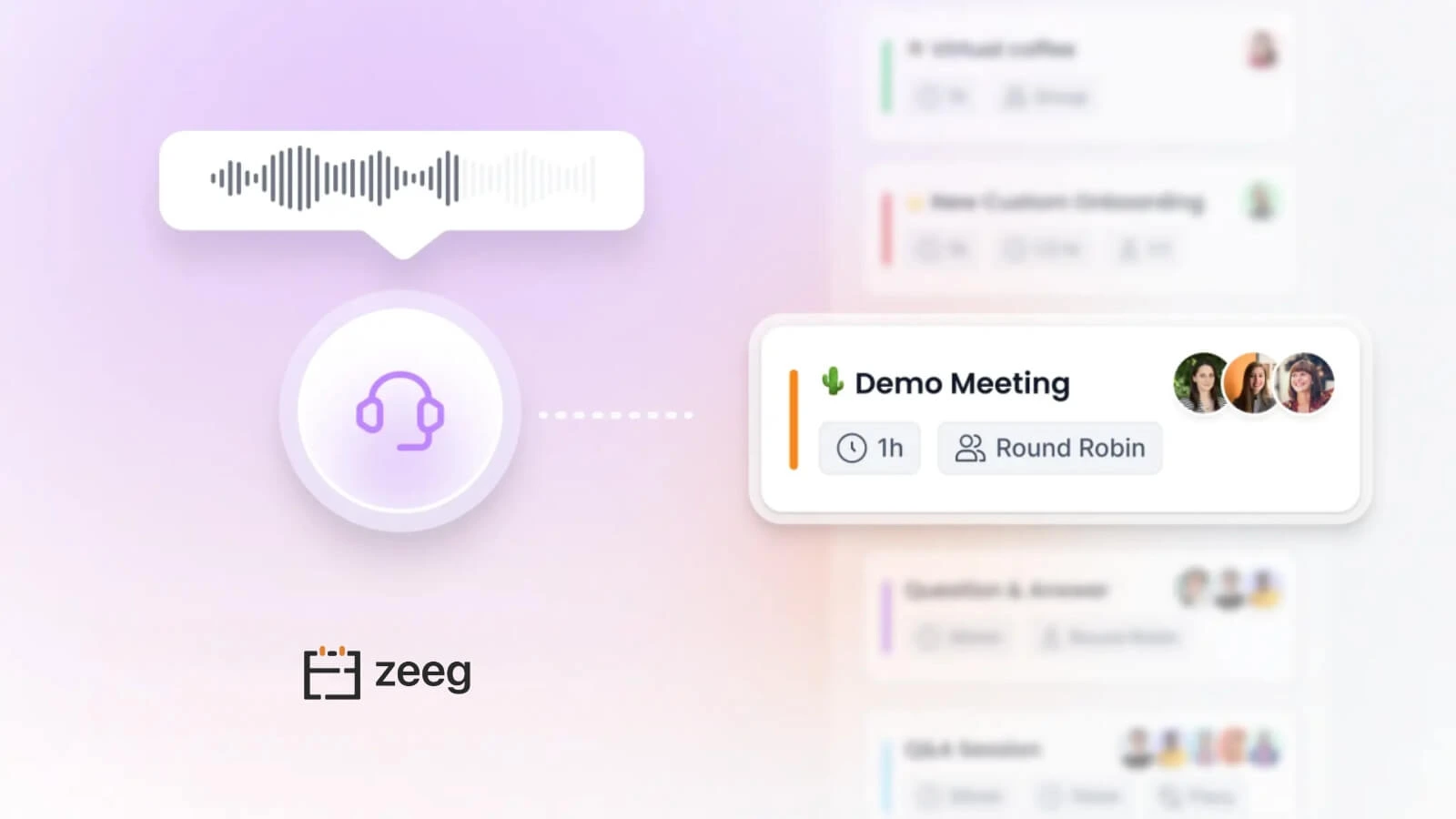
What it is: Zeeg is a GDPR-compliant platform for AI voice agents and scheduling. It answers calls 24/7 with natural conversation, qualifies leads with custom questions you set in your prompt, books appointments directly into connected calendars (e.g. Google, Microsoft, Apple), and routes callers to the right team member. All call data flows automatically into Zeeg's built-in contact management.
Who it's for: Small, medium and large businesses that want AI to handle inbound call routing and appointment booking as part of a broader scheduling and CRM workflow. It's really well-suited for industries where every missed call is a missed booking: sales, legal, real estate, coaching, financial services, etc.
What makes it different: Different from most platforms in this guide, Zeeg's AI agent is not just a voice tool. It sits inside a complete platform that natively has scheduling and contact management, meaning that every call outcome — booking confirmed, lead qualified, caller routed — is automatically logged and tracked, with the voice transcript and notes, without any additional integration work. Also, GDPR compliance and European data hosting are built in from the ground up, which matters for teams working with EU customers.
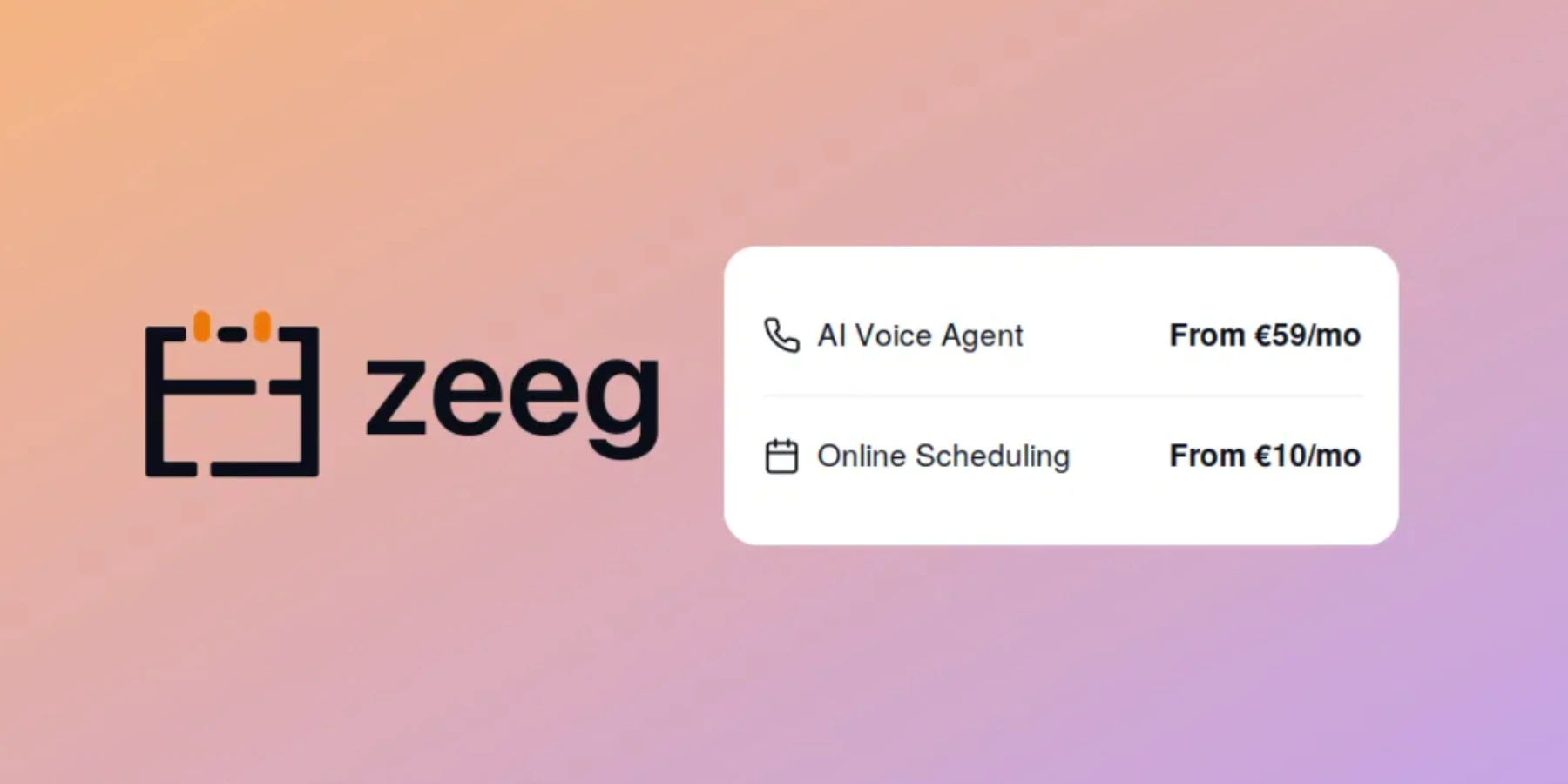
Pricing: Zeeg uses a two-layer pricing model: a subscription plan for online scheduling, plus inbound and outbound minute bundles for the AI phone feature — and the two are sold independently. You don't need a paid scheduling plan to use AI voice, and you don't need AI voice to use scheduling. The subscription tiers are:³
- Starter: Free forever (basic scheduling)
- Professional: €12/month, or €10/month if billed annually
- Business: €20/month, or €16/month if billed annually
- Scale: €40/month, or €30/month if billed annually
- Enterprise: Custom pricing
AI voice minute bundles can be purchased on any scheduling plan⁴:
Every call shows its exact credit cost directly in the database — no hidden fees, no surprise line items at the end of the month. Volume purchasing brings the per-minute rate down significantly: moving from the smallest bundle to the largest cuts the effective cost nearly in half.
For a business handling, say, 2,500 inbound minutes per month and needing the Professional plan on online scheduling, the total monthly outlay would be the subscription fee (from €10/user/month) plus the €299 credit bundle — putting the all-in cost well below most standalone voice agent platforms, while also getting phone booking, online booking features, contact management, GDPR compliance, and calendar integrations included.
You can learn more about Zeeg pricing here. Also read more if you wand to know:
- Why Zeeg is a HalloPetra alternative
- Why it's a Fonio alternative
- Why it's a Vitas alternative
- Why it's a Smao alternative
2. Retell AI
What it is: This one is a developer-focused voice agent platform that gives technical teams full access to build, test, and deploy AI phone agents (they also have chat agents). It still covers both inbound and outbound calls, and includes a built-in cost calculator so you can estimate spend before going live, which can be useful.
Who it's for: Retell AI is made for developers and businesses that want granular control over their voice stack. They'll choose their own LLM, voice engine, and phone system, and they need to be comfortable managing a modular system, and to have technical capacity to set up the tool.
Pricing model: They have a pay-as-you-go model, with no monthly commitment, where new accounts get $10 in free credits to start. The platform fee is transparent and component-based, with a published cost estimator. But there's also an Enterprise plan — the pricing is custom-made, though, so you'd have to get in touch with them.
Here's what the components cost on the pay-as-you-go plan:⁵
Real-world all-in cost: Using GPT-4.1 and a standard voice with US telephony, a typical call runs approximately $0.13–$0.15/min. But with more capable models or premium voices, that figure rises to $0.20–$0.31/min. And indeed Retell's own pricing page shows a range of $0.07–$0.31/min, depending on configuration.⁵ With so many different paid options, there's a learning curve coming with Retell AI, as you try to understand what's the best model for your business.
Enterprise plan: As said before, this plan has custom pricing for organizations with high volume. It includes dedicated servers, a higher concurrency cap, HIPAA/BAA compliance, custom MSA/DPA terms, and 24/7 support.
Other costs to know:⁵
- Phone numbers: $2.00/month each
- Concurrency (beyond the 20 included): $8.00/concurrent call/month
- Branded caller ID: +$0.10/outbound call
- AI Quality Assurance: $0.10/min (first 100 minutes free)
- PII removal: +$0.01/min · Advanced denoising: +$0.005/min
- Knowledge bases: $8.00/month each beyond the first 10
- SMS: $0.01/message · Verified phone number: $10.00/month
Bottom line: Retell is one of the more transparent platforms in this space, and that's an advantage — the component-based pricing means you know exactly where your money is going, and the built-in calculator helps estimate monthly costs before you commit. However, that doesn't necessarily mean being cheaper.
3. Vapi

What it is: Vapi is also a developer-first voice AI infrastructure platform, for teams that want maximum flexibility to bring their own models, voice engines, and phone systems. It's basically considered "middleware" — you connect the pieces yourself rather than getting a ready-to-deploy product.
Who it's for: Technical teams with strong engineering resources who need deep customization and want to control all layers of their voice system.
Pricing model: Vapi publishes two plans — Build (usage-based, no monthly subscription) and Scale (annual contract, fixed platform fee plus committed volume at volume-based per-minute rates). On Build, Vapi charges $0.05/min for its own hosting layer and $0.005 per SMS or chat message. Everything else — STT, LLM, TTS, telephony — is passed through at cost, and costs nothing extra if you bring your own API keys. Build includes 60+ minutes to start and 10 concurrent call lines, with additional concurrency at $10 per line per month.⁶
Here's how the actual cost breaks down in a typical production setup. Note that only the Vapi hosting line is a published Vapi rate — the rest are our estimates of what the underlying providers typically charge, since Vapi bills those at cost rather than publishing a rate card:
Real-world all-in cost: When you add STT, LLM, TTS, and telephony on top of the $0.05/min platform fee, the total per-minute cost rises considerably — with the exact figure depending on which models and providers you choose. A lean configuration using low-cost STT and a smaller LLM will land at the lower end; a setup using premium models like GPT-4.1 and ElevenLabs will push costs noticeably higher. Unlike Retell, where component costs are consolidated in one dashboard, Vapi's model means you may be reconciling bills from four or five separate vendors each month.
Scale plan: Custom pricing with custom concurrency, dedicated account team, a support SLA, data residency, and SOC 2, HIPAA, PCI, SSO and RBAC included.⁶
Important caveats: Compliance is sold as flat monthly add-ons on both plans — HIPAA at $2,000/month and Zero Data Retention at $1,000/month.⁶ These are often confused with each other, so check which one you actually need. Data retention on Build is 14 days for call history and 30 days for chat history. Businesses choosing Vapi for enterprise deployments should factor in not just per-minute costs but also the engineering time and overhead of managing a multi-vendor stack — costs that don't appear on any single invoice.
Bottom line: The $0.05/min headline rate covers only Vapi's orchestration layer, and the full deployment cost is meaningfully higher once all components are included. For teams with the technical capacity to manage the complexity, the customization is genuine. But for others, the operational overhead can be significant.
4. Bland AI
What it is: Here, we're talking about a voice agent platform for building inbound and outbound AI phone agents using a conversational pathways system. The tool offers a free tier to get started and tiered plans with lower per-minute rates at higher subscription levels.
Who it's for: Developers and teams looking for a structured, plan-based pricing model with relatively straightforward rate tiers.
Pricing model: Bland moved to a plan-based per-minute pricing structure on 5 December 2025. The rate you pay depends on which plan you're on:⁷
A few things worth noting about how billing works:⁷
- Billing is prorated to the exact second — so there's no rounding per call.
- Only connected calls are charged; but failed calls still incur a $0.015 minimum outbound fee.
- After a human transfer, only the reduced transfer rate applies; the full per-minute rate stops.
- Customers who bring their own Twilio (BYOT) pay no transfer fees.
- Agent Phone is a separate self-serve tier for a single agent number: unlimited voice minutes and SMS to the US and Canada in place of per-minute billing, with 1,000 call minutes per day.
Plan limits:⁷
Other costs: SMS at $0.02/message, and web widget messages at $0.01 each.⁷
Bottom line: Their pricing is cleaner than Vapi's because the per-minute rates are clearly published per plan. The free Start tier is usable for testing, though the jump to $0.14/min on the free plan is noticeably higher than developer-tier rates on Retell. For teams with predictable, mid-volume usage, the Build or Scale plans offer a reasonable cost-per-minute.
5. GoHighLevel (GHL)

What it is: GoHighLevel is more like a marketing automation and CRM platform built for agencies. And within its AI Employee suite, there's the Voice AI — an inbound phone agent that answers calls, qualifies leads, and books appointments — along with conversation AI, content AI, and more. It's tightly integrated with their CRM, pipeline, and automation workflows.
Who it's for: Marketing agencies and their clients, like small businesses in service industries (dental, home services, real estate, etc.) that already use the GoHighLevel ecosystem.
Pricing model: This is the one that changed most recently. On 20 May 2026 GoHighLevel unbundled Voice AI: the single blended per-minute rate is gone, replaced by separate components.⁸ If you see a figure like "$0.13/min" or "$0.163/min average" quoted anywhere for GHL Voice AI, it is historical and should not be used for budgeting.
On pay-per-use, a Voice AI minute is now billed as:⁸
- Voice engine: $0.045/min
- Text-to-speech: $0.015/min (OpenAI, Cartesia) up to $0.170/min (ElevenLabs V3)
- LLM tokens: $0.05 to $3.00 per million, depending on model
- Phone minutes: billed separately via LC Phone or Twilio
That puts a Voice AI minute at roughly $0.06 to $0.215 before tokens and telephony — a 3.6x swing driven almost entirely by which voice you pick.
There are also two subscription options for the AI Employee suite, both priced per sub-account:⁸
- AI Employee Growth — $50/month: includes 1,000 Conversation AI responses and 100 Voice AI minutes, plus unlimited Reviews AI and Content AI. Usage beyond the included amounts bills at pay-per-use rates.
- AI Employee Unlimited — $97/month: unlimited Conversation AI and unlimited Voice AI across inbound, outbound and the widget, plus Reviews AI and Content AI, subject to fair use.
Two things "unlimited" does not cover: phone system charges still apply to every call regardless of plan, and Agent Studio is excluded from both subscriptions and always bills pay-per-use.
Platform subscription (needed separately):
- Starter: $97/month
- Unlimited: $297/month
- SaaS Pro: $497/month (required for rebilling to clients)
So a typical agency deploying GHL Voice AI to a client sub-account pays their platform subscription, plus the $50 or $97 AI Employee fee per sub-account, plus the phone minutes underneath.
Rebilling: Agencies on the $497/month SaaS Pro plan can mark up and resell AI Employee services to their clients — a common packaging model. The "AI Receptionist" package typically retails at $200–$400/month to end clients.
Bottom line: GHL's Voice AI is compelling for teams already inside the GHL ecosystem, since everything connects natively to CRM, pipeline, and automation. Since the May 2026 unbundling, the cheapest voice stack is genuinely cheap — but the premium voices cost nearly four times as much per minute, so the voice you choose now matters more than the plan you're on.
6. Synthflow

What it is: Synthflow is a no-code voice AI platform designed for businesses that want to deploy agents without managing multiple third-party integrations. It bundles the voice engine, telephony options, and LLM access into a single platform.
Who it's for: As of 2026, enterprises. Synthflow has moved decisively upmarket — their own materials describe the platform as powering 65M+ voice calls a month across 30+ countries, and their published pricing now speaks only to high-volume teams.
Pricing model: This is the biggest change in this guide. Synthflow's pricing page now publishes a single option: Enterprise contracts starting at $30,000 annually.⁹ Final pricing is scoped around call volume, concurrency, telephony setup, integrations, security needs and launch support. The contract covers an enterprise SLA, Synthflow Native Telephony or SIP trunking, custom concurrency and routing, CRM/calendar/contact-centre integrations, MSA and DPA support with a security review, and implementation and launch support.⁹
What is not there matters just as much. The self-serve pay-as-you-go plan — the component-based model with a published voice engine rate, per-model LLM pricing, reserved concurrency slots and a white-label add-on — is no longer listed on the public pricing page. Neither is the "most setups land between $0.15 and $0.24 per minute" guidance that circulated widely. Any per-minute figure you find for Synthflow in a third-party comparison today is either from the retired self-serve plan or from an older legacy tier, and cannot be verified against the vendor.
Synthflow's page does display SOC 2, GDPR, HIPAA, ISO 27001, and both EU and US hosting badges.⁹
Bottom line: Synthflow is no longer a realistic option for a small business or a pilot, at least not at published prices. If you are evaluating it, you are evaluating an enterprise contract with a five-figure annual floor, and the only way to get a number is to talk to their sales team. For SMBs who came here looking for a no-code voice agent they can start using this week, the other platforms in this guide are the relevant comparison.
7. JustCall

What it is: JustCall's AI Voice Agent is just an add-on, in this case. Because JustCall is a business communications platform (VoIP, SMS, analytics). But the AI agent handles inbound calls 24/7, including appointment scheduling, lead qualification, FAQ handling, and call transfers.
Who it's for: Sales and customer support teams that want AI voice capability layered on top of an existing business phone system, especially teams already using JustCall for their calling stack.
Pricing model: JustCall has two separate pricing layers. The base platform subscription is required first, and note the two-license minimum on the standard plans — so the real entry price is $58/month, not $29:¹⁰
The AI Voice Agent is then priced separately as an add-on. A free trial includes 50 minutes:¹⁰
What's in each AI plan:
- PAYG: Basic AI voice agent, 14 languages, no CRM logging included.
- Agent Lite: Adds CRM logging, appointment scheduling, knowledge base (1 KB), SMS, call transfers, and API/webhook support.
- Agent Max: Adds voice cloning, 5 knowledge bases, multilingual support, custom AI actions, and outbound calling (beta).
Cost per effective minute: At $99/month for 100 minutes, the Agent Lite plan works out to $0.99/min of AI call time — the same as the PAYG rate. The value comes from the bundled features (CRM logging, scheduling, transfers) rather than volume savings. At Agent Max, 300 minutes for $249 works out to $0.83/min — modest savings. Overage on every tier is billed at $0.99/min and deducted from your JustCall credits.¹⁰
Bottom line: JustCall's AI Voice Agent is now the most expensive per-minute option in this comparison. The value proposition is integration — it's built directly into the JustCall communications stack, so teams already using JustCall for calling and SMS get AI voice without stitching together additional tools.
8. Dialpad

What it is: Voice, video, messaging, and AI-powered contact center capabilities — that's Dialpad's offer, on its mature unified communications platform (UCaaS). Its AI Agents product, launched as part of its Agentic AI Platform in late 2025, handles autonomous voice-based customer interactions.
Who it's for: Mid-market and enterprise teams that want AI voice capability within a full UCaaS stack, especially those already using Dialpad for their business phone system.
Pricing structure: The pricing model is split across different product lines, which can make it confusing to compare. The entry point ($15/user/month) applies to Dialpad Connect — the standard business phone product — not the AI contact center.¹¹
Dialpad Connect (UCaaS):¹¹
Dialpad Support (the AI contact centre):¹¹
Dialpad AI Agents (autonomous voice agents): Priced on a conversation basis — not per-seat. Rates are not published publicly; you purchase a pool of AI Agent Credits and talk to sales for a quote. Usefully, Dialpad does define when a conversation becomes billable: only when the AI retrieves information or executes a real action such as scheduling, routing or an order lookup. If no work is done, you are not charged.¹¹ Teams combining human agents on Support plans with AI Agents still face a third, uncapped billing layer.
Additional cost layers to be aware of:
- International calling beyond the plan's pooled allowance reverts to per-minute billing via calling credits.
- AI features like CSAT scoring and AI Scorecards are locked behind the Premium tier.
- Premium support is a separate paid add-on.
- Internet fax, larger meetings, and conference room lines all carry extra fees.
Bottom line: This is a capable platform for enterprises, no doubt — but one that needs a unified communications stack with AI features built in. However, the gap between its $15/user/month headline and the real cost of running an AI contact center with autonomous agents is quite steep. So, budget modeling here requires careful attention to which product suite, pricing tier, and add-ons you'll need.
9. Bolna AI
What it is: Here's another open-source-friendly voice AI platform. But this one is built primarily for the Indian market and Southeast Asian languages, including Hindi, Tamil, Telugu, and Hinglish. It's used by businesses running high-volume outreach, lead qualification, and appointment-setting campaigns.
Who it's for: Teams operating in South Asian markets, companies needing strong multilingual support in Indian languages, or developers looking for a cost-effective platform for high-volume calling.
Pricing model: Bolna offers three routes — pay-as-you-go credits, a one-off Pilots plan, and Enterprise contracts.¹²
Pay-as-you-go: Purchase credits from $10 to $5,000 and top up whenever the balance runs low, with no commitment. Billing is token-based on what you actually consume. New accounts get $5 in free credits. Bolna also supports BYOK (bring your own keys) for LLM, TTS and ASR providers, which reduces cost while still using their platform and infrastructure. If credits run out your agents stop calling, so it's worth enabling automatic top-ups or low-balance notifications.¹²
The per-minute rate falls as you buy more credit at once. Bolna's standard rate is 6.00¢/min, improving to 4.51¢/min at the top of the curve, with bonus minutes added from $300 upward:¹²
Pilots plan: A one-time recharge aimed at teams running a first deployment. It buys 10,000 minutes at a fixed 6¢/min (billed in 30-second pulses) with a 20% bonus on top, for 12,000 total minutes — an effective 5¢/min. It includes up to 100 concurrent calls, one pre-configured voice agent, sub-account access, and a free phone number for the first 30 days.¹²
Enterprise: Custom scalable plans with best-in-class pricing at committed volumes, customised integrations and deployment, priority support, and a dedicated account manager.¹²
Bottom line: Their rates per minute are the lowest in this guide — 6¢ at the standard rate, falling to 4.51¢ at the largest commitment. For teams running large outbound campaigns in Indian or South Asian markets, Bolna is a strong contender, and the BYOK option gives you a further lever on cost. For Western markets or smaller volumes, other platforms may offer a more turnkey experience.
10. Cartesia AI
What it is: Cartesia is an AI voice technology company focused on ultra-low-latency text-to-speech and speech-to-text models, as well as voice agent deployment through its Managed Agents product. Cartesia states that its flagship Sonic TTS model achieves a 90ms time-to-first-audio, which would be among the fastest available. Cartesia is often used as a voice component by other platforms (Retell AI, for example, offers Cartesia voices) and is now expanding into full agent deployment.
Who it's for: Developers and product teams that care deeply about voice latency and quality, either as a TTS/STT component integrated into another stack, or as a full voice agent platform.
Pricing model: Cartesia uses a monthly subscription with credits for its Sonic (TTS) and Ink (STT) models, plus a separate prepaid balance for Managed Agents voice calls. The agent call rate is the same on every plan:¹³
Voice agent calls (Managed Agents):¹³
- Call duration: $0.06/min on every plan
- Telephony: $0.014/min, and only if you use a Cartesia-provided phone number
- LLM usage during calls: free for UI-created agents, for a limited time
- TTS: drawn from your plan credits (roughly 1 credit per character)
- Cartesia-provisioned phone numbers: 1 on Free, 3 on Pro, 5 on Startup, 10 on Scale
A note on credits: Sonic TTS consumes 750–800 credits per minute of generated audio, and Ink STT consumes 3 credits per second. On the Scale plan that works out to roughly $0.39 per hour of speech-to-text — competitive, though not the order-of-magnitude gap that some comparisons suggest. Each service has its own concurrency pool, so TTS usage does not eat into your agent or STT limits.
Bottom line: Cartesia is a specialist in a world of generalists. If voice latency is your top priority, or if you want to use best-in-class TTS/STT as a component inside another platform, Cartesia is worth evaluating. As a standalone voice agent platform, Managed Agents is still maturing compared to Retell or Vapi — and note that the free LLM usage is explicitly time-limited, so model the cost without it.
11. Aircall
What it is: When you look at Aircall, it's important to know its core basics — a cloud business phone system aimed at sales and support teams. Its AI Voice Agent, a virtual receptionist, handles inbound calls, answers FAQs, qualifies callers, and transfers to human agents with context. It's built on top of Aircall's existing VoIP infrastructure.
Who it's for: Sales and support teams that want AI voice capability within their existing phone system, particularly those already using Aircall for calling.
Pricing model: Aircall's platform subscription is required first, with the AI Voice Agent priced separately using tiered per-minute rates.
Base platform:¹⁴
AI Voice Agent rates. Note that Aircall restructured these — the older three-tier model starting at $0.99/min has been replaced by two paid tiers:¹⁵
Prepaid bundles bring the rate down further: 500 minutes for $175, 2,500 for $725, and 5,000 for $1,450. Bundles are billed upfront and unused minutes expire at the end of the billing cycle — they do not roll over. Usage is consumed in order: free minutes first, then bundle minutes, then on-demand overage.¹⁵
Two other charges to budget for. Calls under 15 seconds are not billable, but every outbound attempt carries a $0.015 origination fee, charged even if the call is never answered.¹⁵ Standard Aircall telephony rates also apply separately on top (local inbound calls are included at no extra cost on existing plans, except toll-free numbers).
AI add-ons: Separate from the AI Voice Agent, Aircall sells AI Assist (call summaries, sentiment analysis, CRM logging) at $9/license/month — included on Professional and Custom plans — and AI Assist Pro (live transcription, real-time prompts, automated scoring) at $49/license/month on all plans.
Cost in context: At $0.49/min falling to $0.39 above 2,550 minutes, Aircall sits in the upper-middle of this comparison rather than at the top, where the old $0.99 rate placed it. It is still several times more expensive per minute than the developer platforms, but it is now materially cheaper than JustCall's AI agent, and the free 50 minutes a month make it easy to trial.
Bottom line: Aircall's strength is its existing VoIP infrastructure and integrations (Salesforce, HubSpot, Zendesk, and 100+ others). Teams already on Aircall can add AI voice without switching platforms. For teams evaluating AI voice from scratch, the per-minute pricing requires careful volume modeling before committing — particularly the non-rollover bundles and the per-attempt outbound fee.
What does an AI voice agent cost compared to a human receptionist?
An AI voice agent is billed per minute of conversation. A receptionist is billed per hour of availability, whether the phone rings or not. That difference matters more than the headline rate.
The U.S. Bureau of Labor Statistics puts the median receptionist wage at $17.90 an hour — $37,230 a year — across just over one million people in the role.² That is wages only, before payroll taxes, benefits, equipment, or cover for holiday and sickness. It also buys roughly 40 hours of coverage a week.
At $0.15 per minute, an AI agent costs the equivalent of one receptionist-hour after about 119 minutes of connected calls. Below that volume, per-minute pricing is cheaper outright. Above it, the comparison turns on coverage rather than cost.
Response speed is the other half. Harvard Business Review's audit of 2,241 companies found that 23% never responded to an inbound enquiry at all, and that the average response time among those that did was 42 hours.¹ Their parallel analysis of 1.25 million leads found that firms responding within the hour were nearly seven times as likely to qualify the lead.¹ An agent that answers on the first ring is competing against that 42-hour average, not against a well-run front desk.
Receptionist figures are BLS median wages only² — before payroll taxes, benefits or cover. AI agent minutes are modelled at $0.15/min, mid-range for the platforms in this guide.
Overview comparison
How to choose the right platform for your needs
The right platform depends less on the headline number and more on your specific situation. A few questions that help narrow it down:
Do you want to sort your scheduling and your contact tracking? If you want one of the best voice AI agents for meeting scheduling, with lead routing and complex booking cases, Zeeg's bundled approach gives you AI call handling, complete scheduling, plus a contact management in a single product — without managing separate vendor relationships.
Do you have in-house engineering resources? Vapi and Retell give developers the most flexibility and potentially the lowest per-minute cost, but they require meaningful engineering investment to deploy and maintain. GoHighLevel is more accessible if your team doesn't want to manage a multi-vendor stack — and Synthflow, once the no-code answer here, is now enterprise-contract only.
How predictable is your call volume? Low or inconsistent volume favors pay-as-you-go (Retell, Vapi, Bland's Start plan, Bolna credits). High, predictable volume makes bundled minutes from Zeeg, Bolna or JustCall more cost-effective.
Are you subject to GDPR or HIPAA compliance requirements? Retell and Dialpad offer HIPAA compliance at enterprise tiers, while Vapi sells it as a $2,000/month add-on on both plans. Zeeg is built GDPR-compliant by default, with all data hosted on European servers — making it the only platform in this guide that was designed and built in the EU, with European data hosting as a standard feature across all plans rather than an enterprise add-on.
Are you building a product or deploying a business tool? Cartesia is an infrastructure provider — ideal for product teams building voice into their own software. JustCall and Aircall are operational tools — better for businesses deploying voice AI for their own customer interactions.
Sources
- Oldroyd, McElheran & Elkington, "The Short Life of Online Sales Leads," Harvard Business Review, March 2011
- U.S. Bureau of Labor Statistics, Occupational Outlook Handbook: Receptionists (May 2024 data)
- Zeeg pricing
- Zeeg AI Phone Answering
- Retell AI pricing page
- Vapi AI pricing
- Bland AI billing documentation
- GoHighLevel AI Product Pricing Update
- Synthflow pricing page
- JustCall pricing page
- Dialpad pricing page
- Bolna AI pricing page
- Cartesia AI pricing page
- Aircall pricing page
- Aircall AI Voice Agent pricing documentation
Zeeg is Europe's leading AI voice agent and appointment scheduling software in one solution — GDPR-compliant, made in Germany. Start for free →
Frequently Asked Questions
What is the difference between pay-as-you-go and subscription pricing for AI voice agents?
Pay-as-you-go pricing means you only pay for the call time you use — ideal for variable or unpredictable call volumes. Subscription or bundle-based pricing (such as Zeeg's inbound minute bundles or Bolna's monthly plans) typically delivers lower effective per-minute rates once you commit to a volume tier. For businesses with high, predictable call volumes, subscription models usually offer better cost efficiency. For early-stage testing or low-volume use cases, pay-as-you-go avoids unnecessary upfront commitment.
Which AI voice agent is best for appointment scheduling?
Zeeg is purpose-built for appointment scheduling — its AI phone agent integrates natively with Zeeg's scheduling engine, booking directly into connected calendars (Google, Microsoft, Apple) and logging all call data into the built-in CRM with no additional integrations required. It handles inbound calls 24/7, qualifies leads with custom questions, and routes callers to the right team member. Other platforms like JustCall and GoHighLevel also support scheduling, but require connecting to third-party calendar tools. For businesses where every missed call is a missed booking — sales teams, law firms, real estate agencies, coaches, financial advisors — Zeeg offers the most seamless scheduling-to-phone workflow of any platform in this comparison.
Do AI voice agent costs include telephony charges?
It depends on the platform. Some platforms include telephony in their all-in per-minute rates — Retell AI and Synthflow both publish rates that cover carrier costs for US calls. Others bill telephony separately: Vapi requires you to bring your own Twilio or Telnyx account, and GoHighLevel bills its LC Phone system separately. Bland AI supports bring-your-own-Twilio (BYOT) to eliminate transfer fees. Always check whether a platform's advertised rate is truly all-in before comparing it against competitors — a $0.05/min headline rate that excludes telephony, STT, and LLM often ends up costing $0.15–$0.20/min in practice.
How does Zeeg's AI voice agent pricing compare to other platforms?
Zeeg uses a two-layer model: a subscription plan for online scheduling from €10/month (billed annually), or €12/month (billed monthly), plus inbound and outbound minute bundles for AI voice — the two are sold independently, so neither requires the other. Inbound bundles range from €0.236/min (smallest bundle, monthly billing) down to €0.111/min at volume (annual billing, 9,000-minute bundle); outbound minutes are billed separately at a higher per-minute rate. Unlike standalone voice agent tools, Zeeg's per-minute rate comes bundled with full scheduling, CRM, calendar integrations (Google, Microsoft, Apple), and GDPR-compliant European data hosting — features that competing platforms typically require separate subscriptions to replicate. For businesses that need AI phone answering as part of a broader scheduling and CRM workflow, Zeeg's all-in cost is typically lower than assembling equivalent functionality from multiple vendors. Zeeg is Europe's leading AI phone assistant and appointment booking software in one GDPR-compliant solution.
Which AI voice agent platforms are GDPR compliant?
Zeeg is the only platform in this comparison that was designed and built in the EU, with European data hosting as a standard feature across all plans — not an enterprise add-on. This makes it the natural choice for businesses handling EU customer data under GDPR. Other platforms like Retell AI and Dialpad offer HIPAA compliance at enterprise tiers (targeting US healthcare regulations), but do not offer EU-based data hosting by default. If GDPR compliance is a requirement, Zeeg is Europe's leading AI phone assistant and appointment scheduling software in one solution, built with data privacy at its core.
Which AI voice agent platform has the cheapest per-minute rate?
Bolna AI offers some of the lowest published rates at $0.05–$0.07/min at volume, though it is primarily built for Indian and South Asian markets. For Western markets, Bland AI ($0.11–$0.14/min), Retell AI (~$0.13/min all-in), and Zeeg (from $0.11/min at high volume) are among the most competitive. Vapi advertises $0.05/min but this covers only its orchestration layer — the real all-in cost is meaningfully higher once STT, LLM, TTS, and telephony are added. Always compare total effective cost per minute, not just the headline rate.
What components make up AI voice agent pricing?
Most AI voice agents charge for multiple layers: the platform or orchestration fee, speech-to-text (STT) to convert caller audio to text, a large language model (LLM) like GPT-4.1 or Claude to generate responses, text-to-speech (TTS) to convert those responses back to audio, and telephony to connect the actual phone call. Some platforms bundle these into a single transparent per-minute rate; others charge each component separately — meaning you may reconcile invoices from four or five vendors each month. Always check whether a published rate is all-in or covers only one layer.
How much does an AI voice agent cost?
AI voice agent pricing ranges from around $0.05/min to over $0.99/min depending on the platform and configuration. Developer platforms like Retell AI and Vapi run $0.13–$0.15/min all-in for a standard setup, while business-focused tools like JustCall and Aircall charge $0.49–$0.99/min. Platforms like Zeeg bundle scheduling and CRM into the cost, starting from $0.11/min at volume. For most SMBs, expect to pay $0.10–$0.25/min once all components (orchestration, STT, LLM, TTS, and telephony) are included.