SMS CRM: Complete Guide to Integrate Text Messaging in CRM


Businesses today need direct, immediate communication channels to connect with their customers effectively. SMS CRM systems combine the power of customer relationship management with text messaging capabilities, creating a communication channel that boasts 98% open rates and immediate response times (simpletexting.com). Whether you're looking for CRM with SMS integration or exploring specialized SMS CRM software, understanding your options helps you choose the right solution for your business needs.
In the end, we'll talk about Zeeg, an AI voice agent and scheduling software that is leading the European market and adds native contact management made in Germany and completely GDPR-compliant.
What is SMS CRM and why does it matter?

SMS CRM refers to customer relationship management systems that integrate text messaging functionality directly into their platform. This integration allows businesses to send automated notifications, marketing campaigns, appointment reminders, and support messages while maintaining complete visibility of customer interactions within their CRM system.
The power of SMS in business communication cannot be overstated. Unlike emails that might sit unread for hours or days, text messages are typically read within three minutes of delivery. This immediacy makes SMS an essential tool for time-sensitive communications, urgent updates, and high-priority customer touchpoints.
Modern businesses use SMS CRM systems for various purposes: e-commerce companies send order confirmations and shipping updates, healthcare providers send appointment reminders, financial institutions deliver security alerts, and service businesses communicate scheduling changes. The versatility of SMS messaging combined with CRM data creates personalized, timely communication that customers actually engage with.
SMS messaging has evolved from simple promotional tool to sophisticated customer communication channel that plays a crucial role in modern customer relationship management strategies. Understanding how to effectively integrate SMS into CRM workflows helps businesses improve customer satisfaction, increase engagement, and drive better business outcomes.
Customer lifecycle communication
Onboarding and welcome sequences: New customers expect immediate acknowledgment and guidance when they begin relationships with businesses. SMS messaging provides an ideal channel for welcome messages, account setup instructions, and initial engagement that sets positive expectations for ongoing communication. CRM integration enables businesses to trigger welcome SMS sequences automatically when new contacts enter the system, ensuring consistent onboarding experiences regardless of how customers initially engage with the business.
Purchase and transaction notifications: Order confirmations, shipping updates, and delivery notifications represent high-value SMS use cases that customers actively want to receive. These transactional messages build trust and reduce customer service inquiries by proactively providing information customers need. CRM systems can automatically trigger these notifications based on order status changes, inventory updates, or fulfillment milestones, creating seamless customer experiences without manual intervention from customer service teams.
Appointment and service reminders: Service businesses rely heavily on SMS reminders to reduce no-shows and improve operational efficiency. CRM integration enables automated reminders based on appointment schedules, with personalization using customer names, service details, and location information. Advanced CRM SMS systems support reminder sequences with multiple touchpoints, allowing businesses to send confirmation messages, pre-appointment reminders, and follow-up communications that improve customer experience and business operations.
Customer engagement strategies
Personalized marketing campaigns: CRM data enables highly targeted SMS marketing campaigns based on customer preferences, purchase history, geographic location, and engagement patterns. This personalization increases campaign effectiveness while reducing opt-out rates from irrelevant messaging. Segmentation capabilities allow businesses to create specific message campaigns for different customer groups, ensuring that promotional messages, product announcements, and special offers reach the most interested audiences.
Customer feedback and surveys: SMS provides an excellent channel for collecting customer feedback through short surveys and rating requests. The immediate nature of text messaging typically generates higher response rates than email surveys or other feedback collection methods. CRM integration enables businesses to trigger feedback requests based on specific customer interactions, purchase events, or service completions, ensuring that feedback collection happens at optimal moments in the customer journey.
Loyalty program communications: SMS messaging works particularly well for loyalty program updates, point balances, reward notifications, and exclusive member offers. The immediate delivery ensures that time-sensitive offers reach customers when they can act on them. CRM systems can automatically calculate loyalty program benefits, trigger reward notifications, and send personalized offers based on customer behavior and program participation levels.
Customer service applications
Support ticket notifications: Customers appreciate timely updates about support requests, service appointments, and issue resolution progress. SMS notifications keep customers informed without requiring them to actively check email or log into customer portals. CRM integration enables automatic status updates based on ticket changes, with personalized messages that include relevant details about the specific issue and expected resolution timeframes.
Proactive service alerts: Businesses can use SMS to notify customers about service outages, maintenance schedules, account issues, or other situations that might impact their experience. This proactive communication builds trust and reduces frustrated customer contacts. CRM systems can identify affected customers based on location, service type, or account status, enabling targeted notifications that reach only customers who need specific information.
Emergency and urgent communications: Critical situations like security alerts, payment failures, or urgent account issues require immediate attention. SMS provides the most reliable channel for ensuring customers receive and respond to urgent communications quickly. CRM integration enables businesses to identify customers who need urgent notifications and send immediate alerts while maintaining compliance with communication preferences and regulatory requirements.
Compliance and privacy considerations
Opt-in management: Effective SMS CRM systems maintain careful tracking of customer communication preferences, ensuring that messages are only sent to customers who have explicitly consented to receive business texts. CRM integration provides comprehensive opt-in tracking with timestamps, source attribution, and preference management that supports regulatory compliance and customer relationship management.
Message frequency controls: Businesses must balance communication effectiveness with customer preferences to avoid overwhelming subscribers with too many messages. CRM systems can track message frequency and implement automatic controls to prevent excessive messaging. Advanced systems enable businesses to set messaging limits based on customer preferences, engagement patterns, and business rules that maintain positive customer relationships while maximizing communication effectiveness.
Data privacy protection: SMS CRM systems must protect customer phone numbers and message content according to privacy regulations like GDPR, CCPA, and industry-specific requirements for healthcare, financial services, and other regulated industries. CRM integration ensures that SMS data is protected using the same security measures and access controls that protect other customer information, maintaining consistent privacy protection across all communication channels.
Key benefits of integrating SMS with CRM systems
✅ Immediate delivery and high open rates: Text messages achieve open rates that email marketing can only dream of. While email open rates typically hover around 20%, SMS messages maintain consistently high engagement levels. This reliability makes SMS particularly valuable for urgent communications, time-sensitive offers, and critical customer service updates.
✅ Personalized customer communication: CRM integration enables businesses to personalize SMS messages using customer data stored in their system. Companies can include customer names, account information, purchase history, and other relevant details to create meaningful, contextual communications that feel personal rather than generic.
✅ Automated workflow integration: The best CRM with SMS capability allows businesses to automate text messaging based on customer actions, lifecycle stages, or specific triggers. This automation ensures consistent communication without requiring manual effort, while maintaining the personal touch that customers expect.
✅ Two-way communication capabilities: Modern SMS CRM systems support conversational messaging, allowing customers to reply to business texts and engage in real-time communication. This two-way capability transforms SMS from a broadcast medium into a genuine communication channel that supports customer service and engagement.
✅ Complete communication history: Integrating SMS with CRM ensures that all customer communications are tracked and stored in one central location. This unified view helps customer service teams understand the complete customer journey and provides context for every interaction.
CRM platforms with SMS capabilities
1. Zeeg
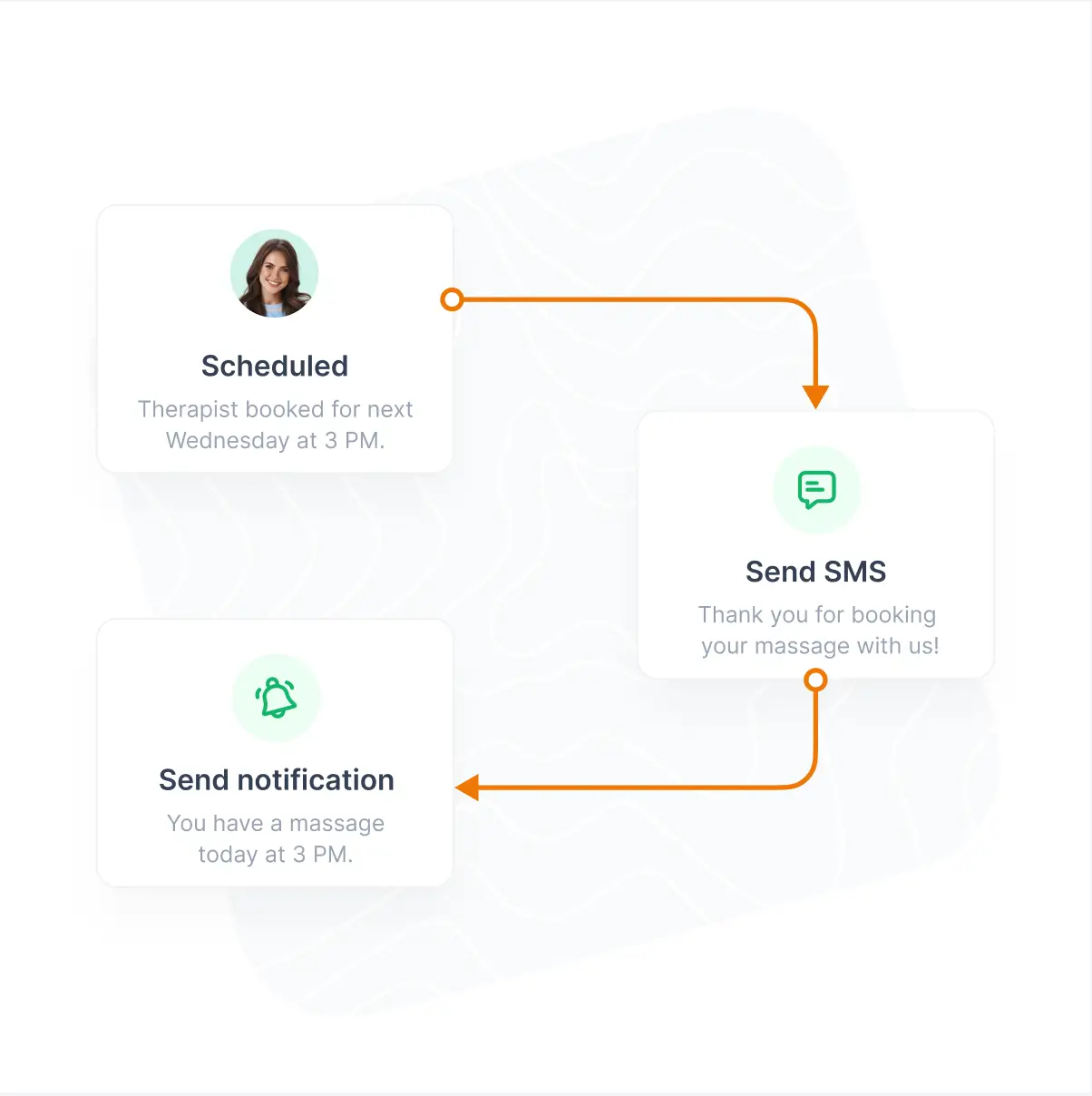
Zeeg combines appointment scheduling with contact management functionality and SMS workflow automation, creating a complete solution for businesses that need customer relationship management with integrated communication capabilities. The platform's SMS features complement its scheduling functionality, enabling automated notifications and customer engagement workflows.
SMS workflow integration
Zeeg's workflow automation includes SMS capabilities that can be triggered based on appointment activities, customer actions, and scheduled events. Businesses can create automated SMS sequences for appointment confirmations, reminders, follow-ups, and cancellation notifications.
The workflow builder allows businesses to design SMS automation sequences with conditional logic, timing controls, and personalization using customer data stored in the CRM. This automation reduces manual work while maintaining consistent customer communication.
Integration with appointment scheduling means SMS workflows can be triggered by booking events, reschedules, cancellations, and no-shows, ensuring that customers receive timely communication about their appointments without requiring manual intervention.
Customer relationship features
Contact management in Zeeg includes detailed customer profiles with communication history, appointment records, and preference tracking. The SMS functionality integrates with these profiles to enable personalized messaging based on customer characteristics and interaction history.
Lead routing capabilities can trigger SMS notifications when new appointments are booked, ensuring that appropriate team members receive immediate notification about customer engagement opportunities.
Business applications
Service businesses use Zeeg's SMS capabilities for appointment confirmations, reminder sequences, and follow-up communications that improve show rates and customer satisfaction while reducing administrative overhead.
Sales teams leverage the CRM functionality with SMS notifications for lead follow-up, meeting confirmations, and customer relationship maintenance activities that support sales processes and relationship building.
Healthcare providers benefit from automated appointment reminders, cancellation notifications, and patient communication workflows that improve practice efficiency while maintaining HIPAA-compliant communication protocols.
Cost-effective solution
Zeeg's pricing starts at €10 per user per month for the Professional plan and €16 per user per month for the Business plan, providing contact management functionality with SMS automation at competitive pricing compared to separate CRM and SMS platform combinations.
The integrated approach eliminates the need for multiple platform subscriptions and complex integration setup, reducing total cost of ownership while providing complete customer relationship and communication management capabilities.
Businesses can start with basic functionality and scale up as their needs grow, avoiding large upfront investments while maintaining access to professional-grade CRM and SMS automation features.
2. Brevo

Brevo offers SMS among other digital marketing channels as part of its all-in-one CRM solution. The SMS functionality allows you to send both marketing campaigns and transactional messages from Brevo’s interface.
Core SMS features
Brevo (formerly Sendinblue) offers robust SMS functionality alongside email and marketing automation, making it a versatile tool for businesses that want to centralize communications. Its SMS features include one-way and two-way messaging, personalized campaigns, bulk sending, and MMS support for richer media.
Users can automate SMS workflows triggered by user behavior, set up reminders, or nurture leads directly from the platform. Analytics dashboards track delivery, open rates, and responses, helping teams optimize their campaigns.
Brevo’s SMS campaign management allows users to schedule, segment, and personalize messages. Its visual automation editor lets teams create multi-step workflows that combine SMS, email, and other triggers, enabling automated customer journeys across channels.
Business applications
Brevo’s SMS capabilities are ideal for marketing campaigns, customer engagement, and transactional messaging. Businesses can use SMS for appointment reminders, flash sales, promotions, or follow-ups to abandoned carts.
The two-way messaging feature enables conversational flows, improving customer support and engagement without relying on separate tools. Its integration with the built-in CRM allows teams to send messages based on contact segments, deal stages, or past behavior.
Brevo also integrates with Shopify, WordPress, Zapier, and other platforms to automate SMS triggers from external systems.
Pricing structure
Brevo uses a credit-based pay-as-you-go model for SMS. That means businesses only pay for messages sent, which is ideal for scaling usage according to need.
The platform offers a free plan with limited email sends and SMS sending, while higher tiers unlock unlimited automations, advanced analytics, and additional messaging channels (e.g. push notifications, WhatsApp).
Pricing and features from brevo.com on 19 November 2025.
3. Zoho CRM SMS integration

Zoho CRM offers one of the most complete SMS solutions among major CRM platforms. The Zoho CRM SMS functionality is built natively into the platform, supporting both transactional and marketing communications through automated workflows and triggers.
Core SMS features:
The platform provides regulatory compliance tools that help businesses obtain necessary approvals for SMS messaging. Users can validate sender IDs and submit message templates for approval directly within the CRM, ensuring compliance with local regulations and carrier requirements.
Template management in Zoho CRM allows businesses to create personalized message templates using merge fields and customer data. These templates can be designed for different modules within the CRM, ensuring consistent messaging across various customer touchpoints and business processes.
Workflow automation enables businesses to send automated SMS notifications through triggers configured in workflows, Blueprints, or CommandCenter journeys. This integration means SMS messaging becomes part of the natural business process rather than requiring separate management.
Credit management features prevent communication disruptions by automatically purchasing SMS credits when balances reach predetermined minimums. This automated approach ensures that businesses never miss important customer communications due to insufficient credits.
Business applications:
Sales teams use Zoho CRM SMS integration to send follow-up messages after meetings, notify prospects about proposal updates, and share time-sensitive offers. The integration with sales pipelines means messages can be triggered based on deal stages or customer actions.
Customer service teams leverage the system for order confirmations, shipping notifications, appointment reminders, and support ticket updates. The ability to automate these messages based on CRM data ensures customers receive timely, relevant information without manual intervention.
Marketing teams utilize the platform for campaign notifications, event invitations, and promotional offers. The segmentation capabilities allow for targeted messaging based on customer characteristics, purchase history, and engagement patterns.
Pricing and availability:
Zoho CRM SMS features are currently only supported for companies registered in India. They are available through add-on packages that integrate with existing CRM subscriptions. The cost structure typically includes both platform fees and per-message charges, with volume discounts available for higher usage levels.
Freshworks CRM SMS capabilities
Freshworks offers SMS integration through Freshchat, their customer messaging platform that connects with Freshsales CRM. The Freshworks SMS solution focuses on conversational support and customer engagement across multiple channels.
Core SMS features:
Freshworks partners with established SMS providers like Twilio for North America and global markets, and Gupshup for the Indian market. This partnership approach ensures reliable message delivery while leveraging specialized SMS infrastructure.
The platform supports both SMS and MMS messaging, allowing businesses to send text messages and media files up to 5MB in size. This multimedia capability extends communication options beyond simple text messages.
Setup and configuration are designed to be straightforward, with no additional app downloads required once the integration is established. The system handles the technical complexity while providing businesses with user-friendly interfaces for message management.
Business applications:
Conversational support enables two-way SMS communication between businesses and customers, creating a natural dialogue that feels personal and responsive. Customer service teams can manage these conversations alongside other communication channels.
Multi-channel integration means SMS conversations can be viewed and managed alongside email, chat, and phone interactions, providing a complete picture of customer communication history and context.
Automation capabilities allow businesses to set up triggered messages based on customer actions or CRM events, ensuring timely communication without manual intervention from team members.
Pricing and availability:
Geographic availability varies depending on the SMS provider partnership, with Twilio serving most global markets and Gupshup specifically handling Indian market requirements. Businesses need to verify availability in their target markets.
Integration setup requires coordination between Freshworks CRM and the chosen SMS provider, typically involving API configuration and account setup with the third-party SMS service.
HubSpot SMS marketing integration

HubSpot CRM SMS features are available through their Marketing Hub with an SMS add-on, focusing primarily on marketing campaigns and customer engagement rather than transactional messaging.
Core SMS features:
Campaign management tools allow businesses to create, schedule, and send SMS marketing campaigns to segmented contact lists. The platform includes personalization capabilities using HubSpot's contact properties and smart content features.
Contact management integration ensures that SMS messaging respects customer preferences and subscription statuses. The system automatically handles opt-outs and maintains compliance with SMS marketing regulations.
Analytics and reporting provide detailed insights into SMS campaign performance, including delivery rates, open rates, click-through rates, and conversion metrics. These analytics integrate with HubSpot's broader marketing reporting capabilities.
Business applications:
Workflow triggers can automatically send SMS messages based on contact behavior, lifecycle stages, or custom properties. For example, businesses can send welcome messages to new subscribers or follow-up texts after specific actions.
Lead nurturing sequences can incorporate SMS touchpoints alongside email marketing, creating multi-channel campaigns that maintain consistent messaging across different communication channels.
CRM integration means SMS interactions are recorded in contact timelines, providing sales teams with complete communication history when engaging with prospects and customers.
Pricing and availability:
HubSpot CRM SMS capabilities require a Marketing Hub Professional or Enterprise subscription plus the SMS add-on. The pricing structure includes both monthly platform fees and per-message charges based on usage levels.
Geographic availability is currently limited to specific markets, with HubSpot gradually expanding SMS capabilities to additional regions based on regulatory compliance and carrier partnerships.
Pipedrive SMS integration options

Unlike other major CRM platforms that offer native SMS functionality, Pipedrive focuses primarily on sales pipeline management and doesn't include built-in text messaging capabilities. However, Pipedrive's open API and integration marketplace enable businesses to add SMS functionality through external services when needed.
Core SMS features:
Third-party app integrations available through Pipedrive's marketplace provide SMS capabilities that connect with the CRM through established API connections. These integrations require separate subscriptions but offer seamless data synchronization with Pipedrive contacts and deals.
Zapier automation enables businesses to trigger SMS messages based on Pipedrive activities like deal stage changes, new contact additions, or scheduled activities. This automation approach provides flexibility while requiring some technical configuration.
Webhook functionality allows businesses to send SMS messages when specific events occur in Pipedrive, such as won deals or lost opportunities. This method requires development resources but enables highly customized SMS automation workflows.
Business applications:
Sales teams can use SMS integrations for follow-up messages after meetings, deal update notifications, and time-sensitive offers. The integration ensures that SMS activities are tracked within Pipedrive's activity timeline for complete customer communication history.
Lead generation processes can incorporate SMS follow-up through automated workflows triggered by new leads entering the pipeline. This immediate response capability helps sales teams engage prospects while interest levels are highest.
Customer relationship maintenance benefits from automated SMS reminders, check-in messages, and renewal notifications that keep businesses connected with customers throughout the sales cycle and beyond.
Pricing and availability:
Integration costs include both Pipedrive subscription fees and separate charges for chosen SMS providers. Popular options like Textmagic offer pay-as-you-go pricing, while platforms like Salesmsg provide monthly plans with included message allowances.
Setup complexity varies depending on the chosen integration method, with marketplace apps typically offering simpler configuration than custom API integrations that require technical expertise.
Sage CRM SMS functionality
Sage CRM takes a similar approach to Pipedrive by focusing on core CRM capabilities while enabling SMS functionality through partner integrations and external API connections rather than providing native text messaging features.
Core SMS features:
API connections allow businesses to integrate various SMS providers with Sage CRM, enabling automated messaging based on CRM data and customer interactions. These integrations typically require technical setup and ongoing maintenance to ensure reliable operation.
Workflow automation can trigger SMS messages based on CRM events, customer actions, or scheduled activities. The automation capabilities depend on the specific SMS provider integration and how thoroughly the systems are configured to work together.
Contact synchronization ensures that SMS messaging respects customer preferences and maintains accurate contact information across both the CRM and SMS platforms. This synchronization is crucial for compliance and effective customer communication.
Business applications:
Customer service teams can automate SMS notifications for support ticket updates, appointment confirmations, and service reminders. The CRM integration ensures that all messaging activities are recorded in customer records for complete communication history.
Sales processes benefit from automated follow-up messages, proposal notifications, and deal update communications that keep prospects engaged throughout the sales cycle. Integration with sales stages enables targeted messaging based on opportunity progress.
Marketing automation can include SMS campaigns triggered by customer segments, lifecycle stages, or behavioral patterns stored in the CRM. This targeted approach improves campaign effectiveness while maintaining customer relationship context.
Pricing and availability:
Third-party SMS provider costs are separate from Sage CRM subscription fees, requiring businesses to manage multiple vendor relationships and billing arrangements for complete SMS CRM functionality.
Implementation complexity varies based on chosen SMS providers and integration requirements, with some businesses requiring custom development or professional services for advanced automation needs.
Specialized SMS CRM software and tools
While major CRM platforms offer SMS integration, specialized SMS CRM software often provides more advanced messaging capabilities and better pricing for businesses focused on text communication.
SimpleTexting: SMS marketing campaigns made easy

SimpleTexting focuses specifically on SMS marketing campaigns while offering CRM-like features for contact management and customer communication. The platform excels at running marketing campaigns quickly and efficiently.
Core platform features:
Campaign management tools make it simple to send the same message to entire contact lists. Users can create campaigns with intuitive interfaces, schedule messages for optimal timing, and track performance through detailed analytics.
Keyword campaigns allow businesses to collect phone numbers through text-to-join programs. Customers can text specific keywords to join mailing lists, automatically triggering welcome messages and ongoing communication sequences.
Automation features include autoresponders that immediately engage new subscribers, drip campaigns that nurture leads over time, and triggers that send messages based on customer actions or behaviors.
Marketing tools provide built-in capabilities for surveys, polls, sweepstakes, and other engagement activities. These tools help businesses gather customer feedback and increase engagement beyond simple promotional messaging.
Business applications:
Contact management includes detailed subscriber profiles, conversation history, and segmentation capabilities. Businesses can organize contacts based on preferences, behaviors, and demographic information for targeted messaging.
Team collaboration features allow multiple users to manage campaigns, with user permissions and conversation assignment capabilities. Team members can leave notes on conversations and coordinate customer communication efforts.
Integration capabilities include connections to popular CRM systems, email marketing platforms, and business tools through Zapier and direct API integrations. This connectivity enables businesses to maintain unified customer data across platforms.
Pricing structure:
SimpleTexting uses credit-based pricing starting at $33.20 per month for 6000 credits (billing annually). Additional credits cost approximately $0.055 each on entry-level plans, with volume discounts available for higher usage levels.
The pricing model includes team collaboration features, analytics, and basic automation capabilities in all plans, making it accessible for small businesses while scaling for larger organizations.
Pricing and features from simpletexting.com on 6 August 2025.
Textmagic: Pay-as-you-go SMS flexibility
Textmagic offers a straightforward approach to SMS CRM with pay-as-you-go pricing and an intuitive web application that makes sending texts simple and efficient.
Core platform features:
User interface design prioritizes simplicity, taking users directly to message composition rather than overwhelming dashboards. The clean design makes it easy for new users to start sending messages immediately.
Contact management includes Excel and CSV import capabilities, manual entry options, and automatic contact creation from incoming messages. Businesses can also use click-to-text forms on websites to collect phone numbers.
Message scheduling enables businesses to plan campaigns in advance, with options for recurring messages like weekly specials or monthly reminders. Template creation streamlines common message types like appointment confirmations.
Flexible pricing allows businesses to pay only for messages they send, without monthly commitments or minimum usage requirements. This approach works well for businesses with variable messaging needs.
Business applications:
API access enables businesses to integrate Textmagic with existing business systems, CRMs, and workflow tools. The integration capabilities support automated messaging based on external system triggers.
Zapier connectivity provides pre-built integrations with popular business tools, enabling automated workflows without custom development. Businesses can trigger SMS messages from calendar events, form submissions, or CRM activities.
Two-way messaging supports customer replies and conversations, with messages delivered to the web application, mobile apps, or email addresses. This flexibility ensures businesses never miss customer communications.
Pricing structure:
Pay-as-you-go pricing starts at $0.049 per text message, with dedicated virtual numbers available for $10 per month. This pricing structure provides predictable costs for businesses with known messaging volumes.
Volume discounts are available for businesses willing to commit to monthly subscriptions, offering reduced per-message costs in exchange for regular billing commitments.
Pricing and features from textmagic.com on 6 August 2025.
Textla: Affordable SMS CRM solution
Textla stands out in the SMS CRM market for its exceptionally low per-message pricing combined with user-friendly features and comprehensive customer support.
Core platform features:
Per-message costs of $0.005 represent some of the lowest rates in the SMS industry, making Textla attractive for businesses with high-volume messaging needs or tight budget constraints.
Onboarding support includes surveys to collect business information and assistance with regulatory compliance requirements like Campaign Registry registration. Customer support proactively reaches out to new users.
User interface focuses on simplicity with inbox functionality for two-way messaging, campaign creation tools, contact management, and analytics reporting. The straightforward design minimizes learning curve for new users.
Integration capabilities include Zapier connectivity for connecting with other business tools and CRM systems. Pre-built workflows enable automated messaging based on external system triggers.
Business applications:
Customer service teams can use Textla for appointment reminders, order updates, and support communications while maintaining affordable per-message costs for high-volume scenarios.
Marketing teams benefit from the low messaging costs for campaign activities, allowing for more frequent communication without budget concerns that might limit other SMS solutions.
Sales teams can leverage the platform for follow-up messages and customer engagement while controlling costs through the affordable pricing structure.
Pricing structure:
Monthly subscription fees start at $19 per month (billed annually), providing access to the platform and basic features before per-message charges apply. This structure offers predictable base costs with variable usage fees.
The combination of low monthly fees and exceptional per-message rates makes Textla one of the most cost-effective SMS solutions available for businesses with significant messaging volumes.
Pricing and features from textla.com on 6 August 2025.
SlickText: Advanced SMS marketing capabilities
SlickText combines powerful marketing tools with SMS messaging capabilities, making it particularly strong for businesses focused on customer acquisition and engagement through text messaging.
Core platform features:
Lead generation tools include opt-in web forms, website pop-ups, and social media integration for collecting phone numbers. The templates look professional and can be customized to match brand aesthetics.
Customer engagement features encompass loyalty programs, contests, coupons, and surveys that encourage ongoing interaction. These tools help businesses build relationships beyond simple promotional messaging.
Campaign management includes segmentation capabilities, scheduled messaging, and automated workflows that deliver targeted messages based on customer characteristics and behaviors.
Workflow automation enables businesses to create sophisticated messaging sequences based on customer actions, preferences, and lifecycle stages. These workflows can nurture leads and maintain customer engagement over time.
Business applications:
Trigger-based messaging sends automatic responses to customer actions like website visits, purchases, or form submissions. This immediate responsiveness helps businesses capitalize on customer interest and engagement.
Integration options include connections to CRM systems, e-commerce platforms, and marketing tools that enable data sharing and coordinated customer communication across channels.
Retail businesses leverage SlickText for promotional campaigns, loyalty program communications, and customer retention initiatives. The marketing tools support comprehensive customer engagement strategies.
Pricing structure:
SlickText offers a free trial with limited functionalities. Monthly pricing starts at $24.17 per month for 6000 texts per year (billed annually), with higher tiers available for increased messaging volumes and advanced features.
The platform includes marketing automation tools, analytics, and customer engagement features in all plans, providing complete SMS marketing capabilities without requiring additional add-ons.
Pricing and features from slicktext.com on 6 August 2025.
Salesmsg: Local business SMS solution
Salesmsg targets small and local businesses with features designed specifically for US and Canadian markets, offering local phone numbers and CRM integrations tailored to sales processes.
Core platform features:
Local phone numbers are available throughout the US and Canada, allowing businesses to maintain local presence in their communication. Each team member can have separate numbers for personalized customer relationships.
Regulatory compliance support helps businesses navigate SMS regulations specific to North American markets, including registration requirements and opt-in management for business messaging.
Native integrations with popular CRMs like HubSpot, Pipedrive, and Zoho ensure that SMS communications are tracked and managed within existing customer relationship workflows.
Call forwarding options enable customers to call SMS numbers with calls automatically forwarded to business phones or handled through the web application. This flexibility supports customer communication preferences.
Business applications:
Lead routing capabilities automatically direct incoming messages to appropriate team members based on territory, expertise, or availability. This routing ensures prompt response to customer inquiries.
Sales teams use Salesmsg for lead follow-up, appointment scheduling, and customer relationship maintenance. The CRM integration ensures all communications are tracked and coordinated with sales activities.
Service businesses leverage the platform for appointment reminders, service updates, and customer support communications. The local phone numbers help maintain professional, trustworthy communication.
Pricing structure:
Monthly plans start at $25 per month for 500 text messages and one phone number. Additional messages cost $0.04 each, while extra numbers are available for $10 per month.
Higher volume tiers offer reduced per-message costs for businesses with significant messaging needs, making the platform scalable as communication requirements grow.
Pricing and features from salesmessage.com on 6 August 2025.
EZ Texting: Beginner-friendly SMS platform

EZ Texting focuses on providing comprehensive guidance and support for businesses new to SMS marketing, making it accessible for non-technical users while offering powerful capabilities.
Core platform features:
Onboarding support includes detailed tutorials, getting started guides, and customer service assistance to help new users understand SMS marketing best practices and platform capabilities.
Interface design emphasizes clarity with large, intuitive buttons and clear navigation. The platform provides working examples and templates to help users understand how to create effective campaigns.
Campaign management tools support both broadcast messaging to lists and individual customer conversations through a unified interface. Users can easily switch between mass communication and personal customer service.
Help resources include detailed documentation, video tutorials, and responsive customer support to ensure users can successfully implement SMS marketing strategies.
Business applications:
Automation features include drip campaigns, autoresponders, and trigger-based messaging that can nurture leads and maintain customer engagement without constant manual intervention.
Analytics reporting provides detailed insights into campaign performance, subscriber growth, and engagement metrics. The reports help businesses understand what messaging strategies work best for their audiences.
Customer service includes phone support and email assistance from knowledgeable team members who can provide strategic guidance beyond technical support.
Pricing structure:
Launch plans start at $20 per month for 500 text messages (billed annually) and one textable number, with straightforward pricing that includes core features and customer support.
Training resources encompass best practices for SMS marketing, compliance guidance, and strategic advice for improving campaign performance and customer engagement.
Pricing and features from eztexting.com on 6 August 2025.
Twilio: Customizable SMS platform
Twilio operates as a communications API platform that enables businesses to build custom SMS solutions integrated with their existing systems and workflows.
Core platform features:
API-first approach allows developers to create custom SMS applications that integrate seamlessly with existing business systems, CRMs, and customer databases. This flexibility supports unique business requirements.
No-code tools enable non-developers to create SMS workflows and integrations using visual interfaces and pre-built connectors. Zapier integration extends these capabilities to thousands of business applications.
Scalability features support businesses from startup to enterprise level, with pricing and infrastructure that can handle everything from occasional messages to millions of messages per month.
CRM connections include pre-built integrations with major platforms like HubSpot, Salesforce, and Zoho, enabling businesses to add SMS functionality to existing customer relationship management processes.
Business applications:
Business tool integration extends to marketing automation platforms, customer support systems, e-commerce platforms, and custom business applications through API connections and middleware.
Workflow automation enables businesses to trigger SMS messages based on any system event, customer action, or scheduled activity, providing complete control over messaging logic and timing.
Custom development capabilities allow businesses to create unique SMS solutions that match their specific workflow requirements and integrate perfectly with existing business processes.
Pricing structure:
Cost structure includes both per-message charges starting at $0.0083 per message and monthly fees for phone numbers starting at $1.15 per month, with pricing that can be more economical than specialized SMS platforms for high-volume users.
Technical requirements vary from simple no-code implementations to complex custom development projects, depending on business needs and integration complexity.
Pricing and features from twilio.com/en-us on 6 August 2025.
Which SMS marketing service integrates with my CRM?
Choosing the right SMS marketing service to integrate with your CRM depends on several factors: your CRM platform, messaging volume, budget constraints, feature requirements, and technical capabilities.
Understanding when to add external SMS to your CRM
While some CRM platforms include native SMS capabilities, others focus on their core strengths and rely on integrations to provide text messaging functionality. Understanding when and why to add external SMS services helps businesses make informed decisions about their communication strategy.
Why CRMs use external SMS providers:
Specialization benefits allow CRM platforms to focus on customer relationship management while partnering with SMS specialists who handle the complexities of message delivery, carrier relationships, and regulatory compliance across different markets.
Cost flexibility enables businesses to choose SMS providers that match their specific volume needs and budget constraints, rather than being locked into pricing structures that may not align with their messaging patterns.
Feature variety means businesses can select SMS platforms with specialized capabilities like advanced marketing automation, industry-specific compliance, or unique pricing models that better serve their communication requirements.
When external SMS integration makes sense:
Businesses using CRMs like Pipedrive or Sage that don't include native SMS functionality need external providers to add text messaging capabilities while maintaining their existing CRM investment and workflows.
Companies with high-volume messaging needs may find specialized SMS providers offer better pricing and delivery capabilities than CRM-native solutions that may have higher per-message costs or volume limitations.
Organizations requiring advanced SMS features like sophisticated marketing automation, specialized compliance capabilities, or unique communication workflows often benefit from dedicated SMS platforms that focus exclusively on messaging.
Integration approaches:
Direct API integrations provide seamless data flow between CRM systems and SMS platforms, enabling automated messaging based on CRM activities while maintaining unified customer communication records.
Zapier automation offers user-friendly integration options for businesses without technical resources, providing pre-built workflows that connect CRM events with SMS messaging activities.
Webhook configurations enable real-time messaging triggers based on CRM activities, ensuring immediate customer communication when important events occur in the customer relationship management process.
Volume and budget considerations
Low-volume messaging (under 1,000 messages per month): Textla offers exceptional value with its $0.005 per message pricing, while Textmagic's pay-as-you-go model provides flexibility without monthly commitments. EZ Texting and SimpleTexting offer user-friendly options with reasonable entry-level pricing.
Medium-volume messaging (1,000-10,000 messages per month): SimpleTexting and SlickText provide good value with their monthly plans, while Salesmsg offers competitive pricing for businesses needing local numbers and CRM integration. HubSpot's SMS add-on becomes cost-competitive at these volumes for existing HubSpot customers.
High-volume messaging (over 10,000 messages per month): Twilio typically offers the most economical pricing for high-volume users, especially when combined with custom development. Textla maintains cost advantages even at high volumes, while enterprise plans from SimpleTexting and other platforms provide volume discounts.
Feature-specific recommendations
For advanced marketing automation: SlickText and SimpleTexting offer the most complete marketing tools, including loyalty programs, contests, and sophisticated segmentation. HubSpot SMS integrates well with broader marketing automation workflows for existing HubSpot customers.
For sales team communication: Salesmsg focuses specifically on sales processes with CRM integration and local numbers. Twilio provides the most flexibility for custom sales workflows, while Textmagic offers simplicity for basic sales communication needs.
For customer service applications: Freshworks provides excellent customer service integration through Freshchat, while Twilio enables custom customer service solutions. EZ Texting offers good support for service reminders and customer communication.
For e-commerce businesses: SimpleTexting and SlickText include e-commerce-specific features like cart abandonment messaging and purchase confirmations. Twilio provides the most flexibility for custom e-commerce integrations and automated order notifications.
Cost optimization strategies when deciding on SMS tool
Volume-based pricing evaluation: Businesses should calculate total costs based on their expected CRM users and SMS message volumes. Some combinations that appear expensive for low volumes become cost-effective at higher usage levels, while others provide better value for smaller operations.
Regular usage monitoring helps businesses optimize their plans and avoid overpaying for unused capacity or features they don't actively utilize in their customer communication strategies.
Feature requirement assessment: Evaluating actual feature needs versus available capabilities helps businesses avoid paying for unnecessary functionality. Many businesses can achieve their SMS CRM goals with basic plans and selective add-ons rather than comprehensive enterprise packages.
The most cost-effective approach often involves starting with basic functionality and scaling up as business needs grow, rather than purchasing advanced features that may not be immediately necessary.
Integration complexity considerations: While separate CRM and SMS platforms may offer better pricing, businesses should factor in setup costs, ongoing management time, and potential technical support needs when evaluating total cost of ownership.
Simple integrations through platforms like Zapier typically require minimal technical expertise and ongoing maintenance, making them accessible for small businesses without dedicated IT resources.
Choosing the right SMS CRM solution for your business
The landscape of SMS CRM solutions offers numerous options for businesses seeking to integrate text messaging with customer relationship management. From comprehensive platforms like Zoho CRM SMS and HubSpot to specialized SMS tools like Textla and SimpleTexting, the choice depends on your specific business needs, budget, and technical requirements.
For businesses prioritizing native integration and complete functionality, platforms like Zoho CRM with built-in SMS capabilities provide seamless workflows and unified customer data management. Companies already invested in specific CRM ecosystems often find the best value in adding SMS functionality through dedicated add-ons or integrated solutions.
Budget-conscious businesses can achieve professional SMS CRM capabilities through combinations like Pipedrive with Textmagic or by leveraging free CRM platforms with affordable SMS services. The key is evaluating total cost of ownership including setup time, ongoing management, and actual usage patterns rather than just comparing list prices.
Specialized SMS platforms often provide better messaging features and pricing for businesses with high-volume communication needs, while CRM-native solutions offer better integration and unified customer experiences for businesses prioritizing complete relationship management.
The most affordable CRM tools with SMS campaign capabilities in 2025 combine competitive base pricing with flexible messaging costs, allowing businesses to scale their communication efforts without dramatic cost increases as they grow.
Success with SMS CRM implementation depends on choosing solutions that align with your business processes, technical capabilities, and growth plans. Whether you opt for an all-in-one platform or a best-of-breed combination, the integration of SMS messaging with CRM data creates powerful opportunities for improving customer relationships and business outcomes.
Zeeg is Europe's leading AI voice agent and appointment scheduling software in one solution — GDPR-compliant, made in Germany. Start for free →