The 11 Best AI SDR Tools in 2026


AI SDR tools have changed how sales teams build pipelines by automating prospecting, outreach, and qualification so reps can focus on actually closing deals. Here's a look at the best ones in 2026, starting with Zeeg, Europes leading AI voice agent with appointment booking and full GDPR-compliance, made in Germany.
What makes AI SDR tools different from basic sales automation?
Before we dive into the tools right away, let us clarify the differences between SDR tools with AI and basic sales automation tools. Now, there's a version of "automation" that just means scheduling emails in advance and logging calls automatically. That's been around for years, and most sales teams already have it. AI SDR tools are a different category entirely, and the distinction matters when you're deciding where to spend your budget.
The core difference here comes down to judgment. Traditional sales automation does exactly what you tell it to, every time, in the same exact order. An AI SDR tool takes a look at the situation and decides what to do next. If a prospect opens an email three times but never replies, the system picks up on that signal and changes its approach. If someone asks a question that indicates they're looking at other competitors, the tool adjusts the messaging accordingly. No human has to intervene for any of that to happen.
That shift has a few practical implications for SDR teams:
- Less time on research: AI tools pull firmographic data, recent news, job changes, and intent signals automatically, so reps show up to conversations already knowing the context instead of having to spend 20 minutes on LinkedIn beforehand.
- Outreach that doesn't read like a template: Good AI SDR tools personalize at the message level, not just the name field. That means referencing a prospect's recent funding round, a role change, or a relevant pain point, which is what makes someone think a human actually wrote it.
- Follow-up that actually happens: One of the most common SDR failure points is inconsistent follow-up. AI handles the cadence without dropping the ball, and adjusts timing based on engagement signals instead of a fixed schedule.
- Cleaner handoffs to sales: When a lead is ready for a human conversation, AI SDR tools can route them automatically to the right rep, with context attached, and a meeting already on the calendar.
None of this replaces the judgment a good rep brings to a complex deal. What it does is handle the volume work so that judgment gets applied where it actually counts. Now, let’s have a look at the tools that do this the best.
Overview of the 11 best AI SDR tools in 2026
Top 11 SDR tools with AI in 2026
1. Zeeg — Best AI SDR tool for converting leads through scheduling

Zeeg is on number one, and for good reason. Most AI SDR tools focus on getting a reply. Zeeg, on the other hand, focuses on what happens after: turning that interest into a booked meeting. As an AI-powered appointment scheduling platform, Zeeg fits neatly into the SDR workflow by automating the handoff from outreach to meeting, thus removing one of the biggest friction points in the sales process.
SDR teams use Zeeg to build branded booking pages, set up AI voice agents for phone calls, set up routing forms that qualify leads before they land on a rep's calendar, and distribute meetings automatically through round-robin logic. When a prospect clicks a link, the system handles the rest: timezone detection, calendar checks, CRM sync, and confirmation emails.
Key features:
- Routing forms that qualify and route leads to the right rep based on custom criteria
- Round-robin scheduling for fair and automatic meeting distribution
- Automated workflows and reminders throughout the scheduling process
- Native integrations with HubSpot, Salesforce, Pipedrive, Zoom, Apple Calendar, Google Meet, and Teams
- Full GDPR compliance with end-to-end encryption
- Collective and group meeting scheduling for multi-rep calls
- CRM features for managing contacts and leads directly in the platform (including custom objects)
Pricing:
- Starter: Free forever
- Professional: $10/user/month (annual) or $12/user/month (monthly)
- Business: $16/user/month (annual) or $20/user/month (monthly)
- Scale: $30/user/month (annual) or $40/user/month (monthly)
What users say¹: The numbers speak for themselves. Zeeg holds a 4.9/5 on OMR with leader and top rated awards in meeting management, and users often praise how easy it is to set up and how well it fits into existing sales workflows.
The verdict: If your SDR process involves getting prospects, booking appointments, automating phone calls (inbound and outbound), then Zeeg closes the gap between "interested" and "on the calendar" faster than most tools in this list. The routing and round-robin features alone make it worth using for any team managing inbound volume, and the pricing is competitive compared to alternatives with similar functionality.
2. Qualified - Best AI SDR for inbound pipeline generation
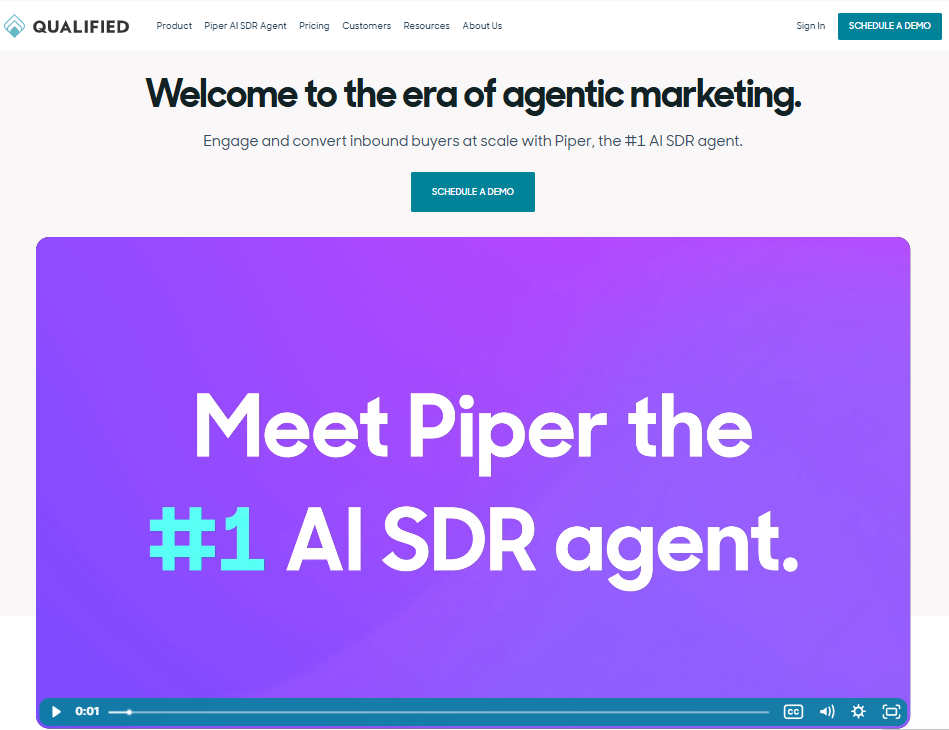
Unlike outbound-focused AI SDR tools, Qualified is built around converting inbound website traffic into pipeline. For teams exploring what is an AI SDR and how the technology applies to inbound sales, the platform combines conversational AI, live chat, and automated lead routing to help sales teams engage buyers the moment they land on the site.
Key features:
- AI-powered website conversations that qualify visitors in real time
- Autonomous AI SDR agents that book meetings and route leads automatically
- Intent-based engagement using CRM and account-level data
- Native Salesforce integration for lead syncing, routing, and attribution
- Live chat and human handoff capabilities for sales-assisted conversations
Pricing: Custom pricing
What users say: Users often highlight how effective Qualified is at increasing inbound conversion rates and speeding up meeting bookings from high-intent website traffic. Many also praise the Salesforce integration and ease of routing leads to the right reps. Some users mention that setup and optimization can take time, especially for larger enterprise teams managing complex workflows.
The verdict: In conclusion, Qualified may be a strong fit for B2B companies that generate significant inbound website traffic and want to engage buyers instantly with AI-powered conversations. It’s especially well suited for Salesforce-centric revenue teams focused on pipeline acceleration rather than high-volume outbound prospecting.
3. Apollo.io — Best for prospecting at scale
Moving into pure-play AI SDR territory, Apollo.io remains one of the most widely used sales prospecting tools in 2026. It combines a large B2B contact database with outreach sequencing and AI-assisted personalization all in one single platform.
Key features:
- Access to 275M+ verified B2B contacts with email and direct dial data
- AI-powered Outbound Copilot that sources and enrolls prospects into sequences
- AI Writing Assistant for generating subject lines, openers, and full emails
- Real-time lead scoring based on firmographic and behavioral signals
- Native CRM integrations with Salesforce, HubSpot, and Pipedrive
Pricing²:
- Free: Basic access with limited credits
- Basic: $49/user/month
- Professional: Custom pricing
- Organization: Custom pricing
What users say³: Users appreciate the size of the database and the convenience of having prospecting and sequencing in one place. A common complaint is that data accuracy varies, especially for smaller companies and contacts outside core markets. It gets a solid 4.7/5 G2 rating, too.
The verdict: In conclusion, Apollo may be a solid choice for teams that prioritize contact coverage and want to run outbound sequences without stitching together multiple tools. Just be ready to verify data quality for niche audiences.
4. Clay — Best for research-driven prospecting
On number three, we have Clay. For those that compete on personalization and not volume, Clay has carved out a clear position in the SDR tools market. Its AI agent, Claygent, browses the web like a researcher would by pulling recent news, LinkedIn activity, podcast appearances, and other signals that standard enrichment tools miss.
Key features:
- Claygent AI agent that researches prospects from 50+ data sources
- Visual workflow builder to connect research to outreach sequences
- Waterfall enrichment strategies that pull from multiple providers to reduce cost
- Integrations with major CRMs and outreach platforms via webhooks and API
Pricing⁴:
- Free: Free (100 data credits/month, 500 actions/month)
- Launch: $167/month (annual) or $185/month (monthly)
- Growth: $446/month (annual) or $495/month (monthly)
- Enterprise: Custom
What users say⁵: The level of personalization Clay enables is often mentioned in positive reviews. The trade-off is a learning curve. Getting workflows configured takes time, and credit costs can creep up if you're not careful enough. Still, it gets a 4.7/5 G2 rating.
The verdict: To be honest, Clay is best suited for RevOps-minded teams or anyone who wants to build highly tailored prospecting workflows. It's not a plug-and-play tool, but for teams where message quality matters more than raw send volume, it gets the job done.
5. Reply.io (Jason AI) — Best for conversational outreach

Now, Reply.io takes a different angle from most SDR tools. Its AI agent, Jason, is built to handle multi-turn conversations. It responds to objections, answers questions, and moves prospects toward a booked meeting across both email and LinkedIn.
Key features:
- Conversational AI that manages full back-and-forth exchanges with prospects
- Multi-channel orchestration across email and LinkedIn
- Automated meeting scheduling once a prospect shows interest
- AI-generated sequences with stop-on-reply logic
- Integration with major CRMs and calendar tools
Pricing⁶:
- Email Volume: $159/user/month (annual)
- Multichannel: $89/user/month (annual)
- AI SDR Starter: $500/month for 1,000 active contacts
- AI SDR Growth: $1,500–$3,000/month for 5,000–10,000 contacts
What users say⁷: The conversational quality of Jason AI gets positive marks, with users noting that replies feel more natural than other AI-generated outreach. Implementation takes one to two weeks to configure properly, which comes up as a disadvantage for teams that want a fast setup. On G2, it has a user rating of 4.6/5.
The verdict: If your SDR motion relies on email and LinkedIn conversations that go beyond a single exchange, Reply.io handles that better than most platforms in this space. Keep in mind that LinkedIn automation carries platform risk, which is worth factoring in before going heavy on that channel.
6. Amplemarket — Best multi-channel AI SDR platform

Halfway through the list, Amplemarket stands out for combining signal monitoring with multi-channel outreach in a way that feels cohesive instead of bolted together. Its AI copilot, Duo, watches for over 20 buying signals (funding rounds, job changes, competitor reviews), and triggers personalized sequences based on what it finds.
Key features:
- Duo AI copilot that monitors intent signals and generates personalized outreach
- Multi-channel sequences across email, LinkedIn, and phone
- Built-in deliverability tools including domain health monitoring and email warmup
- Contact-level intent data for targeting prospects showing active buying signals
Pricing⁸:
- Startup: $300/month (annual), includes 2 users and 30,000 contacts
- Growth and Elite: Custom pricing
What users say⁹: On G2, Amplemarket has a rating of 4.6/5. Those that use Amplemarket tend to note deliverability as their best feature, with inbox placement rates holding up well at volume. However, some users also report a learning curve at first use.
The verdict: To sum up, Amplemarket is a strong fit for mid-market teams running outbound at scale who want signal-based prospecting baked into the platform. The pricing is on the higher end, but the deliverability infrastructure justifies it for teams where inbox placement is an outmost priority.
7. Salesloft — Best for enterprise sales teams
Here’s another enterprise option for you. Salesloft has evolved well beyond its origins as a mere cadence tool. Its Conductor AI system now turns buyer signals into prioritized rep actions to explain the reasoning behind each recommendation rather than just firing off tasks.
Key features:
- Conductor AI that ranks tasks by deal potential and explains its logic
- AI Agent portfolio covering account research, email generation, and conversation summaries
- Conversation intelligence that transcribes and analyzes calls for coaching insights
- Deep CRM integration with Salesforce and other enterprise platforms
Pricing¹⁰: Quote-only. Custom enterprise packages with no published rates.
What users say¹¹: Salesloft gets strong marks from enterprise teams who value the depth of its analytics and coaching tools. Smaller teams, however, tend to find it more than they need, and the lack of transparent pricing makes budget planning tricky before you get on a call. Also, it gets an overall rating of 4.3 on Capterra.
The verdict: For large sales organizations with established processes and the need for detailed performance analytics, Salesloft delivers. For everyone else, the complexity and cost may be harder to justify.
8. Outreach — Best AI assistant for enterprise reps
Number seven has a slightly different approach than others. Outreach takes the view that AI should work with your team instead of replacing it completely. Its Kaia AI assistant handles deal analysis, email drafting, and task automation to give enterprise reps a smarter day-to-day workflow without pulling control away from them.
Key features:
- AI deal analysis that identifies risks and recommends next steps based on engagement data
- Smart email composition that suggests relevant content while matching brand voice
- Automated task management for meeting prep, follow-ups, and CRM updates
- Strong integration with Salesforce and enterprise tech stacks
Pricing¹²: Quote-based, starting around $100/user/month.
What users say¹³: Reps at large organizations tend to appreciate how Outreach fits into existing workflows without forcing a complete process overhaul. The main criticism is how complicated it can get, hence why it’s safe to say that it's built for teams that already have established sales infrastructure, and not for those starting from scratch. On G2, it has a rating of 4.3/5.
The verdict: At the end of the day, Outreach is a capable tool for enterprise teams that want AI-assisted selling without going fully autonomous. Implementation is involved, so budget time and resources for setup.
9. Instantly — Best for high-volume cold email

Now, Instantly is purpose-built for teams running cold email at serious volume. Where most platforms try to do everything, Instantly focuses almost entirely on deliverability and scale with unlimited email accounts, AI personalization, and automated warmup built to keep messages out of spam.
Key features:
- Unlimited email accounts with automated warmup to protect sender reputation
- AI-generated first lines and per-prospect message customization
- A/B testing for subject lines, sender names, and message content
- Deliverability analytics including inbox placement rates and domain health
Pricing¹⁴:
- Growth: $47/month (monthly) or $30/month (annual)
- Hypergrowth: $97/month (monthly) or $77.60/month (annual)
- Light Speed: $358/month (monthly) or $286.30/month (annual)
What users say¹⁵: The deliverability focus gets positive feedback. The most common complaint is that Instantly is email-only, so teams that want LinkedIn outreach or phone sequences will need to look elsewhere or combine it with another tool. Still, it has a staggering 4.8/5 overall rating on G2.
The verdict: Instantly earns its spot on this list for teams where cold email is the primary outbound channel. It's not a full-stack SDR solution, but within its scope, it does the job well and at a price point most teams can work with.
10. 11x AI — Best for fully autonomous prospecting

Nearing our list, 11x AI represents the most autonomous end of the AI SDR spectrum. Its digital workers handle the entire outbound cycle (research, outreach, conversation handling, and meeting booking) without requiring human oversight at each step.
Key features:
- Autonomous agents managing 1,000+ accounts simultaneously
- Multi-channel engagement across email and phone
- AI-powered conversation handling including objection responses and lead qualification
- SOC 2 Type II and CASA Tier 3 security compliance
Pricing¹⁶: Custom annual contracts, usually starting around $40,000–$45,000/year.
What users say¹⁷: With a 4.5/5 G2 rating, 11x AI has a mixed track record in independent reviews. Teams with well-defined ICPs and clean data report solid results, while those with broader targeting or less structured processes tend to see inconsistent outcomes.
The verdict: 11x AI is worth exploring for companies ready to hand off a huge portion of their outbound motion to AI. Go in with realistic expectations, though, as fully autonomous outreach requires careful setup, ongoing monitoring, and a clear ICP to perform well.
11. Artisan AI (Ava) — Best AI SDR agent for outbound execution

Last but not least, Artisan AI has a different take on the autonomous agent model. Its flagship agent, Ava, combines a large B2B contact database with AI-driven enrichment and outreach, with the option to review messages before they go out to make it more controllable than fully hands-off alternatives.
Key features:
- Ava AI agent handling lead enrichment, email generation, and follow-up sequences
- Flexible operation modes including full autopilot or human-in-the-loop review
- Access to 300M+ contacts plus proprietary website visitor tracking
- Built-in email warmup and mailbox health monitoring
- White-glove onboarding for enterprise clients
Pricing¹⁸: Custom, quote-based. No published tiers.
What users say¹⁹: The human-in-the-loop option is often cited as a reason teams choose Artisan over more hands-off competitors. Some reviewers note that AI-generated messages can sound formulaic without ongoing prompt refinement, which is worth factoring into your setup time. Artisan Sales has a 3.9/5 user rating on G2.
The verdict: Artisan is a reasonable choice for teams that want autonomous AI outreach but aren't comfortable removing humans from the review process entirely. The lack of pricing transparency is a friction point, but the quality controls make it more approachable than platforms that send everything without review.
How to choose the right AI SDR tool for your team
As of this year, the market has matured enough that there's no single "best" tool, it depends on what your team actually needs.
If the gap in your process is converting inbound interest into booked meetings, Zeeg solves that directly. If you need a large, verified contact database for outbound, Apollo is the most practical starting point. Teams competing on personalization will get more from Clay or Amplemarket, while high-volume email shops tend to gravitate toward Instantly. For enterprise-scale workflows with deep CRM requirements, Salesloft and Outreach are the natural options.
Here are a few things worth checking regardless of which tool you evaluate:
- Integration with your CRM — data should flow both ways without manual work
- Deliverability infrastructure — warmup, domain health monitoring, and inbox rotation matter more than most teams expect
- Quality controls — AI-generated outreach needs a review process to stay on-brand
- Real onboarding time — most platforms require more setup than their sales decks suggest
Start with a small pilot group, measure what actually moves to qualified meetings, and scale from there.
Source list
- https://omr.com/en/reviews/product/zeeg
- https://www.apollo.io/pricing
- https://www.g2.com/products/apollo-io/reviews
- https://www.clay.com/pricing
- https://www.g2.com/products/clay-com-clay/reviews
- https://reply.io/pricing/
- https://www.g2.com/products/reply/reviews
- https://www.amplemarket.com/pricing
- https://www.g2.com/products/amplemarket/reviews
- https://www.salesloft.com/pricing
- https://www.capterra.com/p/157977/SalesLoft/#reviews
- https://www.outreach.io/pricing
- https://www.g2.com/products/outreach/reviews
- https://instantly.ai/pricing
- https://www.g2.com/products/instantly/reviews
- https://www.11x.ai/
- https://www.g2.com/products/11x/reviews
- https://www.artisan.co/pricing
- https://www.g2.com/products/artisan-sales/reviews
Zeeg is Europe's leading AI voice agent and appointment scheduling software in one solution — GDPR-compliant, made in Germany. Start for free →
Frequently Asked Questions
Can AI SDR tools work alongside scheduling tools like Zeeg?
Yes, and combining them is one of the more practical ways to reduce friction in the SDR workflow. AI SDR tools handle prospecting and outreach; Zeeg handles what happens when a prospect is ready to book: automatically routing them to the right rep, removing the back-and-forth, and making sure the meeting actually lands on the calendar. Together, they cover the full top-of-funnel motion from first touch to booked meeting.
What should I look for when evaluating AI SDR tools?
A few things matter more than the feature list. First, check how the tool integrates with your CRM, as data needs to flow both ways without manual cleanup. Second, look at deliverability infrastructure, especially if email is your primary channel. Third, be realistic about the learning curve: some tools take days to set up, others take months. Finally, ask vendors for case studies from companies with a similar ICP and team size to yours, not just their best-case logos.
How much do AI SDR tools cost?
The range is wide. Entry-level email-focused tools like Instantly start around $30–$47/month. Mid-market platforms like Apollo run $49/user/month. Full-stack solutions like Amplemarket start at $300/month. At the enterprise end, autonomous agent platforms like 11x AI can run $40,000+ per year. The right budget depends on what you actually need: like email volume, multi-channel orchestration, autonomous agents, or something in between.
How long does it take to see results from an AI SDR tool?
That depends mostly on how clean your data is and how well-defined your ideal customer profile is going in. Teams with both in good shape can start seeing qualified opportunities within the first month. If you're starting with a messy CRM database or a broad ICP, expect three to six months before the system is performing consistently. Either way, plan for a real setup period, as most tools require more configuration than their onboarding materials suggest.
Do AI SDR tools replace human SDRs?
Not entirely, and the teams that treat them as a full replacement tend to run into trouble. What AI SDR tools do well is handle volume: prospecting, initial outreach, follow-up cadences, and data entry. What they still struggle with is nuance: complex objections, multi-stakeholder relationship building, and the judgment calls that come with navigating a long sales cycle. The most effective setups use AI for the top-of-funnel grind and humans for the conversations that actually close deals.
What is an AI SDR tool?
An AI SDR tool is software that automates the work a sales development rep would usually do by hand such as finding prospects, researching accounts, writing outreach, following up, and routing qualified leads to the right rep. The key distinction from basic automation is that AI SDR tools make decisions based on real-time signals and context instead of following a fixed sequence regardless of how prospects behave.