The 9 Best Bland AI Alternatives in 2026


Bland AI gets a lot of attention in the AI voice agent space, but a 55% price hike in late 2025¹ and a developer-only setup have pushed many teams to look elsewhere.
Whether the issue is cost, ease of deployment, or the need for something beyond a standalone calling tool, this guide covers 9 solid Bland AI alternatives — starting with Zeeg, Europe's leading AI phone assistant and scheduling software in one solution, GDPR-compliant and made in Germany, which combines AI voice calls and booking natively, without third-party tools.
What makes people look for Bland AI alternatives?
In December 2025, Bland AI restructured its pricing, raising the entry-level rate from $0.09 to $0.14 per minute — a 55% increase.¹ Beyond the rate itself, there’s no no-code builder, meaning any deployment requires either a development team or an enterprise contract.¹ The billing structure also layers in costs from failed outbound call attempts ($0.015 each), SMS, voice cloning, and premium LLM access — all billed separately.²
That said, Bland AI is a capable platform for large enterprises running high call volumes with dedicated engineering support. For most businesses, though, the combination of Blanding's pricing complexity and technical barriers makes alternatives worth a serious look.
The 9 best Bland AI alternatives in 2026
1. Zeeg — Best for businesses that want AI voice agents with advanced scheduling
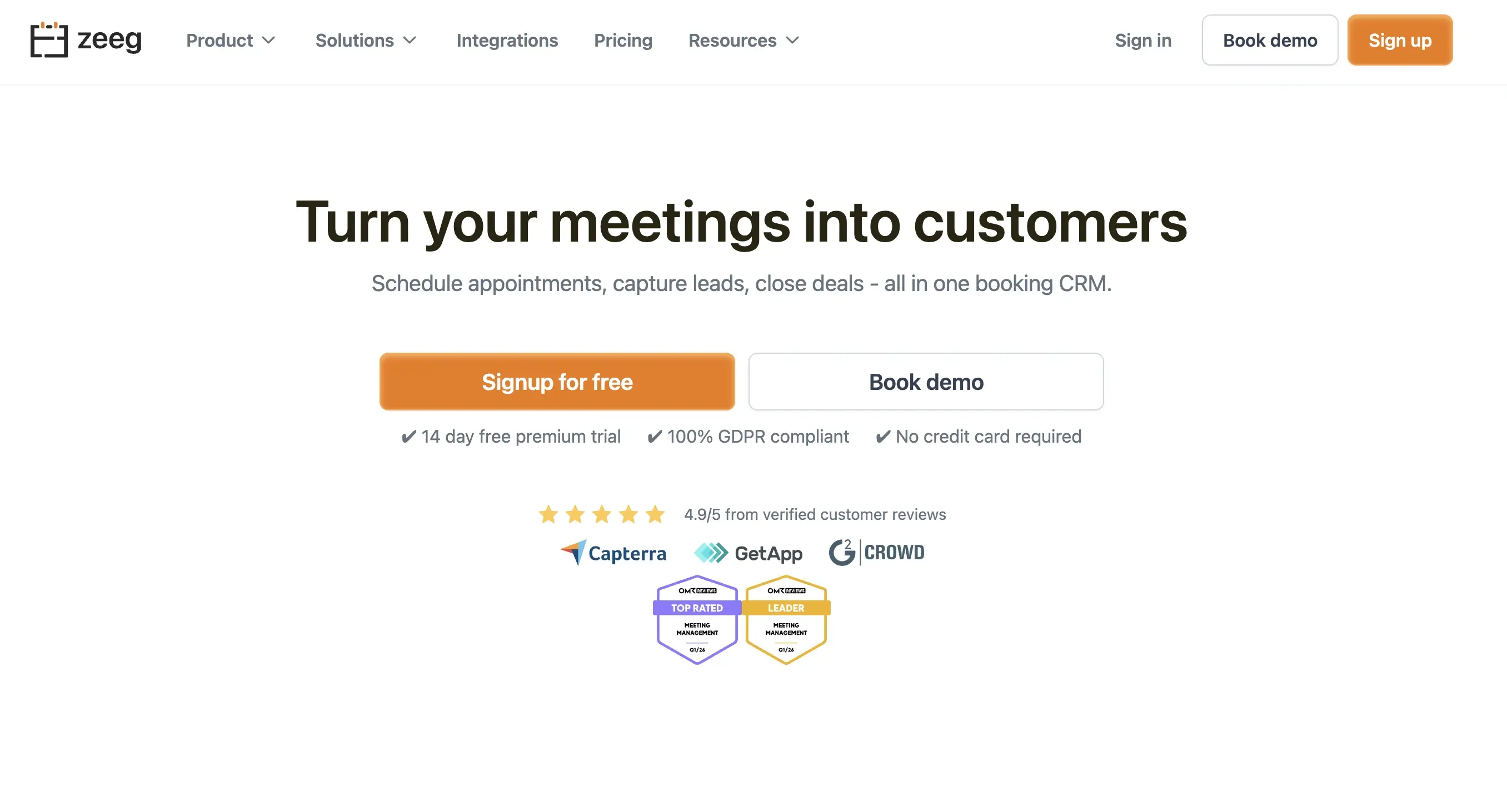
If your business runs on booked meetings coming out of phone calls, you’ve probably cobbled together a voice AI tool and a booking platform — two separate subscriptions, at least. Zeeg was built to replace that stack. The AI receptionist answers the call (and makes them too), holds a real back-and-forth conversation, captures the caller’s details, and books the right meeting directly into your calendar. The booking, the contact record, and the full call transcript land automatically in Zeeg's system.
Nothing gets stitched together. That’s the actual differentiator.
Key features:
- Inbound and outbound calling with fully conversational AI dialogue — not a phone tree or IVR
- Prompt Builder: write agent behavior in plain text, with pre-built templates for Appointment Booker, Sales Qualifier, and Support Callback
- Smart routing by intent: define rules in plain language to route callers to the right team, meeting type, or location
- Phone number flexibility: buy a local number in Zeeg, or import your existing business number via SIP trunk
- Built-in contact management: every call creates or updates a contact profile with full transcript, timestamps, and post-call email notifications (within Zeeg or other CRMs)
- Full GDPR compliance: European hosting and end-to-end encryption across all plans
Pros:
✓ AI voice agent and scheduling in one platform — natively, not via integration
✓ Advanced scheduling scenarios, like lead routing and round-robin (for AI phone calls and online bookings)
✓ No Zapier or third-party connectors required
✓ Every call shows its exact cost in credits inside the CRM — no billing surprises
✓ Import your existing business number via SIP with no disruption to current setup
✓ No-code setup — live in minutes from a prompt and a phone number
✓ You don't need need a paid scheduling tier in order to use the AI voice agent
✓ Full GDPR compliance with European data hosting on all plans
Cons:
✗ Outbound calling (~€0.19/min) costs more per minute than inbound (~€0.11/min)
✗ No mobile app available yet
Pricing
There are two main products, therefore two pricing models:
Online scheduling
- Starter free plan available
- Professional from $10/user/month (billed annually)
- Business from $16/user/month (billed annually)
- Scale from $30/user/month
- Voice minutes from approximately $0.11/min inbound, purchased in minute bundles
What users say on G2 — ⭐ 4.9/5
“It has really streamlined and automated my meeting workflow from scheduling all the way through follow-ups. I’d recommend it to any business struggling with manual scheduling chaos.”
2. Retell AI — Best for developer teams who want transparent, usage-based billing
Ask most developers what frustrates them about AI voice platforms and “unpredictable billing” comes up fast. Retell AI built its entire value proposition around the opposite: no platform fee, no feature gating, no minimum commitment.⁴ You pay per minute of connected call time and nothing else. That pricing clarity alone has made it one of the more popular choices among technical teams who’ve been burned by invoices that looked nothing like the advertised rate.
Beyond pricing, the platform holds up technically. The conversation flow builder uses nodes, transitions, and reusable components — more structured than pure prompt-based systems, which matters when you need predictable behavior on complex call paths. Barge-in support means the agent stops mid-sentence the moment a caller speaks, rather than plowing through its script.⁴ For teams evaluating voice quality, that’s one of the details that separates platforms that feel natural from those that don’t.
The honest caveat: $0.07/min only covers the voice engine. Add a production-quality LLM, a decent voice provider, and telephony, and real costs land at $0.13–$0.20+/min.⁴ Still among the more transparent in this space — but worth factoring those Retell costs in from the start.
Pros:
✓ No platform fee — pay only for actual usage, no minimums
✓ Sub-second latency and barge-in support for natural call flow
✓ SOC 2 certified, HIPAA-ready, GDPR compliant
✓ Good visual flow builder for structured, multi-step conversations
✓ 20 concurrent calls included on all accounts by default
Cons:
✗ Requires developer resources to configure and maintain
✗ Real production costs are meaningfully higher than the $0.07/min base rate
✗ No no-code option — non-technical teams are effectively excluded from the platform
✗ Some users report slow support response times
Pricing: Pay-as-you-go from $0.07/min for the voice engine. LLM, voice provider, and telephony billed separately. Real all-in production cost typically $0.13–$0.20+/min. Additional concurrent calls at $8/month per slot. Enterprise plans available.⁴
What users say on G2 — ⭐ 4.8/5
“The setup process is straightforward, the call quality is very natural, and the latency is impressively low. We’ve been able to launch voice agents for lead qualification, appointment booking, and customer support much faster than expected.”
3. Vapi AI — Best for maximum control over the AI voice stack
You can think of Vapi as the middleware layer of the voice AI stack. It doesn’t lock you into a single AI provider — instead, you bring your own speech-to-text engine, language model, text-to-speech provider, and telephony carrier, and Vapi orchestrates everything into a working phone agent.⁵ Flow Studio maps conversation paths visually, the Squads feature lets you chain multiple specialized agents within a single call, and function calling lets agents hit external APIs mid-conversation without breaking the flow.
There's many alternatives to Vapi AI, but fgor engineering teams building voice AI as a core product capability — not a side feature — that modularity is genuinely valuable. The landscape shifts fast, and being able to swap components without rebuilding the entire agent is a meaningful advantage.
If you need something easier to set up and with built-in scheduling capabilities, you might just want a Vapi alternative like Zeeg.
But let's look at Vapi's pricing. The $0.05/min platform fee covers Vapi’s orchestration only. Speech-to-text, LLM, text-to-speech, and telephony are all billed separately by the providers you choose.⁵ Most production deployments land between $0.15 and $0.33 per minute all-in. On top of the money, managing four or five separate vendor billing relationships adds operational overhead that’s easy to underestimate until the first real invoice arrives.
Pros:
✓ Maximum model and provider flexibility — bring your own LLM, voice, and telephony
✓ Competitive base orchestration fee at $0.05/min
✓ Strong API documentation and active developer community
✓ $10 in free credits for new accounts to test the platform
✓ Squads feature enables sophisticated multi-agent call routing
Cons:
✗ Real-world total cost is significantly higher than the advertised base rate
✗ No true no-code environment — developer resources are non-negotiable
✗ Multiple vendor billing accounts add operational complexity
✗ Phone number availability outside North America requires workarounds
Pricing: Platform orchestration fee from $0.05/min. Real all-in production cost typically $0.15–$0.33/min once LLM, voice provider, and telephony are added. New accounts get $10 in free credits. Enterprise plans with custom pricing available.⁵
What users say on G2 — ⭐ 4.2/5
“Vapi AI is very easy to use, and the integration is straightforward. The initial setup was very easy, which was a big relief and made the whole process smooth.”
4. Synthflow AI — Best no-code voice agent platform for agencies
Not every team has a developer available to wire together a voice pipeline. Synthflow was built for exactly that situation — sales teams, agencies, healthcare practices, real estate operations — where the goal is a working voice agent by end of week, not end of month.⁶ The drag-and-drop flow designer is genuinely no-code, industry-specific templates cover the most common use cases out of the box, and a 14-day free trial on paid plans means you can test it with real callers before committing.
The compliance story is also strong. SOC 2, HIPAA, and GDPR are all covered without needing an enterprise contract,⁶ which matters in regulated industries. For agencies specifically, the white-label tier is one of the more complete reselling setups in this market — your clients log into a branded dashboard and never see the Synthflow name.
One thing worth knowing before you sign up: Synthflow pricing page doesn’t show the full picture. Synthflow requires BYOK (Bring Your Own Keys), so you pay separately for OpenAI, ElevenLabs, and Deepgram on top of the subscription.⁶ On the Pro plan, those provider costs typically add $140–$320/month — meaning your actual bill is closer to $590–$770, not $450. It’s not a dealbreaker for the right use case, but it’s worth building into the budget from day one.
Pros:
✓ Genuinely no-code — accessible without technical expertise
✓ White-label tier built specifically for agency reselling
✓ Fast to deploy — agents can go live in under a day
✓ 200+ CRM and workflow integrations out of the box
✓ Full compliance stack (SOC 2, HIPAA, GDPR) without enterprise gating
Cons:
✗ Real costs are 2–3× the listed price once BYOK provider fees are included
✗ Off-script handling can default to canned responses when conversations go unexpectedly
✗ Voice-only — no native WhatsApp or web chat channel
✗ Pricing becomes hard to forecast as call volumes grow
Pricing: Starter $29/month (50 minutes included). Pro $450/month (2,000 minutes). Growth $900/month (4,000 minutes). Agency $1,400/month (6,000 minutes + white-label). Enterprise from $0.08/min. All plans require additional spend on BYOK AI providers.⁶
Read more about the best Synthflow alternatives.
What users say on G2 — ⭐ 4.5/5
“Synthflow makes it very easy to build and manage AI voice agents without heavy technical setup. The interface is intuitive, agents configure quickly, and the integrations with phone providers like Twilio work well.”
5. GoHighLevel — Best for marketing agencies already in the GHL ecosystem
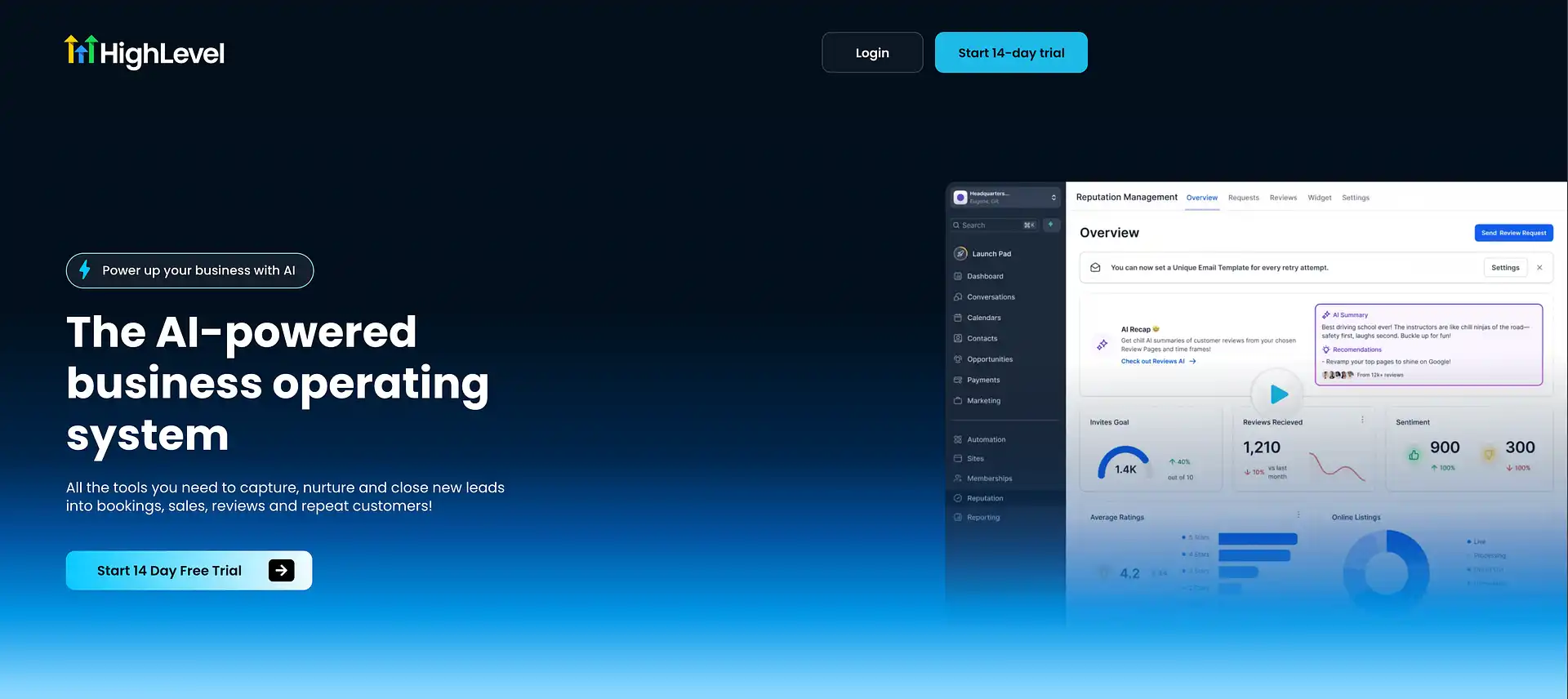
This platform is a comprehensive marketing and sales automation suite covering CRM, funnels, campaigns, scheduling. And now with Voice AI too, joining the most popular most popular AI voice bots in the market. For agencies that already operate inside GoHighLevel, adding a voice agent is a natural next step. Data flows through existing pipelines, it’s one login, and there’s no new vendor to evaluate. For businesses not yet in the ecosystem, the layered complexity is harder to justify as an entry point.
A few things to understand about the pricing before going in. AI features are not included in the base subscription — they’re paid add-ons on top.⁷ The AI Employee plan ($97/month per sub-account) covers inbound Voice AI, Conversation AI, Reviews AI, and Content AI. Voice AI itself runs at approximately $0.163/min based on real usage patterns,⁷ and phone system charges are billed separately on top. For agencies with ten client sub-accounts, that’s $970/month in AI fees alone before a single call is made.
Pros:
✓ All-in-one (CRM, funnels, marketing, voice, scheduling) for agencies already on the platform
✓ No-code voice agent builder through the Agent Studio interface
✓ Voice AI data flows natively through GHL’s CRM and pipelines
✓ White-label and reselling capabilities built in
✓ Strong community and active development velocity
Cons:
✗ AI voice features are add-ons on top of an already-layered pricing structure
✗ Total cost escalates quickly across multiple client sub-accounts
✗ Less specialized than platforms built specifically for voice AI
✗ Some features require a separate Twilio account and setup
Pricing: Base plans: Starter $97/month, Unlimited $297/month, SaaS Pro $497/month. AI Employee add-on: $97/month per sub-account. Voice AI billed per minute (~$0.163/min average). Phone system charges billed separately via LC Phone or Twilio.⁷
What users say on G2 — ⭐ 4.6/5
“Excellent for agencies managing multiple clients — sub-accounts keep everything organized. The AI conversation bot saves hours of manual follow-up by responding to leads automatically.”
6. JustCall AI — Best for sales and support teams that want a phone system with AI on top
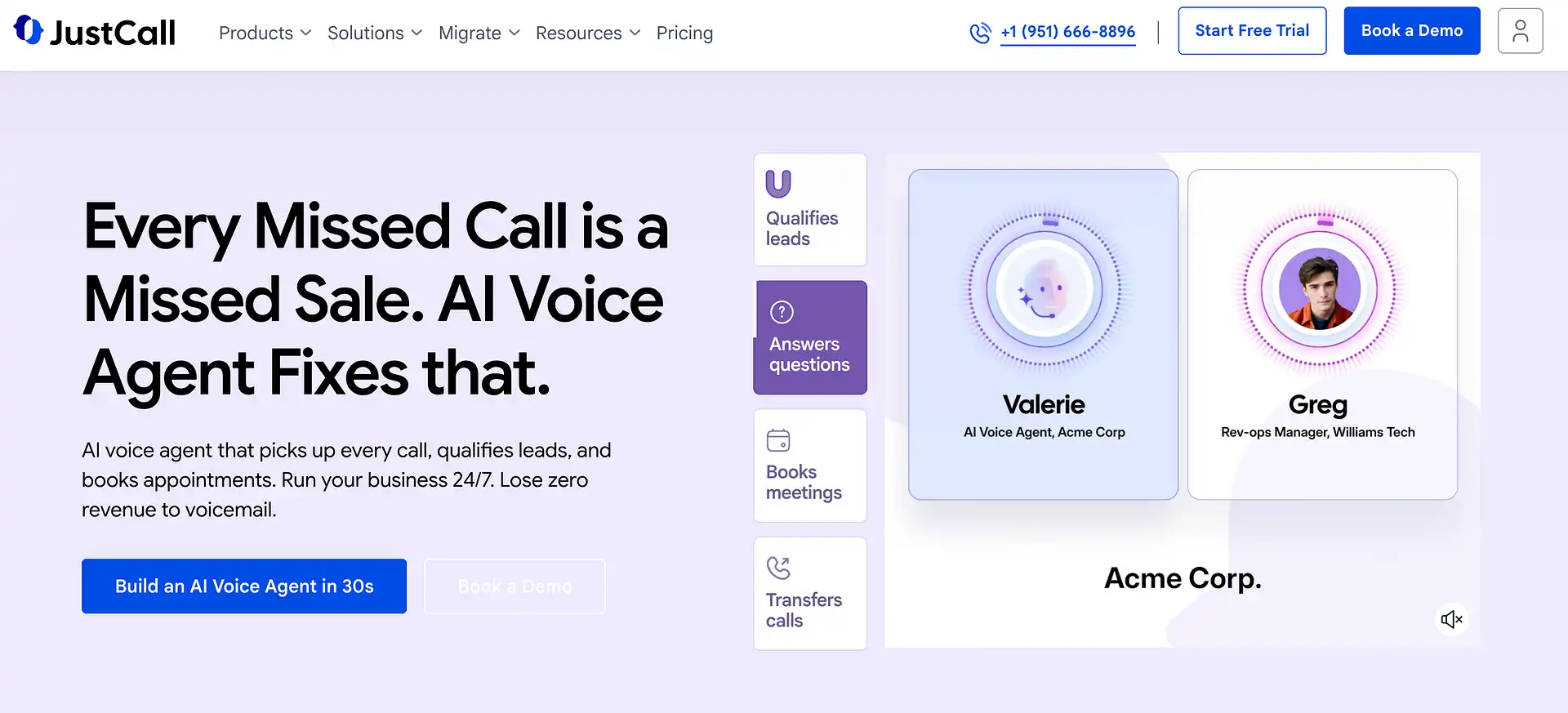
There’s a meaningful difference between a voice AI platform and a business phone system with AI on top. JustCall is firmly the latter — and that positioning is actually a strength for the right team. If your use case is a full calling and SMS stack with CRM sync, outbound dialers, call scoring, and AI coaching all in one subscription, JustCall delivers that. The AI Voice Agent sits inside that broader platform, handling inbound calls 24/7, qualifying leads, booking appointments, and routing callers across 14 languages.⁸
The friction shows up in the pricing model. The AI Voice Agent is a separate paid add-on from all base plans, and the pay-as-you-go rate runs $0.99/min — considerably higher than what dedicated voice AI platforms charge.⁸ Overage charges on monthly plans hit that same $0.99/min, which can climb faster than expected on busy months. One other thing worth flagging: outbound AI calling is still in development. The current agent handles inbound only.
Pros:
✓ Strong combination of calling, SMS, AI coaching, and voice automation in one tool
✓ 100+ CRM integrations including HubSpot and Salesforce
✓ Phone numbers in 70+ countries
✓ Solid outbound dialer tools (auto, predictive, and power dialers) for sales teams
✓ 14-day free trial with no credit card required
Cons:
✗ AI Voice Agent is a paid add-on with a high per-minute rate ($0.99/min for overages)
✗ Current AI Voice Agent handles inbound calls only — outbound AI calling still in beta
✗ Pricing complexity grows significantly with team size and usage
✗ Some users report variable call quality, particularly during peak hours
Pricing: Base plans from $29/user/month (Team) to $89/user/month (Pro Plus), billed annually. AI Voice Agent add-on: $0.99/min pay-as-you-go; $99/month for 100 minutes; $249/month for 300 minutes.⁸
What users say on G2 — ⭐ 4.3/5
“I use JustCall for cold calling and find it useful and easy to use. The call recording feature lets me review my team’s performance, and the integration with HubSpot CRM helps keep everything organized.”
7. Twilio — Best for enterprises building fully custom voice infrastructure
Before going further: Twilio is infrastructure, not a finished product. If you’re looking for something to deploy this week, this isn’t it. What Twilio offers is a globally proven communications platform — 180+ countries, battle-tested uptime, and compliance certifications (SOC 2, HIPAA, GDPR) that matter in regulated industries.⁹ ConversationRelay, its AI voice capability, sits on top of that foundation. The programmability is real and deep.
The catch is that you’re buying building blocks. Getting an AI voice agent live means assembling a speech-to-text provider, a language model, a text-to-speech provider, and Twilio’s telephony layer yourself — then maintaining all of it ongoing. At full production, the all-in cost typically lands around $0.25–$0.50/min.⁹ For large enterprises with dedicated engineering teams and requirements too specific for off-the-shelf platforms, the trade-off is justified. For most businesses evaluating Bland AI alternatives, it’s more engineering overhead than the situation warrants.
Pros:
✓ Proven global infrastructure with exceptional uptime across 180+ countries
✓ Strong compliance certifications (SOC 2, HIPAA, GDPR) built into the platform
✓ Full programmability for custom voice workflows
✓ Well-documented APIs and a large, mature developer ecosystem
✓ Scales reliably from small to very high call volumes
Cons:
✗ Not a ready-made voice agent — significant development and ongoing maintenance required
✗ Real all-in cost of $0.25–$0.50/min at full production setup
✗ Not suited for non-technical teams — requires dedicated engineering resources
✗ Support response times criticized on higher-volume accounts
Pricing: Usage-based. Basic telephony from approximately $0.013/min. Full AI voice agent (LLM + TTS + STT + telephony combined) typically $0.25–$0.50/min in production.⁹
What users say on G2 — ⭐ 4.2/5
“Twilio makes it simple to integrate SMS, voice, and email through one reliable platform. The APIs are easy to work with, well-documented, and scale smoothly from small projects to enterprise deployments.”
8. Dialpad AI — Best for augmenting human agents with real-time AI
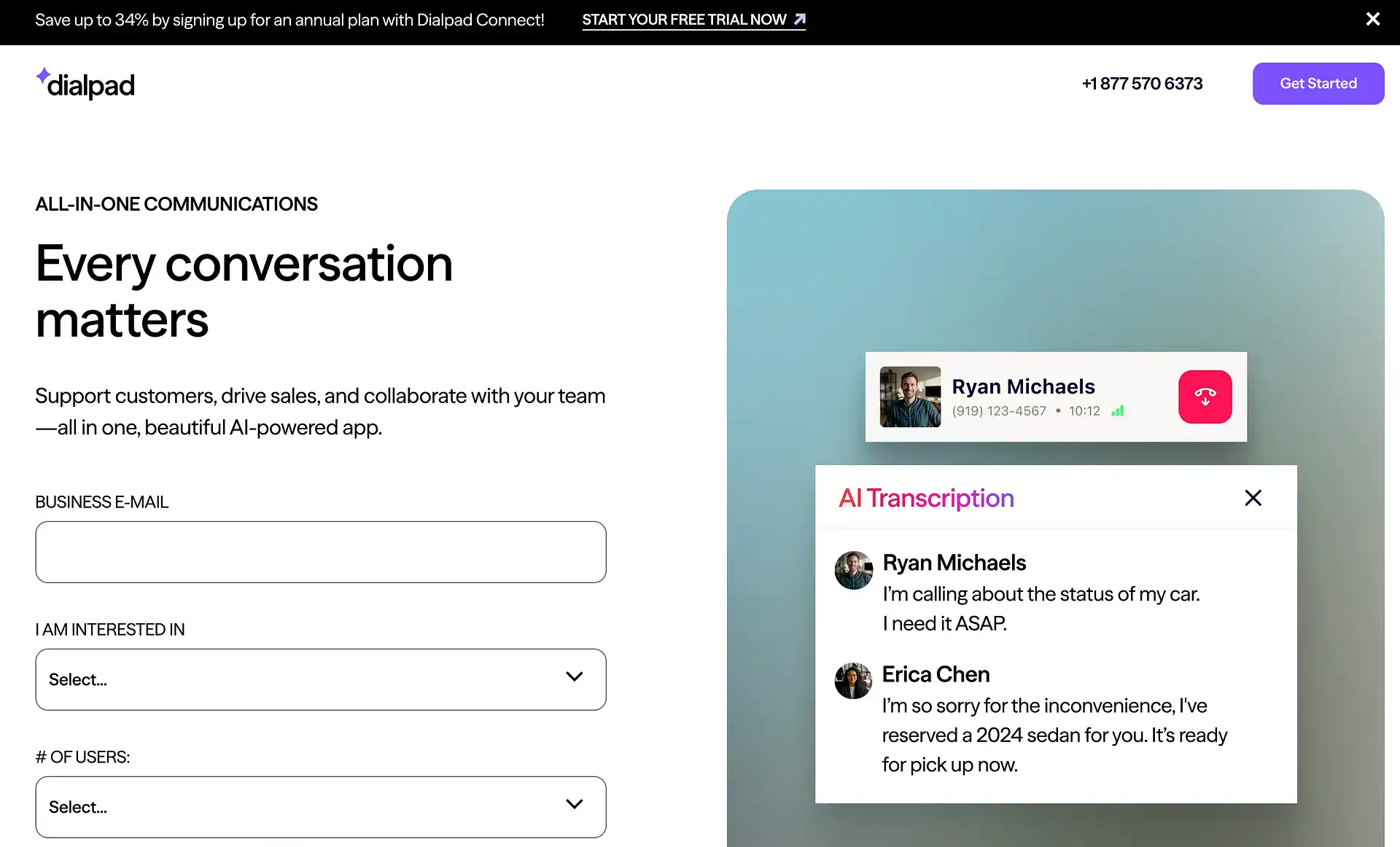
Every other platform in this guide is built around replacing a human on the phone. Dialpad does the opposite. Its AI sits alongside the human — transcribing in real time, surfacing coaching prompts, flagging sentiment, and generating call summaries before the rep has even hung up. Voice, video, and messaging all run from the same app, and the integrations (Salesforce, HubSpot, Zendesk) are consistently praised for how clean the CRM sync is.
That positioning makes Dialpad a genuinely different kind of option here. If you want an AI that picks up calls autonomously while your team sleeps, this isn’t the right tool. But if your business depends on human agents and you want those agents to be faster, better-prepared, and free from post-call admin, Dialpad solves that well. Call quality is reliable, and users across very different company sizes give it high marks for exactly that consistency.¹⁰
Pros:
✓ Real-time AI coaching, live transcription, and sentiment analysis during calls
✓ Unified voice, video, and messaging in a single app across devices
✓ Solid integrations with major CRMs (Salesforce, HubSpot, Zendesk)
✓ Reliable call quality and uptime, consistently rated positively by users
✓ Scales from small teams to enterprise contact centers
Cons:
✗ No autonomous AI agents — AI augments humans, not replaces them
✗ Advanced AI features (coaching, analytics) only available on higher-tier plans
✗ Per-user pricing gets expensive as teams grow
✗ Annual contracts required for most plan tiers
Pricing: Standard from $27/user/month (billed annually). Pro from $35/user/month. Enterprise custom pricing. AI features available on Pro and above.¹⁰
What users say on G2 — ⭐ 4.4/5
“I like how easy it is to handle more than one call at the same time and transfer calls without disruptions. The AI integration provides summaries, transcripts, and recordings of each call, making it easier to review information from past conversations.”
9. Lindy AI — Best for multi-channel AI automation across voice, email, and CRM
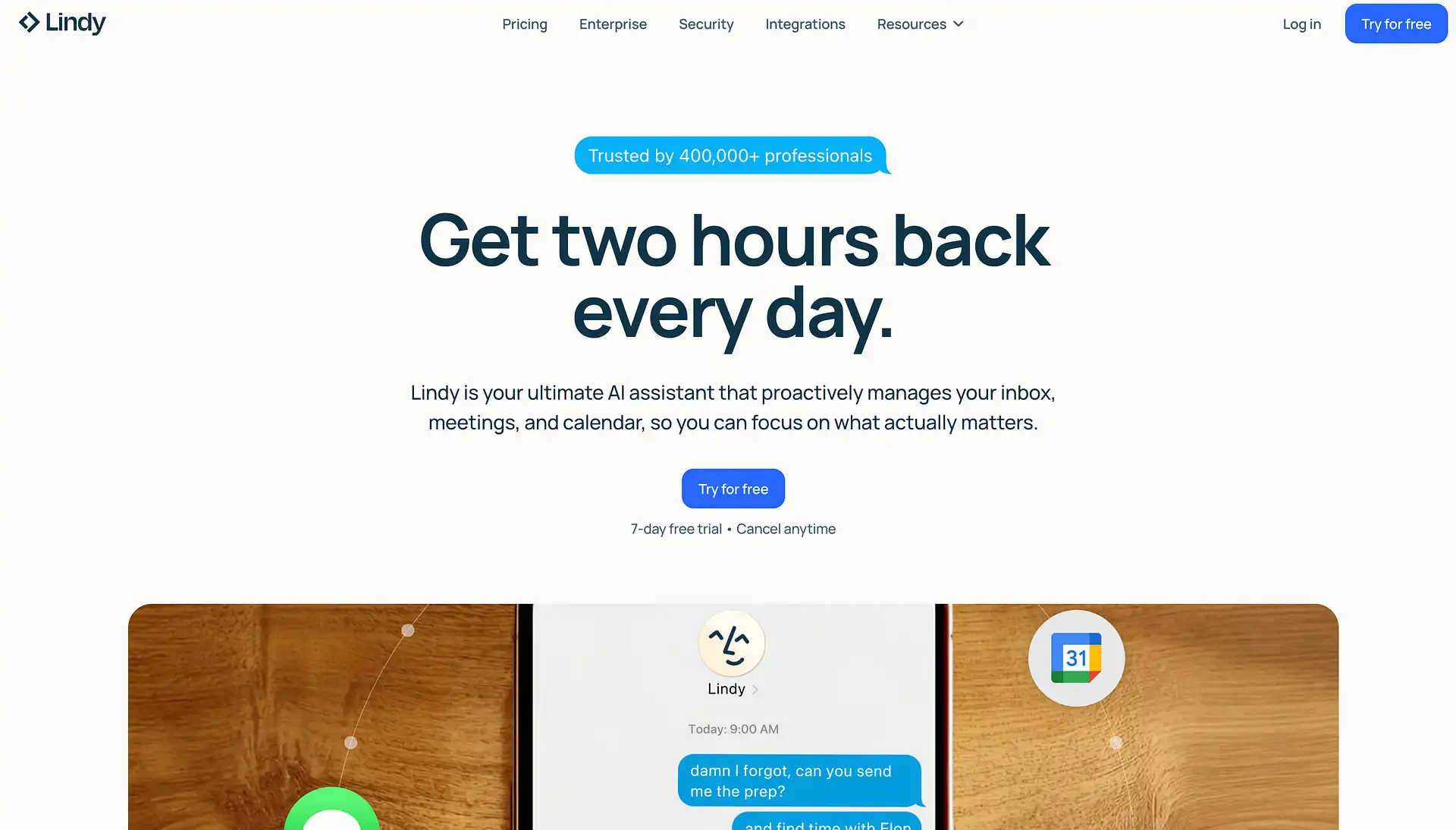
Most platforms on this list stop when the call ends. Lindy keeps going. Its Gaia voice agent handles inbound calls, qualifies leads, and books appointments — but those interactions feed directly into broader automated workflows: follow-up emails send automatically, CRM records update, calendar invites go out, all from within the same agent. For teams that are currently managing separate tools for each of those tasks, that consolidation is worth taking seriously.
The no-code builder is genuinely approachable. You describe what you want in plain language, pick from over 100 templates, and the workflow is live. The platform handles voice, email, scheduling, and CRM updates in one environment — which is a meaningfully different proposition from pure voice AI platforms that require you to connect everything else yourself.
Where it falls short is high-volume calling. Dedicated voice infrastructure platforms handle large outbound campaigns with lower latency and more predictable per-minute economics. Lindy’s sweet spot is growing teams that want one agent covering a full workflow — from first call to confirmed meeting to follow-up — without assembling a multi-vendor stack to get there.¹¹
Pros:
✓ Multi-channel AI agent: voice, email, scheduling, and CRM in one workflow
✓ No-code setup accessible to non-technical teams
✓ Strong automation capabilities across tools and channels
✓ Free plan available for testing before committing
✓ Highly rated user experience on G2 (4.9/5)
Cons:
✗ Less specialized than dedicated voice AI platforms for high-volume or complex outbound calling
✗ Credit-based pricing becomes unpredictable as usage scales — can deplete faster than expected
✗ Voice infrastructure is less mature than purpose-built voice platforms
✗ Not suited for large outbound call campaigns
Pricing: Free plan available (40 tasks and 400 credits). Plus from $49.99/month. Business from $199/month. Team plans available for larger organizations.¹¹
What users say on G2 — ⭐ 4.9/5
“What I like best is how much time it saves me. It handles repetitive tasks and scheduling with surprising accuracy. It’s like having a reliable assistant that just gets things done quietly in the background.”
Quick comparison: Bland AI alternatives at a glance
How to choose the right alternative
Nine platforms are a lot to evaluate. Here’s a simple way to narrow it down based on what actually matters for your situation.
If you need calling, booking, and CRM in one tool — with no Zapier, no separate booking platform, and no multi-vendor stack — Zeeg is the only option here built specifically for that. Voice agent, scheduling, and also contact management (or direct integration or a wide stack of CRMs).
If you have a technical team and want developer-level control — Retell AI and Vapi are the strongest options. Retell is more transparent on pricing; Vapi gives you more flexibility on the specific providers you want in the stack.
If you need something non-technical teams can run without engineering support — Synthflow is the right category. Just go in with accurate expectations about total cost once BYOK providers are added.
If your agency is already operating inside GoHighLevel — adding Voice AI makes sense within the existing setup. The economics work when the platform is already central to your client workflow.
If your team needs a full phone system, not just a voice agent — JustCall covers calling, SMS, dialers, and AI features as an integrated phone platform. Dialpad is the better fit when human agent performance is the focus rather than autonomous call handling.
If you’re building custom infrastructure at enterprise scale — Twilio’s programmability is unmatched, and for that specific use case, the engineering overhead is justified.
Sources:
7. GoHighLevel — AI Product Pricing
Zeeg is Europe's leading AI voice agent and appointment scheduling software in one solution — GDPR-compliant, made in Germany. Start for free →
Frequently Asked Questions
What is the cheapest Bland AI alternative in 2026?
At the advertised rate, Vapi's $0.05/min platform fee looks lowest — but real deployment costs land significantly higher once all components are added. Retell's $0.07/min is more inclusive. For a fully bundled solution covering voice, scheduling, and CRM, Zeeg's minute packages start at $49/month billed annually ($59 monthly), with inbound minutes from $0.11/min. It is not the lowest headline per-minute rate, but it is among the most cost-effective options for businesses that would otherwise need three separate tools.
Is Bland AI good for appointment booking?
Bland AI can be configured for appointment booking workflows, but it requires developer resources and doesn't include a native scheduling engine or CRM. Zeeg handles appointment booking as a core feature — the AI agent books meetings directly into your calendar during the call, with the booking confirmed and logged automatically.
Can I keep my existing phone number with these platforms?
Yes, several support this. Zeeg allows number import via SIP trunk. Retell AI supports custom SIP configurations. Vapi allows BYOT (Bring Your Own Twilio). JustCall supports number porting. For businesses that don't want to disrupt their existing phone presence, this is an important detail to check before committing.
Which Bland AI alternative has the most predictable pricing?
Retell AI offers the clearest per-minute billing with no platform fee. Zeeg's credit model shows the exact cost of every call inside the CRM. Synthflow and Vapi advertise lower base rates, but BYOK provider costs make forecasting harder until you've run enough volume to benchmark real usage.
What is the best Bland AI alternative for non-technical teams?
Synthflow AI is the most accessible option for non-technical teams, with a no-code builder and industry-specific templates. Zeeg is equally straightforward and goes further by integrating scheduling and CRM alongside the voice agent — no code and no additional tools needed.