How to Generate and Qualify B2B Leads: The Complete Guide


I'll help you add internal links to your article while keeping the content exactly the same. Here's the updated version with internal links strategically placed using natural anchor text:
Finding new business opportunities is often challenging for B2B companies. With lead generation consistently ranking as a top challenge for marketers¹, knowing how to generate B2B leads and properly qualify them is essential for sustainable growth. We'll explore here some of the best strategies to fill your pipeline with high-quality prospects and to create a strong B2B lead qualification process that helps your sales team focus on the right opportunities.
Also, we'll show how Zeeg Scheduling CRM can streamline your qualification workflow and help you connect with potential clients more efficiently.
B2B lead generation and qualification: The concepts
The success of any B2B business depends on bringing in new potential customers with some consistency - and, ideally, with growth. But generating just any leads isn't enough. In fact, quality matters more than quantity. When a sales team spends time going on unqualified prospects, they're not focusing on the really important opportunities, the ones that could actually convert.
Basically, that's why you should try to create a great lead generation strategy and an equally good B2B lead qualification process. But let's examine how these two components can work together to drive growth to your business growth.
What is B2B lead generation?
As you may have figured by now, B2B lead generation is the process of identifying and attracting potential business customers interested in your products or services. But, differently from B2C (business-to-consumer) lead generation, B2B often takes longer that the consumer journey, one of the reasons why businesses should pick a CRM for B2B. Not by chance, studies say that 77% of B2B buyers like to do their own research before speaking to sales². You should expect:
- Longer sales cycles
- Multiple decision-makers
- Higher transaction values
- More complex purchasing decisions
- Relationship-based selling
This means that B2B lead generation isn't just about collecting contact information. A good process is also about starting meaningful conversations with prospects who have actual real interest in what you have to offer them.
Why lead qualification matters
Once you've generated a lead, that prospect might be qualified or not.
So, lead qualification is the process of determining whether a potential customer fits your ideal customer profile and has the need and the ability to purchase your solution. Qualifying a lead, then, separates serious prospects from those who are just browsing and have no interest in your product/service.
When you know how to qualify B2B leads, you can:
- Focus your sales team's efforts on the most promising opportunities
- Reduce time spent on prospects who aren't ready to buy
- Increase conversion rates and deal sizes
- Shorten the sales cycle
- Improve forecasting accuracy
How to generate B2B leads: 12 proven strategies
1. Create good content on specific pain points
Content marketing remains one of the most powerful ways to generate B2B leads. By creating resources that address your target audience's specific challenges, you position yourself as a trusted advisor rather than just another vendor. Think of blog content, landing pages, video content, social media, etc. Just try to develop:
- Industry reports and research
- Case studies showcasing client success
- How-to guides and tutorials
- Webinars addressing common challenges
- Templates and tools prospects can actually use
The key is to provide genuine value before asking for anything in return. This builds trust and encourages prospects to engage further with your company.
2. Optimize your website to capture more B2B leads
Your website is often the first impression potential B2B clients have of your business. Make sure it's designed to convert visitors into leads by:
- Creating targeted landing pages for different segments
- Implementing clear calls-to-action throughout
- Using progressive forms that gradually collect information
- Installing live chat to engage visitors in real time
- Offering relevant lead magnets (whitepapers, guides, etc.)
Many customers appreciate the immediacy of live chat for getting questions answered quickly, making it an excellent tool for capturing leads who have immediate questions.
3. Utilize LinkedIn for targeted outreach
In the past few years, LinkedIn has become quite popular for B2B lead generation. To maximize its potential, try to:
- Optimize your company page and personal profiles
- Join and participate in relevant industry groups
- Share valuable content consistently
- Use LinkedIn Sales Navigator to identify decision-makers
- Engage with prospects' content before reaching out
- Send personalized connection requests
The platform's professional focus makes it ideal for connecting with decision-makers and initiating meaningful business conversations.
4. Implement account-based marketing (ABM)
Instead of casting a wide net, account-based marketing focuses resources on a smaller set of high-value target accounts. The point here is to align sales and marketing teams towards the same goals, minimizing friction between those two. To implement ABM, you can:
- Identify your ideal target accounts
- Research key stakeholders within those companies
- Create personalized content for each account
- Coordinate outreach across multiple channels
- Measure results at the account level
This might improve how you generate more sales leads in B2B contexts, especially for companies with higher-value products or services.
5. Use cold email campaigns strategically
Despite predictions of its demise, cold email remains as a quite effective strategy—if they're done correctly. According to Forbes, 81% of all companies use email marketing, and 64% of small businesses do it too³. The key is, once again, personalization…and relevance. For successful cold email campaigns, here's a few ideas:
- Research prospects thoroughly before reaching out
- Personalize each email beyond just the recipient's name
- Focus on how you can solve their specific problems
- Keep emails concise and value-focused
- Include a clear, low-friction call to action
- Follow up appropriately (not excessively)
Using merge tags to personalize elements like names and company information can make scaled outreach feel more individual.
6. Host webinars and virtual events
This can feel like slightly more work, but it can also give you way more B2B leads. Webinars and virtual events provide a platform to showcase your expertise, while you'll also be collecting lots of leads and their information. They work particularly well for complex B2B offerings that benefit from demonstration and explanation. If you do try this one, try to:
- Choose topics that address specific pain points
- Promote the event across multiple channels
- Require registration to collect contact information
- Include interactive elements like polls and Q&A
- Follow up promptly with attendees and no-shows
- Repurpose the content for those who couldn't attend
7. Leverage partnerships and referrals
Recommendations from trusted sources are capable of producing some of the highest-quality B2B leads. Building this network can provide a steady stream of pre-qualified prospects, because they have the power to create trust and to leverage your existing customers. To generate more referral leads:
- Create a formal referral program with clear incentives
- Partner with complementary (non-competing) businesses
- Join industry associations and networking groups
- Establish an advisory board with well-connected members
- Foster relationships with industry influencers
- Make it easy for satisfied customers to refer you
And let's not forget: personal recommendations usually carry more weight than other forms of marketing, thus making referrals excellent for B2B lead generation.
8. Optimize for search engines (SEO)
When potential clients search for solutions to their problems, you want your business to appear in the results. SEO helps increase your visibility for relevant searches. And the best part is that it's not expensive. All you need to do is to plan things in long-term: well optimized content might be untouched on Google for 2 years and yet keep driving you new business prospects (or customers). To improve your SEO lead generation:
- Research keywords your ideal clients are searching for
- Create high-quality content optimized for those terms
- Ensure your website is technically sound and mobile-friendly
- Build high-quality backlinks from reputable sites
- Optimize for local search if you serve specific regions
- Track and analyze your performance regularly
9. Use paid advertising strategically
Paid advertising can help you reach potential clients who might not find you organically. Platforms like Google Ads, LinkedIn, and Meta allow for precise targeting based on job titles, industries, and other relevant factors. But there's a lot to it, reason you might want to get a specialist or an agency on it. For effective B2B paid advertising, here's some lights:
- Target very specific audience segments
- Create ads that speak directly to pain points
- Send traffic to dedicated landing pages
- Test different ad formats and messaging
- Implement retargeting to stay visible to previous visitors
- Monitor and optimize based on performance data
10. Create a community around your brand
Building a community creates engagement and fosters relationships that can lead to sales opportunities. Communities also provide valuable insights into customer needs and challenges.
To build a lead-generating community:
- Create a space for discussion (forum, Slack group, etc.)
- Provide exclusive content and resources
- Facilitate connections between members
- Host regular events or discussions
- Encourage user-generated content
- Maintain an active presence as a brand
Communities take time to develop but can become powerful sources of qualified leads and customer advocacy.
11. Use marketing automation for lead nurturing
Not all leads are ready to buy immediately. Marketing automation helps you nurture relationships until prospects are ready for sales conversations. For example, havTo implement effective lead nurturing:
- Segment leads based on behavior and characteristics
- Create targeted content for each stage of the buyer's journey
- Set up automated email sequences triggered by specific actions
- Score leads based on engagement and qualification criteria
- Notify sales when leads reach qualification thresholds
- Continuously optimize based on performance data
Having a good lead nurturing process can increase qualified inbound leads and reduce acquisition costs at the same time.
12. Streamline lead generation and qualification with Zeeg Scheduling CRM

A lot of leads (and potential leads) end up dropping in the journey simply because there's no easy way for them to book a conversation with you or your team. Zeeg Scheduling CRM solves that. It lets your prospects schedule a call or meeting instantly (according to your real availability). But there's much more:
Integrated lead capture – When someone books, you can automatically collect key qualification details (company size, budget range, industry, etc.) so you know if they fit your ideal customer profile before the call even happens.
Automatic routing – Assigns meetings to the right sales rep based on territory, account size, or specialization, so prospects always speak to the right person.
Faster response times – Prospects can pick a slot that works for them right away, which greatly reduces drop-off and keeps the momentum going.
CRM sync – Pushes booking data directly into your CRM so you can track every touchpoint without manual data entry. You can use Zeeg CRM or connect seamlessly to other popular CRMs.
Pre-qualification forms – You can add custom questions before booking to filter out low-quality leads and prioritize the ones with high potential.
Reminder and follow-ups – These automated and customizable emails (or SMSs) will keep your prospects engaged.
The result? More booked meetings with serious prospects, less time spent on unqualified leads, and a smoother path from first contact to closed deal.
How to qualify B2B leads: A 5-step process
Once you've generated leads, the next step should be qualification. That's why we've put together a five-step B2B lead qualification process.
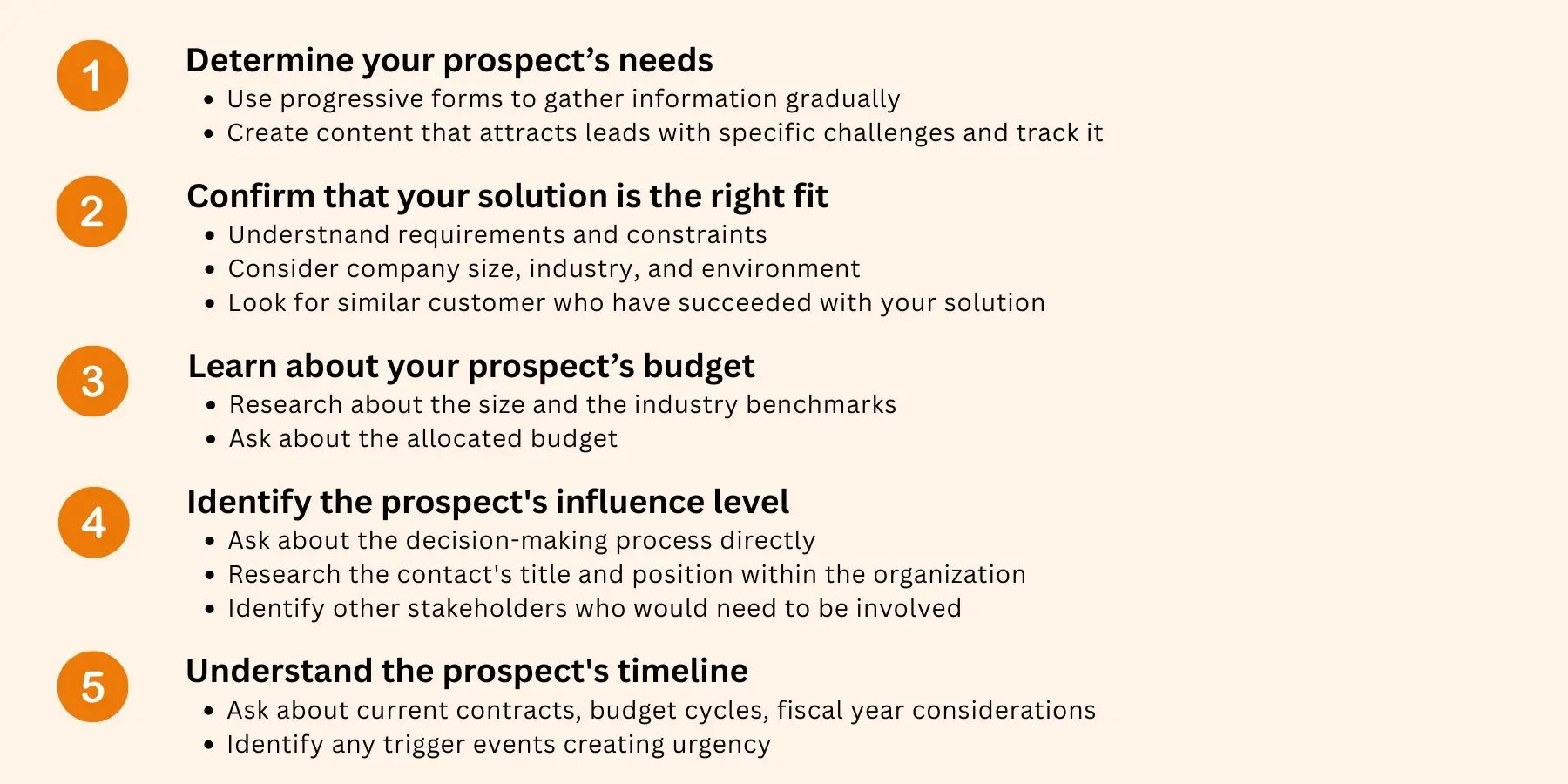
1. Determine what the prospect needs
The first thing to do in B2B sales qualification is understanding whether your prospect has a genuine need for your solution. Many leads may enter your system without actually requiring what you offer—they might be researching for future projects or simply gathering information. So, do the following:
- Use progressive forms to gather information gradually
- Create content that attracts leads with specific challenges
- Ask targeted questions during initial conversations
- Look for behavioral signals indicating specific pain points
- Track engagement with problem-specific content
If a prospect doesn't yet have a need for what you're selling, they shouldn't move forward in your sales process yet. So, no need to go for it.
2. Confirm that your solution is the right fit
After you've established that a lead has a relevant need, you should understand whether your solution is the right fit for their situation. There's many cases where people might misunderstand what your company actually does, which could lead to lost time. To assess fit:
- Understand the specific requirements and constraints
- Consider company size, industry, and technical environment
- Evaluate whether your solution integrates with existing systems
- Identify which version or package would be most appropriate
- Look for similar customers who have succeeded with your solution
3. Evaluate the prospect's budget
It's very important to do some budget considerations. No matter how perfect the fit, if a prospect cannot afford your solution, they're not really a qualified lead for your sales team to go for. If you want to qualify budget effectively, try do these:
- Research company size and industry benchmarks
- Look for funding announcements or financial information
- Ask about allocated budget for solving the specific problem
- Discuss ROI expectations and timelines
- Determine whether there's flexibility for the right solution
Understanding budget constraints early helps sales teams focus on deals that have a realistic chance of closing.
4. Identify the prospect's influence level
In B2B sales, particularly for complex solutions, multiple stakeholders are typically involved in purchasing decisions. Identifying whether your contact has decision-making authority or influence is crucial for effective qualification. To determine this influence level:
- Ask about the decision-making process directly
- Research the contact's title and position within the organization
- Look for signals that indicate authority (or lack thereof)
- Identify other stakeholders who would need to be involved
- Understand the typical buying process for similar solutions
A lead with high influence or direct decision-making authority is generally more valuable than one who has limited input into purchasing decisions.
5. Understand the prospect's timeline
The final step in the B2B lead qualification process is more about understanding when the prospect plans to implement a solution. This helps sales teams prioritize opportunities based on urgency. Among the interesting leads, some need you now, some in just one month. That should count. Assess timeline this way:
- Ask about current contracts with existing providers
- Identify any trigger events creating urgency
- Understand budget cycles and fiscal year considerations
- Determine whether there are fixed deadlines for implementation
- Assess the impact of delaying a decision
Leads with immediate needs should receive priority attention, while those with longer timelines might require nurturing before being handed to sales.
Using frameworks for B2B lead qualification
It's common to see sales teams using established frameworks to standardize their qualification process. We'll cover the three most popular, so you might want to use one of them in your business.
The BANT framework
Developed by IBM, BANT stands for Budget, Authority, Need, and Timeline. This straightforward framework addresses the fundamental qualification criteria:
- Budget: Can they afford your solution?
- Authority: Do they have decision-making power?
- Need: Do they have a problem you can solve?
- Timeline: When do they plan to implement a solution?
BANT is simple to implement but may not capture the complexity of modern B2B buying processes where decisions often involve multiple stakeholders.
The MEDDIC framework
MEDDIC provides a more detailed qualification approach:
- Metrics: What specific metrics will improve with your solution?
- Economic Buyer: Who controls the budget?
- Decision Criteria: What factors will influence the decision?
- Decision Process: How will the decision be made?
- Identify Pain: What specific challenges are they facing?
- Champion: Who will advocate for your solution internally?
This framework works well for complex enterprise sales with longer cycles and multiple stakeholders.
The CHAMP framework
CHAMP reverses BANT's priorities to focus first on the prospect's challenges:
- Challenges: What problems are they trying to solve?
- Authority: Who makes the purchasing decision?
- Money: Is there budget allocated for a solution?
- Prioritization: How important is solving this problem?
This customer-centric approach often resonates better with today's buyers who expect solutions tailored to their specific needs.
Conclusion
Summing things up, any ambitious business that wants to grow should learn how to generate B2B leads and properly qualify them. If you implement some of the strategies outlined in this guide, you'll have more chances to fill your pipeline with higher-quality opportunities. But let's not forget—you shouldn't be counting as many B2B leads as possible, as you want to identify the prospects with the highest potential value. When done right, qualification improves experiences for both your team and your potential customers. It ensures good fit and alignment from the start, and you optimize resources (and time!).
Start by evaluating your current lead generation and qualification processes against the frameworks and strategies we've discussed. Identify the areas for improvement, implement changes methodically, and continuously measure results to refine your approach over time.
With Zeeg's scheduling capabilities integrated into your workflow, you can further streamline how your team connects with potential clients, making the entire qualification process more efficient and effective.
Sources:
Zeeg is Europe's leading AI voice agent and appointment scheduling software in one solution — GDPR-compliant, made in Germany. Start for free →