Retell AI Pricing: Usage Costs, What's Included and What Isn't


Retell AI pricing follows a consumption-based model: you pay per minute of call time rather than a flat monthly fee. But the base rate is rarely the full picture, and what's included versus what costs extra is worth knowing before you commit.
This guide breaks down every cost layer, explains what's included, and shows how Zeeg, Europe's leading AI phone assistant and scheduling software in one solution, GDPR-compliant and made in Germany, compares as an alternative.
What is Retell AI?
Retell AI is a developer-oriented platform for building and deploying AI voice agents. The platform provides the infrastructure to create phone-based AI assistants — agents that handle inbound calls, conduct outbound campaigns, qualify leads, and take action in real time. The pitch is flexibility: Retell gives technical teams the building blocks to construct a voice agent that fits their specific workflow, rather than a rigid template you adapt around.
That developer-first orientation is relevant when understanding the pricing. Unlike no-code platforms where the cost structure is designed for business operators, Retell is built for teams with technical resources who want control over every layer of the stack — which LLM powers the agent, which voice provider handles synthesis, and how telephony is routed. Each of those choices carries its own cost.
Worth noting upfront: Retell AI is primarily a voice infrastructure layer. It handles the conversation well, but for full-cycle workflows — booking meetings, logging contacts, syncing with a CRM — you'll need to connect it to other tools. That integration overhead has direct implications for total cost, which we'll get into further on.
Adopting AI voice agents for business operations is accelerating fast. According to Gartner, conversational AI is projected to reduce contact center labor costs by $80 billion in 2026.² And with 80% of businesses planning to integrate AI-driven voice technology into customer service by 2026, choosing the right pricing model matters more than it might have even a year ago.³
How Retell AI pricing works
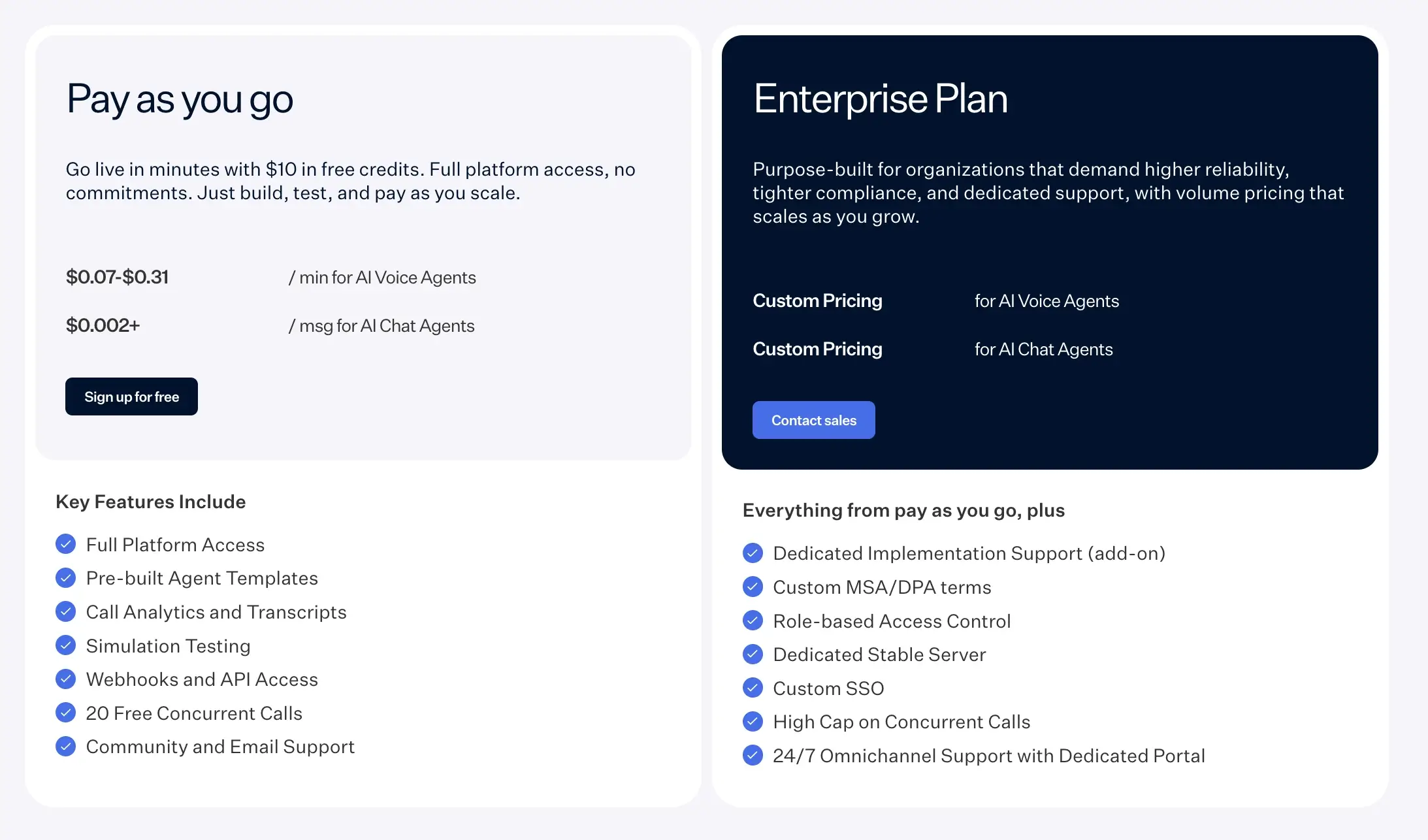
Retell AI operates on a pay-as-you-go model. There's no mandatory monthly subscription to get started; instead, you pay for what you use, and the bill is a sum of separate cost components that depend on how you've configured your agent.¹ And then, there's also te Enterprise plan, which is custom-made.
But essentially, the pricing has three primary layers:
- The Retell voice engine rate — what Retell charges for speech-to-text, orchestration, and voice output
- LLM costs — the underlying language model that powers the agent's reasoning
- Telephony — the phone infrastructure to route calls in and out
What makes the Retell AI pricing model more complex than it first appears is that each of these layers is billed separately, and your choices within each layer meaningfully change the final cost. A lean configuration can run significantly cheaper per minute than a premium setup. Let's look at each in turn.
Breaking down the Retell AI costs
The voice engine rate
Retell charges $0.07 per minute as its base voice engine rate.¹ This covers the conversation layer — speech-to-text processing, real-time response latency management, and the text-to-speech output. Some configurations using ElevenLabs or OpenAI as the voice provider may run at $0.08/min instead, depending on how the voice is processed.¹ The rate applies to both inbound and outbound calls, regardless of what other components you layer on top.
This base rate is among the more competitive in the AI voice agent pricing landscape — lower than several comparable platforms. But it doesn't include the LLM or telephony, so the effective per-minute cost will always be higher once everything is factored in.
LLM costs
The language model gives your agent its reasoning ability — how it understands what a caller says and decides how to respond. Retell lets you choose from several models, each priced differently:¹
- GPT-5 nano / lightweight models — approximately $0.003/min. The most cost-efficient option, suited to simple, predictable call flows.
- Mid-range models (e.g. GPT-4o mini) — approximately $0.01–$0.02/min. A reasonable balance between cost and capability.
- Advanced models (e.g. GPT-4o, Claude 3.7 Sonnet) — approximately $0.04–$0.06/min. Better reasoning for complex or unpredictable conversations.
- Claude 4.5 Sonnet — approximately $0.08/min. The most capable option at the highest per-minute rate.¹
- Bring Your Own LLM — connect your own model via custom integration, in which case LLM costs are handled entirely outside Retell.
The spread here is significant. There's a 26x difference between the cheapest and most expensive LLM options.¹ For most standard use cases — appointment booking, basic lead qualification, FAQ handling — lighter models are genuinely adequate. Higher-end models earn their cost when the conversation needs to handle objections, nuanced qualification, or multi-step reasoning.
Telephony costs
Getting calls in and out requires a phone number and routing infrastructure. Retell handles telephony through Twilio by default, though you can bring your own Twilio account or use a third-party SIP trunk.
- Retell-managed Twilio — $0.015/min, plus a phone number rental fee of $2/month per number¹
- Bring Your Own Twilio — your Twilio account is billed directly at Twilio's rates; this cost line disappears from your Retell bill
- SIP trunking — possible for teams with existing telephony infrastructure¹
If you're starting from scratch without existing telephony, the managed Twilio route is the simplest path. It adds a modest per-minute cost but removes the need to configure a separate Twilio account. International calls are billed separately at higher rates that vary by destination — $0.03–$0.80/min depending on the country — a factor worth flagging for businesses with a global customer base.¹
What your per-minute cost looks like
Adding all layers together gives a clearer picture of real-world call costs. Here are four representative configurations:
To put that in practical terms: a typical 6-minute inbound call on a standard setup (mid-range LLM, managed Twilio) costs roughly $0.78–$0.84. For a business handling 400 calls per month at that average length, the monthly call cost lands between $312 and $336 — and that's before add-ons or integrations.
Users who have reported their actual spend confirm that realistic production costs tend to land in the $0.11–$0.15/min range for standard setups, which is 30–60% above the advertised $0.07 base rate.⁴
What's included in the Retell AI plan
The pay-as-you-go access covers:
- Unlimited AI agents (no cap on how many agents you configure)
- Access to the Retell dashboard and agent builder
- Pre-built templates for common use cases
- API access for custom integrations
- Call logs and basic analytics
- Webhook support for triggering external actions
- 20 free concurrent calls included on all accounts¹
There's no seat-based charge or monthly platform fee on standard pay-as-you-go usage. You create an account, receive $10 in free starting credits, and start building. For developer teams evaluating the platform, that low barrier to entry is a genuine advantage.
Additional concurrent call capacity beyond the 20 included slots costs $8 per slot per month, which can be added or removed at any time.¹ For high-volume operations that need to handle many simultaneous calls, this is a real line item to plan for.
What isn't included — and where costs stack up
This is where the Retell AI pricing picture gets more complete. Several essential components of a real-world voice workflow aren't included in the base rate.
CRM and contact logging. Retell doesn't have a native CRM. Call outcomes, caller details, and transcript data need to be pushed to an external system — Salesforce, HubSpot, or similar. That means paying for a separate CRM subscription and maintaining the integration.
Calendar booking. If the goal of your voice agent is to schedule meetings, Retell doesn't handle booking natively. You'd connect it to a scheduling tool via webhook or API, and that tool carries its own subscription cost. Read more about AI scheduling assistants that handle booking directly.
Automation middleware. Connecting Retell to a CRM and a booking tool typically requires a workflow automation layer — Zapier, Make, or custom API logic. For non-developer teams, Zapier plans run $20–$50/month depending on task volume.
Concurrent call capacity. While 20 concurrent calls are included, operations that need dozens of simultaneous calls will need to purchase additional slots at $8/month each, and high-volume scenarios require an Enterprise conversation.¹
Knowledge bases. The plan includes 10 free knowledge base documents. Additional ones cost $8/month each, which adds up if your agents need access to extensive reference material.¹
Enterprise features. Dedicated support, SLA guarantees, custom compliance requirements, and SSO are not available on self-serve plans. Retell's Enterprise plan starts at $8,000, and includes fully managed agent setup, a premium private Slack channel, and dedicated support.¹
None of these limitations are hidden exactly, but the "no platform fee" framing can give a misleading impression of the full cost. For a business building a real calling workflow from scratch — voice agent, CRM, booking, and automation — the realistic monthly spend is meaningfully higher than the call minutes alone.
Is Retell AI pricing worth it?
For the right team, yes. The pay-as-you-go model works well for developer teams building custom voice workflows who want API-level control, businesses with variable or unpredictable call volumes where a fixed monthly fee doesn't make sense, and operations that already have CRM and booking infrastructure in place and just need a voice layer on top.
The picture gets harder to justify for small to mid-sized businesses that need a complete workflow — voice agent, meeting booking, and contact logging — without existing tools to connect. By the time you've added the call costs, a CRM subscription, a booking tool, and Zapier to bridge them, a fully loaded monthly bill for even moderate call volumes can climb to $300–500 or higher.
That raises a fair question: is there an alternative that bundles more of these pieces under one cost? For teams whose goal is to turn calls into confirmed meetings, the answer is yes.
Zeeg: AI voice agents with scheduling
Zeeg is a platform for AI voice agents and advanced appointment scheduling. Rather than assembling a voice layer and a booking tool, everything is in one place — one subscription, one interface, one system where all call and booking data lives.
What Zeeg's AI voice agents do
Zeeg AI voice agents handle both inbound and outbound calls through a fully conversational voice dialogue — not a phone tree. The agent listens to the caller, understands their intent, captures their details (name, email, company, and any custom fields you define), applies routing rules you've set in plain language, and books the right meeting directly into the calendar. The call transcript, contact profile, and booking outcome land automatically in the database, with no Zapier, no manual steps, and no separate booking tool required.
Setup works through a prompt-based builder: describe how the agent should behave, choose from templates (Appointment Booker, Sales Qualifier, Support Callback), set the language and voice, define routing rules, and test from your browser before going live. Most setups are ready in under an hour. You can keep your existing phone number by importing it via SIP, or buy a local number directly in the platform.
This kind of AI phone answering approach is gaining serious traction: over a third of small and medium businesses now credit automation with meaningfully improving their customer service capabilities.⁵ The difference with Zeeg is that the booking doesn't require a follow-up step — it happens during the call.
Zeeg pricing
There's two main ways to use Zeeg, and therefore two pricing models:
1. Zeeg's scheduling plans:
- Starter — Free forever. A solid entry point with no credit card required.
- Professional — $10/user/month (billed annually) or $12/month billed monthly. AI agents are available from this plan onwards, alongside advanced scheduling, multiple calendar connections, and custom branding.
- Business — $16/user/month (billed annually) or $20/month billed monthly. Adds team scheduling, round-robin distribution, routing forms, and analytics — the right tier for teams that need collaborative scheduling alongside AI calling.
- Scale — $30/user/month (billed annually) or $40/month billed monthly. For organizations with higher call volumes and more complex routing requirements.
2. Voice minutes work on an independent per minute pricing model:
Read more about Zeeg AI voice agents and how they compare to standalone calling tools.
Retell AI vs. Zeeg: How they compare
The honest comparison between Retell AI and Zeeg comes down to what you're trying to build and what technical resources you have available.
Retell AI gives you more flexibility at the infrastructure level. You choose your LLM, your voice provider, your telephony setup. For teams that want to build custom call logic, integrate with niche systems, or want control over every configuration choice, that modularity is genuinely valuable. The tradeoff is complexity and the need to assemble a complete workflow yourself. As one analysis put it, Retell AI doesn't sell a finished car — it sells the engine, wheels, and chassis separately.⁴
Zeeg takes a different approach: the agent, the booking system, and the contact management are all together. Less configuration flexibility at the infrastructure level, but the core use case — taking a call, qualifying a lead, booking a meeting and logging that info into the system — is ready out of the box. For businesses whose goal is turning calls into confirmed meetings without building infrastructure, Zeeg's model is more direct.
If you're evaluating a broader set of developer-oriented voice platforms, Vapi AI pricing follows a similar modular model worth understanding alongside Retell.
Retell AI and other alternatives
Retell sits in a competitive field of AI voice agent platforms, each with different pricing approaches:
Vapi AI is the closest peer to Retell in terms of audience and architecture. Also developer-first, also modular, Vapi's orchestration layer starts at $0.05/min — lower than Retell's base, but with the same stacking dynamic across LLM, TTS, STT, and telephony. Non-technical users face similar setup challenges to Retell. Read more on the Vapi AI review, why Zeeg is a great alternative to Vapi, or about other Vapi alternatives.
Synthflow AI takes the opposite approach: a no-code builder with a higher base rate ($0.09/min for the voice engine) but bundled LLM costs. The tradeoff is accessibility over granularity. Read more on Synthflow AI.
Bland AI uses plan-based pricing with monthly fees plus per-minute rates. More predictable than Retell's component model, though still developer-oriented.
What people are saying about Retell AI pricing
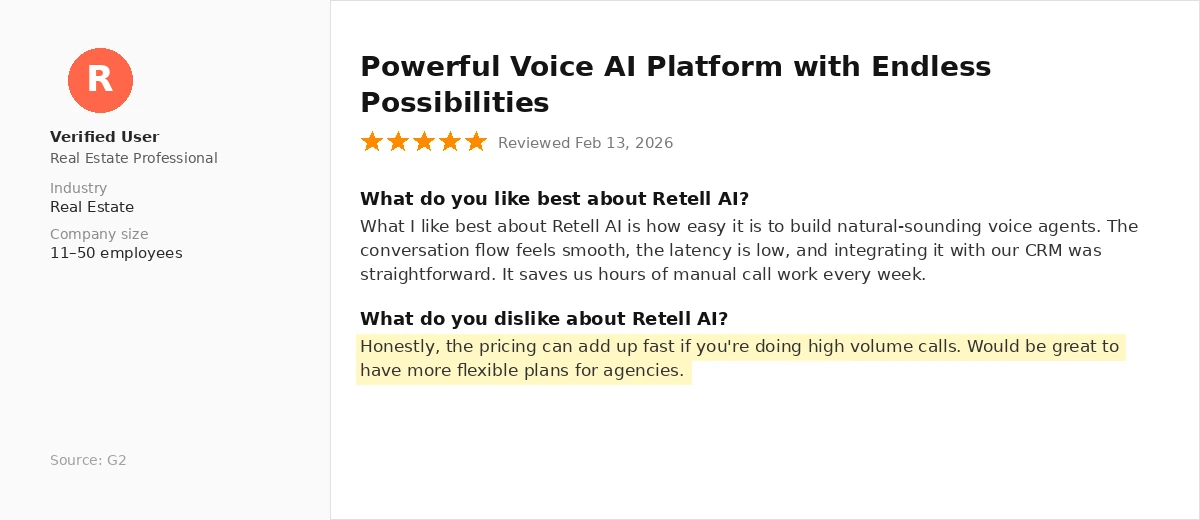
Public reviews on G2 closely mirror the cost breakdown covered above. Across nearly 2,000 verified Retell AI ratings, two themes come up repeatedly when users discuss what they actually pay — and both reflect the layered model we walked through earlier.
High-volume usage drives bills up quickly
The most common pricing complaint is that real spend ramps up faster than the headline rate suggests. Several reviewers flag that the per-minute number looks fine on paper, but actual bills land much higher once the LLM, voice provider, and Twilio minutes are factored in. Agencies and high-volume operators feel this pinch the most, and many ask for more flexible plans that account for production-level traffic.
Forecasting end-to-end spend lacks transparency
A second theme shows up across reviews from technical builders running multi-client setups or production deployments: predicting Retell AI costs at scale takes real effort. Reviewers ask for clearer breakdowns and more visibility across the stack — LLM, voice, and telephony — so they can plan budgets without surprises.

For teams without a dedicated engineer watching usage closely, this opacity around end-to-end cost can become a real source of friction over time. It's also one of the main reasons some operators end up looking at all-in-one alternatives where a single per-minute rate covers every layer of the stack.
Who is Retell AI actually for?
Based on the pricing structure and platform design, Retell AI makes the most sense for organizations with developer resources, where engineering can handle the integration work between the voice layer, a CRM, a booking tool, and any automation logic. It's also a reasonable fit for businesses that need the kind of fine-grained model and provider control that Retell's modular architecture enables.
For small teams and operations groups without a technical setup lead, that overhead is real. And for anyone building toward the same end goal — answer calls, qualify leads, book meetings — a platform that handles all three layers natively will save substantial time and, once the full stack is costed out, likely money too.
If you're still evaluating options, the AI voice agents pricing guide covers 11 platforms side by side, including Retell AI, and is a useful next step before committing.
Sources
Zeeg is Europe's leading AI voice agent and appointment scheduling software in one solution — GDPR-compliant, made in Germany. Start for free →
Frequently Asked Questions
Can I bring my own LLM to Retell AI?
Yes. Retell supports custom LLM integration, so teams with existing model infrastructure can connect their own rather than using one of the default options.
How does Retell AI compare to Zeeg?
Retell AI is modular voice infrastructure — flexible but requiring assembly. Zeeg combines voice AI, scheduling, and CRM in one platform. For teams focused on call-to-booking workflows, Zeeg's all-in-one model typically requires less setup and may cost less once the full toolstack is compared.
Is Retell AI good for non-technical teams?
Retell AI is built for developers and technical teams who want infrastructure-level control. Non-technical users may find the setup process more demanding than platforms with a no-code interface.
How many concurrent calls does Retell AI support?
All accounts include 20 free concurrent calls. Additional capacity costs $8 per concurrent call slot per month, with Enterprise plans offering custom concurrency starting at 50+ calls.
What does Retell AI not include?
The base pricing doesn't include a CRM, native calendar booking, or automation middleware. Teams that need a complete booking and contact management workflow will need to integrate and pay for separate tools.
Does Retell AI have a free plan?
Retell AI offers $10 in free starting credits with no platform fee or monthly commitment. Full production usage requires purchasing additional credits on the pay-as-you-go model.
How much does Retell AI cost per minute?
Retell AI's voice engine rate is $0.07–$0.08/min. Once LLM and telephony are added, realistic production costs typically land between $0.11 and $0.15/min for standard setups. Premium configurations using advanced LLMs and ElevenLabs voices can run higher.