The 12 Best AI Voice Agents for Meeting Scheduling in 2026


Managing appointment scheduling through phone calls drains hours that could go toward more valuable work. AI voice agents for meeting scheduling solve this by handling phone conversations autonomously, answering calls around the clock, understanding natural speech, and booking appointments directly into your calendar without human intervention.
This guide compares the top platforms in this space, including Zeeg, Europe's leading AI voice agent and appointment booking software in one solution, GDPR-compliant and made in Germany. Its native calling and built-in contact management features turn every conversation into a booked appointment. We'll look at capabilities, pricing, and best use cases for each.
Zeeg's AI Agent answers and makes calls, qualifies leads, and books meetings automatically — with your phone number, your routing rules, whichever meeting scenario. Try it free for 14 days.
Book demo nowWhat is an AI voice agent for meeting scheduling?
Before we get into the tools right away, let’s first understand what an AI voice agent for meeting scheduling actually is. In simple words, AI voice agent for meeting scheduling is software that can conduct phone conversations to book, reschedule, or cancel appointments without human involvement. Unlike simple IVR systems that force callers through menu trees, these AI agents use natural language processing to understand spoken requests and respond conversationally.
The technology combines several AI capabilities: speech recognition to convert caller audio into text, natural language understanding to comprehend scheduling intent, decision logic to check availability and book appointments, and speech synthesis to respond naturally. The best systems can handle interruptions, unclear speech, accents, and the conversational back-and-forth that happens in real scheduling calls.
For businesses, this means incoming scheduling calls get answered immediately (even outside business hours) with appointments booked directly into calendars. The AI voice agent can access your availability, ask qualification questions, handle common objections, and confirm details without tying up staff on repetitive phone conversations. That out-of-hours window is where much of the demand sits: in Zeeg's data, a third of meetings are booked when the office is closed.
Before we get into it, feel free to check out our other articles on the topic of AI in general:
- The 10 Best AI Meeting Note Takers
- How AI Call Centers Are Changing Customer Service
- How to Use AI for Phone Answering
AI voice agents for meeting scheduling: Overview
Top 12 AI voice agents for meeting scheduling
1. Zeeg: The only scheduling tool with native AI voice agents
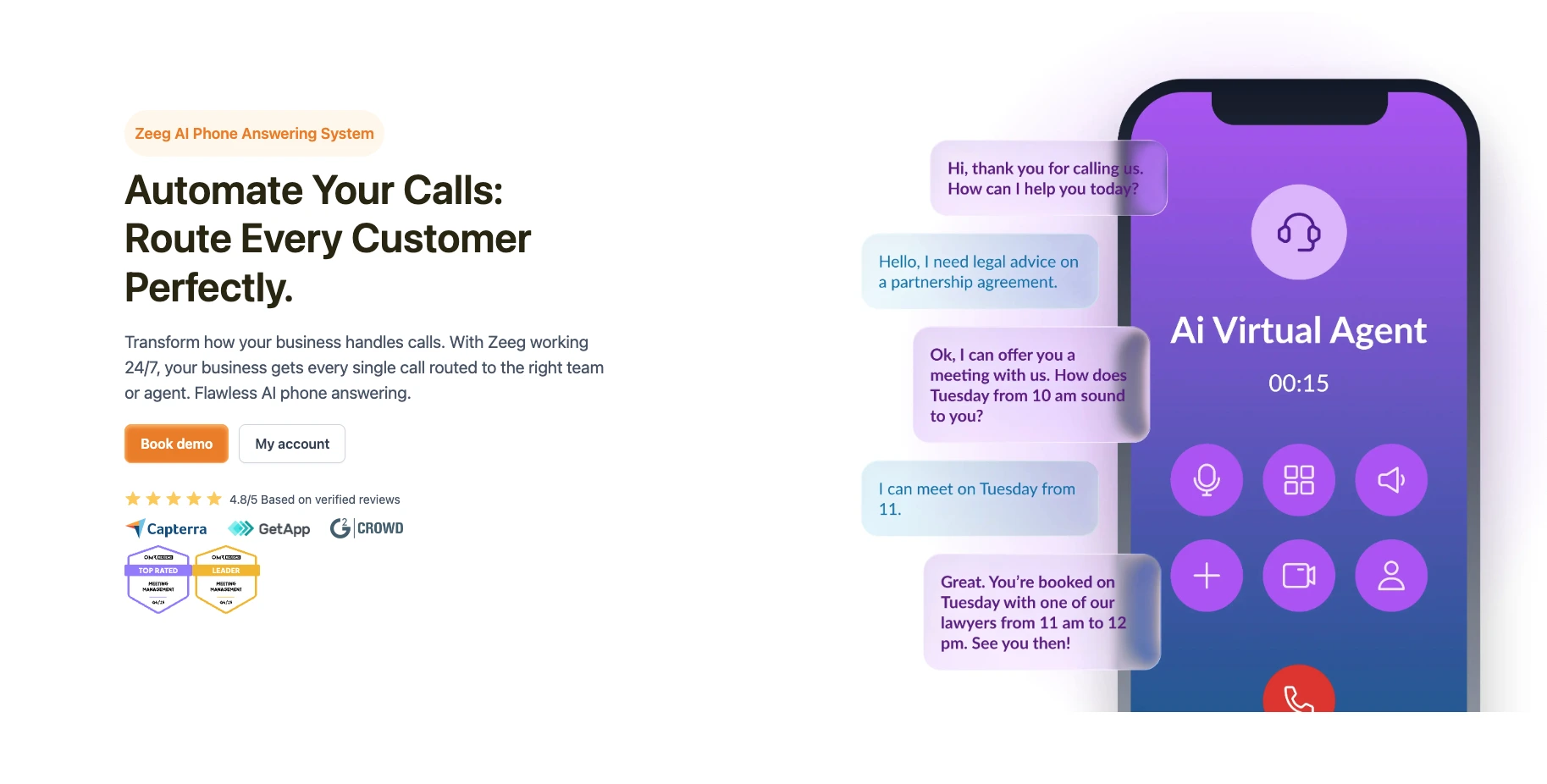
Zeeg is the only appointment booking platform with a voice AI agent built natively into the product — no Zapier, no third-party calling tool. The AI handles both inbound and outbound calls, books the meeting, and logs everything directly into Zeeg's system without any human involvement.
Key features
- Inbound and outbound calling — On inbound, the AI agent answers every call with a real back-and-forth conversation, not a press-1 phone tree. On outbound, it proactively calls leads to qualify them and book meetings before they go cold.
- Smart qualification and routing — The agent captures name, email, company type, and custom data during the call, then routes to the right meeting type or team member based on what the caller actually says. You define routing rules in plain language: "If the caller mentions being a new client, book an Onboarding call." No code required.
- Handles complex team scenarios — Beyond one-on-one booking, Zeeg supports round-robin distribution across your team, collective meetings with multiple hosts, and group sessions with several participants. Think sales calls requiring both an AE and a solutions engineer, full-team onboardings, or multi-attendee workshops — all booked automatically during the call.
- Phone number flexibility — Buy a new local number directly inside Zeeg (German numbers from €1.15/month) or import your existing business number via SIP trunk, so there's no disruption to your current setup.
- Built-in contact database and call records — Every call is logged with a full transcript, AI reasoning annotations, and the exact cost in credits. Person profiles are automatically created or updated after each call.
- Full calendar integration — Direct integration with Google Calendar, Apple Calendar, and Microsoft Exchange ensures appointments sync immediately without conflicts.
Pros and cons
✓ Only platform where voice AI, scheduling, and contact management are fully native — no integrations needed
✓ Works both ways — answers incoming calls and proactively calls leads
✓ Callers have a real conversation, not a menu system
✓ Handles complex team routing, round-robin, and multi-host meetings
✓ No code, no developers, live in minutes
✓ Predictable flat subscription plus transparent per-call credits
✓ GDPR-compliant European hosting — a rare advantage in this category
✓ Phone number stays yours — import via SIP or get a new local number instantly
✓ Setup in minutes — Write a prompt or choose a template (Appointment Booker, Sales Qualifier, Support Callback), pick a number, set your routing rules, test the agent from the browser, and go live.
✗ Newer to voice AI than specialist-only platforms
Pricing¹
Zeeg's pricing covers scheduling, contact management and the AI voice agent, with a 14-day free trial. Scheduling plans, billed annually:
- Starter — free forever, with core scheduling, unlimited events and video conferencing integration
- Professional — €10/user/month, adding API and webhooks, CRM essentials and workflows
- Business — €16/user/month, adding round-robin distribution, CRM integrations and routing forms
- Scale — €30/user/month, adding custom objects, SSO and SCIM, and priority support
- Enterprise — custom pricing, with flexible invoicing and a dedicated account manager
The AI voice agent is billed as its own monthly minute package, separate from the scheduling plans and available without one. Packages start at €49/month billed annually — up to 250 inbound minutes (≈ €0.196/min) and 179 outbound minutes (≈ €0.274/min) — and scale to 9,000 inbound minutes at ≈ €0.111/min. Annual billing keeps the per-minute rate lower, and every call shows its exact cost in the dashboard.
Zeeg's AI Agent answers and makes calls, qualifies leads, and books meetings automatically — with your phone number, your routing rules, whichever meeting scenario. Try it free for 14 days.
Book demo now2. Bland AI: Best for custom voice scheduling workflows

Moving forward, Bland AI offers a developer-friendly platform for building AI voice agents that can handle appointment scheduling conversations. The service provides the infrastructure for voice interactions to let you create custom scheduling flows tailored to your specific business requirements.
Key features
API-first architecture - Bland AI provides RESTful APIs that let developers integrate voice calling capabilities into existing scheduling systems.
Custom conversation design - Build scheduling conversations exactly how you want them, with complete control over what questions the AI asks, how it handles edge cases, and when it escalates to humans.
Real-time calendar checking - Connect the voice agent to your calendar API so it can check actual availability during calls and book appointments immediately without callbacks.
Outbound calling - Beyond answering incoming scheduling requests, Bland AI can proactively call leads or customers to book appointments, handle reminders, or confirm existing meetings.
Call recording and transcription - Every scheduling conversation gets recorded and transcribed, giving you a record of what was discussed and agreed upon during the booking.
Webhook integration - Configure webhooks that trigger when appointments are booked, modified, or cancelled, keeping your CRM and other systems synchronized automatically.
Multiple voice options - Choose from various AI voices to match your brand, from professional and formal to casual and friendly depending on your audience.
Bland AI appeals to businesses that need scheduling voice agents tailored to specific workflows rather than generic solutions. If you have particular qualification questions, complex availability rules, or integration requirements, Bland AI's flexibility lets you build exactly what you need.
The platform's per-minute pricing means costs scale directly with usage, making it economical for businesses with moderate call volumes while potentially expensive for high-traffic scenarios.
Pros and cons
✓ Highly customizable conversation flows
✓ Strong API documentation
✓ Outbound calling capability
✓ Pay-per-minute pricing
✓ Call recording included
✓ Fast setup for developers
✓ Good for MVP testing
✗ Requires technical expertise
✗ No pre-built scheduling templates
✗ Costs increase with call volume
✗ Limited non-technical support
✗ Conversation design is manual
Pricing²
Bland AI charges $0.09 per minute for voice calls, with no monthly platform fee. This usage-based model works well for businesses starting with voice AI or those with unpredictable call volumes. A business handling 100 hours of scheduling calls monthly would pay approximately $540, making per-minute pricing competitive for moderate usage.
3. Synthflow: Best no-code AI voice agent builder

Next up, Synthflow provides a visual interface for creating AI voice agents without writing code. The platform's drag-and-drop conversation builder lets non-technical users design scheduling workflows, making voice automation accessible to small businesses without development resources.
Key features
Visual workflow builder - Design conversation flows using a graphical interface where you drag and drop elements like questions, calendar checks, and appointment confirmations.
Pre-built scheduling templates - Start with templates designed specifically for appointment booking, then customize them to match your business rather than building from scratch.
Calendar integration - Connect directly to Google Calendar or Outlook, letting the voice agent check availability and create appointments during calls without additional development.
Lead qualification - Configure questions that qualify callers before booking, ensuring the voice agent collects necessary information and routes appropriately.
SMS confirmations - Automatically send text message confirmations after the voice agent books appointments, reducing no-shows without manual follow-up.
Call analytics - Track metrics like booking rate, call duration, and common caller questions to optimize your voice agent's performance over time.
Voice customization - Choose from available AI voices and adjust speaking speed, tone, and other characteristics to match your brand personality.
Synthflow makes voice AI accessible to businesses that lack technical teams. The visual builder means marketing managers, office administrators, or small business owners can create functional scheduling voice agents without hiring developers or learning to code.
However, this simplicity comes with limitations in customization depth. Complex scheduling logic or unusual integration requirements may exceed what the no-code builder supports, requiring you to consider more flexible platforms.
Pros and cons
✓ No coding required
✓ Visual conversation builder
✓ Scheduling-specific templates
✓ Direct calendar integration
✓ SMS confirmations included
✓ Accessible to non-technical users
✓ Fixed monthly pricing
✗ Less flexible than code-based platforms
✗ Limited advanced customization
✗ Monthly fee plus call costs
✗ May not support complex workflows
✗ Smaller voice selection
Pricing³
Synthflow charges $29/month for their basic plan, which includes the visual builder and core features, plus per-minute call costs. Plans scale to $79/month and $199/month as you need more concurrent calls and advanced features. This combination of subscription and usage fees creates more predictable costs than pure per-minute platforms.
4. Fish Audio: Best for natural-sounding TTS in custom voice agent builds
Fish Audio provides the text-to-speech layer developers plug into voice agent stacks when voice quality and language coverage matter as much as call logic. Its current model, S2.1 Pro, focuses on how natural and expressive the agent sounds during a scheduling call rather than the scheduling logic itself.
Key features
- Low-latency streaming - ~90ms Time-to-First-Audio on the standard API, fast enough for natural turn-taking in live calls.
- 83-language coverage - one model handles all supported languages, no separate endpoints or per-language pricing.
- Emotion-tagged output - tags like [excited], [whispering], [sad] control tone and pacing for confirmations and rescheduling.
- 15-second voice cloning - clone a voice from a short reference sample for a consistent agent voice across channels.
- Open-weights foundation - built on Fish Audio's open-weights S2 model; commercial use requires a paid license.
- Free evaluation tier - S2.1 Pro is currently available via a free API tier under a fair use policy, useful for prototyping before committing budget.
Pros and cons
✓ ~90ms TTFA, suitable for real-time conversational use
✓ 83 languages on one model
✓ Fine-grained emotion control
✓ 15-second voice cloning
✓ Free API tier for evaluation
✗ Not a full voice agent platform, no built-in scheduling or call orchestration
✗ Commercial use of the open-weights model requires a paid license
Pricing⁴
API access runs about $15 per million characters. Subscription plans start free (7 min/month), Plus at $11/month (200 min), and Pro at $75/month (27 hours).
5. Vapi: Best for low-latency voice scheduling

Continuing on, Vapi focuses on creating voice AI experiences with minimal delay between when callers speak and when the AI responds. For appointment scheduling, this low latency creates more natural conversations where the voice agent feels responsive rather than sluggish.
Key features
Ultra-low latency - Vapi's infrastructure minimizes the delay between speech recognition, processing, and response generation, typically responding within 500-800 milliseconds for natural conversation flow.
Function calling - The voice agent can call functions in your scheduling system during conversations, checking availability or booking appointments in real-time as callers make requests.
Interruption handling - Vapi's agents can handle when callers interrupt mid-sentence, a common occurrence in natural scheduling conversations that simpler systems struggle with.
Custom knowledge base - Upload information about your services, pricing, and policies that the voice agent references when answering caller questions during the scheduling process.
Live call monitoring - Listen to ongoing voice agent calls in real-time through a dashboard, letting you understand how scheduling conversations are progressing.
Developer-friendly API - Clean, well-documented APIs make it straightforward for technical teams to integrate Vapi with existing scheduling and calendar systems.
Multiple language support - Configure voice agents that can conduct scheduling conversations in various languages, useful for businesses serving diverse communities.
Vapi's latency optimization creates noticeably more natural scheduling conversations. When callers ask "Do you have anything available Thursday morning?", a fast response feels conversational while a 2-3 second delay makes the interaction feel robotic and frustrating.
The platform targets developers building voice applications, providing infrastructure and tools rather than pre-built scheduling solutions. This means technical implementation is required but flexibility is high.
Pros and cons
✓ Very low response latency
✓ Natural conversation flow
✓ Handles interruptions well
✓ Strong function calling
✓ Developer-friendly
✓ Competitive per-minute pricing
✓ Live call monitoring
✗ Requires development work
✗ No no-code builder
✗ Less hand-holding for setup
✗ Learning curve for optimal configuration
✗ Costs scale with usage
Pricing⁵
Vapi charges $0.05 per minute for voice calls, making it one of the more affordable voice AI platforms. With no monthly platform fee, costs directly track usage. A business handling 100 hours of appointment scheduling calls would pay approximately $300 monthly, considerably less than higher-priced alternatives.
6. Air.ai: Best for complex scheduling conversations

Shifting our focus, Air.ai specializes in handling longer, more complex phone conversations that go beyond simple appointment booking. While other voice agents work best for straightforward scheduling, Air.ai can manage calls that involve detailed discussions, objection handling, and consultative selling alongside appointment setting.
Key features
Extended conversation handling - Air.ai's agents can maintain context through 30-40 minute calls, useful when scheduling appointments that require explaining services, answering detailed questions, or overcoming objections.
Autonomous decision-making - The AI makes judgment calls during conversations, deciding when to offer alternative times, when to transfer to humans, or how to handle unexpected caller requests.
Natural voice quality - Air.ai emphasizes voice naturalness, with agents that sound human rather than synthetic, creating better rapport during scheduling conversations.
CRM integration - Connect with customer relationship management systems so the voice agent has caller history and context when booking appointments, enabling more personalized interactions.
Appointment qualification - The AI can conduct discovery conversations to determine if callers are good fits before booking, saving time by pre-qualifying prospects through phone screening.
Follow-up orchestration - Beyond initial booking, Air.ai can handle reminder calls, rescheduling requests, and confirmation calls as part of complete appointment lifecycle management.
Performance analytics - Track conversion rates from call to booked appointment, identifying where scheduling conversations succeed or fail so you can optimize scripts.
Air.ai targets businesses where appointment scheduling involves meaningful sales conversations rather than simple logistics. If booking appointments requires explaining value propositions, handling concerns, or qualifying prospects, Air.ai's extended conversation capability becomes valuable.
However, this sophistication comes with enterprise-level pricing rather than accessible per-minute rates. Small businesses seeking basic appointment scheduling will find Air.ai's capabilities and costs exceed their needs.
Pros and cons
✓ Handles complex, long conversations
✓ Natural-sounding voices
✓ Good objection handling
✓ CRM integration
✓ Appointment qualification
✓ Complete lifecycle management
✓ Advanced analytics
✗ Custom pricing only
✗ Enterprise-focused
✗ Higher cost than simple solutions
✗ Overkill for basic scheduling
✗ Longer implementation time
Pricing⁶
Air.ai uses custom pricing based on call volume, complexity, and integration requirements. Businesses must contact their sales team for quotes. This approach suits larger organizations with substantial scheduling needs but creates barriers for small businesses seeking transparent costs.
7. Retell AI: Best for enterprise voice scheduling deployments

Moving along, Retell AI provides enterprise-grade infrastructure for voice AI applications, including appointment scheduling systems that need to handle high call volumes, strict security requirements, and complex integrations.
Key features
SOC 2 compliance - Retell AI maintains SOC 2 Type II certification, meeting security and privacy standards required by regulated industries and enterprise buyers.
High availability - The platform's infrastructure ensures voice agents remain available even during traffic spikes, preventing dropped scheduling calls during busy periods.
Advanced telephony - Support for features like call transfer, conference calling, and voicemail handling creates complete phone system functionality beyond simple scheduling conversations.
White-label capabilities - Retell AI can be branded as your own voice system, with custom phone numbers and caller ID that display your business information rather than a third-party platform.
Detailed logging - Comprehensive logs of every conversation, decision, and system action provide the audit trails enterprises require for compliance and quality assurance.
Priority support - Enterprise customers receive dedicated support channels with guaranteed response times, ensuring voice scheduling systems stay operational.
Custom model training - For specialized vocabularies or unique conversation patterns, Retell AI can train models on your specific data to improve scheduling conversation accuracy.
Retell AI serves organizations where voice scheduling is business-critical infrastructure rather than a convenience feature. If appointment scheduling downtime directly impacts revenue or if you operate in regulated industries, Retell AI's enterprise focus provides appropriate reliability and compliance.
The platform's pricing reflects this enterprise positioning, making it less suitable for small businesses or those testing voice AI for the first time.
Pros and cons
✓ SOC 2 certified
✓ High availability infrastructure
✓ Advanced telephony features
✓ White-label options
✓ Priority support
✓ Detailed logging
✓ Custom model training
✗ Enterprise pricing
✗ Per-minute costs at $0.10
✗ Complexity may exceed small business needs
✗ Longer sales and implementation process
✗ Minimum commitments likely
Pricing⁷
Retell AI charges $0.10 per minute for voice calls, positioning it at the higher end of per-minute platforms. Custom enterprise agreements may offer volume discounts. With infrastructure costs and enterprise features factored in, Retell AI makes sense for organizations handling thousands of scheduling calls monthly rather than smaller volumes.
8. PolyAI: Best for multilingual appointment scheduling

Pressing forward, PolyAI excels at creating voice agents that can conduct scheduling conversations in multiple languages with native-level fluency. For businesses serving diverse communities or operating internationally, PolyAI's multilingual capability becomes essential.
Key features
Multilingual conversations - PolyAI's voice agents can schedule appointments in over 40 languages, automatically detecting the caller's language and responding appropriately.
Accent handling - The system understands various accents within each language, preventing miscommunication when callers have regional speech patterns that confuse simpler voice AI.
Code-switching support - When callers mix languages mid-conversation (common in multilingual communities), PolyAI maintains comprehension and responds appropriately.
Cultural adaptation - Beyond translating words, PolyAI adapts conversation style to cultural norms around formality, directness, and politeness expectations.
24/7 availability - Voice agents can handle appointment scheduling calls around the clock across all time zones, useful for international businesses.
Industry customization - PolyAI builds voice agents customized for specific industries like healthcare, hospitality, or financial services, incorporating sector-appropriate terminology and workflows.
Analytics across languages - Track scheduling conversation performance separately for each language, identifying where voice agents succeed or struggle by language and accent.
PolyAI targets larger organizations with customer bases that speak multiple languages. Rather than forcing callers to navigate English menus or wait for bilingual staff, voice agents can immediately conduct scheduling conversations in the caller's preferred language.
The platform's focus on enterprise deployments means pricing and implementation reflect this scale, making it less accessible for small businesses.
Pros and cons
✓ 40+ languages supported
✓ Accent understanding
✓ Code-switching capability
✓ Cultural adaptation
✓ Industry-specific customization
✓ 24/7 multilingual coverage
✓ Per-language analytics
✗ Enterprise-focused pricing
✗ Custom implementation required
✗ Overkill for single-language businesses
✗ Longer setup time
✗ No transparent pricing
Pricing⁸
PolyAI uses custom pricing based on call volume, language requirements, and customization needs. Organizations must engage their sales process for quotes. This approach suits enterprises with substantial multilingual scheduling needs but creates barriers for smaller businesses.
9. Vocalize: Best for healthcare appointment scheduling

Transitioning to our next platform, Vocalize specializes specifically in healthcare appointment scheduling, providing voice AI agents that understand medical terminology, comply with healthcare regulations, and handle patient scheduling scenarios.
Key features
HIPAA compliance - Vocalize maintains HIPAA compliance for patient information, ensuring voice scheduling conversations meet healthcare privacy requirements.
Insurance verification - The voice agent can collect insurance information during scheduling calls, verifying coverage before booking appointments.
Symptom screening - For practices requiring it, voice agents can ask basic symptom questions to ensure callers book with appropriate providers or specialties.
Prescription refill coordination - Beyond just scheduling, Vocalize agents can handle prescription refill requests and coordinate those with appointment bookings.
EHR integration - Connect with electronic health record systems so appointments booked by voice agents flow directly into clinical workflows.
Appointment reminders - Automated voice calls remind patients about upcoming appointments, reducing no-shows that cost practices revenue.
After-hours coverage - Voice agents handle scheduling calls outside office hours, preventing patients from going to competitors when they can't reach your practice by phone.
Vocalize understands the specific challenges of medical practice scheduling: insurance complexity, provider specialization, urgent vs. routine appointments, and strict privacy requirements. Rather than adapting generic voice AI, Vocalize builds specifically for healthcare workflows.
This specialization makes Vocalize valuable for medical practices but irrelevant for businesses outside healthcare. The platform's features and pricing reflect this narrow focus.
Pros and cons
✓ HIPAA compliant
✓ Healthcare-specific features
✓ Insurance verification
✓ EHR integration
✓ Medical terminology understanding
✓ Appointment reminders included
✓ After-hours coverage
✗ Healthcare-only focus
✗ Custom pricing
✗ No use outside medical field
✗ Implementation requires EHR integration
✗ Limited flexibility
Pricing⁹
Vocalize uses custom pricing based on practice size, call volume, and integration requirements. Healthcare practices must contact sales for quotes. Given the specialized features and compliance requirements, pricing likely exceeds general-purpose voice AI platforms.
10. Cognigy: Best for omnichannel scheduling experiences

Shifting gears, Cognigy provides an AI platform that unifies voice, chat, and messaging channels, letting businesses create consistent appointment scheduling experiences whether customers call, text, or use web chat.
Key features
Omnichannel conversations - Cognigy's AI maintains context as scheduling conversations move between voice calls, web chat, SMS, and messaging apps like WhatsApp.
Contact center integration - Connect with existing call center infrastructure, letting voice AI handle routine scheduling while transferring complex cases to human agents.
Conversation analytics - Track scheduling interactions across all channels, understanding where automated booking succeeds or fails regardless of customer's chosen communication method.
Enterprise scalability - Cognigy's infrastructure handles high volumes across multiple channels simultaneously, supporting large organizations with diverse customer bases.
Workflow automation - Beyond scheduling, Cognigy can automate related workflows like sending confirmations, collecting payments, or triggering follow-up sequences.
Knowledge management - Maintain a central knowledge base that voice and chat agents both reference when answering questions about services, availability, or policies.
Compliance features - Tools for managing data privacy, call recording consent, and regulatory requirements across different jurisdictions and industries.
Cognigy suits larger organizations that need scheduling automation across multiple customer touchpoints. If some customers prefer calling while others want to text or chat, Cognigy ensures consistent scheduling experiences across all channels.
The platform's enterprise focus means implementation complexity and pricing reflect that scale rather than serving small businesses seeking simple voice scheduling.
Pros and cons
✓ Unified voice and digital channels
✓ Contact center integration
✓ Cross-channel analytics
✓ Enterprise scalability
✓ Workflow automation
✓ Central knowledge management
✓ Compliance tools
✗ Complex implementation
✗ Enterprise-oriented pricing
✗ Overkill for voice-only needs
✗ Longer setup time
✗ Requires technical resources
Pricing¹⁰
Cognigy uses custom enterprise pricing based on channels, volume, and features required. Organizations must engage their sales process for quotes. This approach makes sense for large deployments but creates barriers for businesses seeking simple voice scheduling solutions.
11. Thoughtly: Best for small business voice scheduling

Wrapping up our list, Thoughtly provides an accessible entry point for small businesses wanting to automate appointment scheduling through voice AI without enterprise complexity or costs.
Key features
Template-based setup - Thoughtly offers pre-built conversation templates for common scheduling scenarios, letting you launch voice agents quickly by filling in your specific details.
Simple calendar integration - Connect your Google Calendar or similar service through a straightforward setup process without requiring developers or complex API work.
Fixed monthly pricing - Unlike per-minute platforms where costs fluctuate, Thoughtly charges predictable monthly fees that include reasonable call volumes.
Phone number included - Get a dedicated phone number for your voice agent as part of the service, avoiding separate telephony setup.
Basic analytics - Track essential metrics like calls handled, appointments booked, and common caller questions without overwhelming complexity.
Email notifications - Receive alerts when the voice agent books appointments, encounters problems, or needs human intervention.
Live transfer capability - When voice agents can't handle scheduling requests, they transfer callers to your team rather than just hanging up.
Thoughtly targets small businesses that want voice scheduling automation without technical teams or large budgets. The template approach and fixed pricing create lower barriers to entry than developer-focused platforms.
However, this simplicity limits customization depth. Businesses with unique scheduling workflows or complex integration requirements may outgrow Thoughtly's capabilities as they scale.
Pros and cons
✓ Small business friendly
✓ Template-based setup
✓ Fixed monthly pricing
✓ Phone number included
✓ Simple calendar integration
✓ No per-minute charges
✓ Live transfer option
✗ Limited customization
✗ Basic feature set
✗ May not support complex workflows
✗ Smaller voice selection
✗ Less scalable for growth
Pricing¹¹
Thoughtly's entry plan starts at $99/month and includes a phone number, with call volume included up to a monthly allowance. This all-inclusive approach creates predictable costs that work well for small businesses with moderate scheduling call volumes. Additional plans at higher price points provide more call hours and advanced features as businesses grow.
12. CloudTalk: Best for automating high-volume calls and intelligent routing
Cloudtalk is a cloud-based AI call center software designed for sales and support teams. It combines AI voice agents with smart call routing, analytics, and CRM integrations to improve call efficiency, automate conversations, and scale globally.
Key features
AI Voice Agent - Handles inbound and outbound calls 24/7, automating conversations without needing human agents.
Smart Call Routing & IVR - Directs callers to the right agent or department based on rules like skills, language, or availability.
Global Phone Numbers - Provides local and international numbers across a wide range of countries to help businesses appear locally present.
Power & Parallel Dialers - Automates outbound calling to boost agent productivity and reduce idle time.
AI Transcription & Summaries - Converts calls into text, highlights key points, and creates automatic call summaries.
Real-Time Call Monitoring - Allows managers to listen, whisper coaching, or join calls to support agents live.
CRM & Helpdesk Integrations - Syncs with tools like Salesforce, HubSpot, and Zendesk for seamless workflow.
High Reliability & Uptime - Publishes an uptime service level agreement and secure infrastructure for uninterrupted operations.
Pros and cons
✓AI automation reduces manual workload
✓Strong global calling features
✓Easy CRM integrations
✓Good analytics and call insights
✓Reliable uptime and call quality
✗ AI minutes billed separately
✗ Initial setup may take a little time
✗ Can be complex to configure initially
✗ A few features may take learning to use fully
Pricing¹²
CloudTalk follows a custom and tiered pricing approach based on team size, call volume, feature requirements, and AI usage. Companies must contact sales for quotes, especially for AI Voice Agents and advanced tools.
💡 Want more insights? Check also out:
Choosing the right AI voice agent for meeting scheduling
Selecting the best AI voice agent for your appointment scheduling needs depends on what you need the tool to do.
For most businesses, the core requirement is simple: answer calls, qualify leads, and book meetings. No calls missed, no need to hire a receptionist, or to stitch tools together.
Zeeg is the only platform that handles all of that natively, with voice AI, scheduling, and contact management features built into one product. Set up takes minutes, no code is required, and your appointment booking works flawlessly for any type of scheduling rules you have.
But of course, the choice comes down to your specific constraints. Developer teams that need fully custom conversation flows will find a certain degree of flexibility in Bland AI or Vapi, whilst healthcare practices with HIPAA requirements should probably look at Vocalize. And businesses serving multilingual markets at enterprise scale could prefer PolyAI. And if you need scheduling automation across voice, chat, and messaging in a contact center environment, Cognigy also covers that ground.
Zeeg's AI Agent answers and makes calls, qualifies leads, and books meetings automatically — with your phone number, your routing rules, whichever meeting scenario. Try it free for 14 days.
Book demo now
Sources
Zeeg is Europe's leading AI voice agent and appointment scheduling software in one solution — GDPR-compliant, made in Germany. Start for free →
Frequently Asked Questions
Who should use an AI voice agent for scheduling?
Businesses with high call volumes for appointment booking — such as clinics, salons, law firms, and sales teams — benefit most from AI voice agents, since they cut wait times and free staff from repetitive scheduling calls while keeping availability accurate around the clock.
What makes Zeeg different from other AI voice agents?
Zeeg is Europe's leading AI phone assistant and appointment scheduling software in one solution — GDPR-compliant, made in Germany. Unlike standalone voice-AI tools, it combines native calling, smart routing, and a built-in CRM, so every phone conversation becomes a booked appointment and a tracked contact in one system.
Can AI voice agents handle both inbound and outbound scheduling calls?
Yes, leading platforms support both directions: answering inbound calls to book or reschedule appointments, and placing outbound calls to confirm bookings, send reminders, or follow up on missed appointments. Zeeg's AI voice agent handles both inbound and outbound calls alongside its built-in scheduling and CRM.
How much do AI voice agents for scheduling cost?
Pricing varies widely by platform and call volume, ranging from usage-based per-minute billing to flat monthly subscriptions per user. Most providers offer a free trial period, so it's worth testing call quality and booking accuracy with your own scripts before committing to a paid plan.
Are AI voice agents for scheduling GDPR-compliant?
Compliance varies by provider. Zeeg is Europe's leading AI phone assistant and appointment scheduling software in one solution — GDPR-compliant, made in Germany — with data hosted in the EU. Businesses handling caller data should confirm hosting location and data processing terms before choosing a platform.
How does an AI voice agent book appointments over the phone?
The agent answers or places a call, understands the caller's request through speech recognition and natural language processing, checks the connected calendar for open slots, and confirms a time directly with the caller. The appointment is then written straight into the calendar without any manual follow-up.
What is an AI voice agent for meeting scheduling?
An AI voice agent for meeting scheduling is software that conducts phone conversations to book, reschedule, or cancel appointments without human involvement. Unlike simple IVR menu systems, it uses natural language processing to understand spoken requests and respond conversationally, checking calendar availability and confirming bookings in real time.