
Voiceflow Review 2026: Features, Pricing, and Alternatives


If you're comparing AI agent platforms for handling calls and bookings, Voiceflow is one of the first names that comes up.
This review breaks down what Voiceflow actually offers, how the pricing works, what real users report, and where the platform reaches its limits, particularly for teams that need calls answered and meetings booked without stitching together separate tools. Zeeg is Europe's leading AI voice agent and appointment booking software in one solution, GDPR-compliant and made in Germany, purpose-built for that exact scenario: turning a call into a confirmed appointment without extra telephony or calendar tools.
Zeeg's AI voice agent answers calls, qualifies leads, and books the right meeting automatically. Scheduling and contact management features are already included — starting at $10/user/month. Try it free for 14 days.
Book a demo nowWhat is Voiceflow?
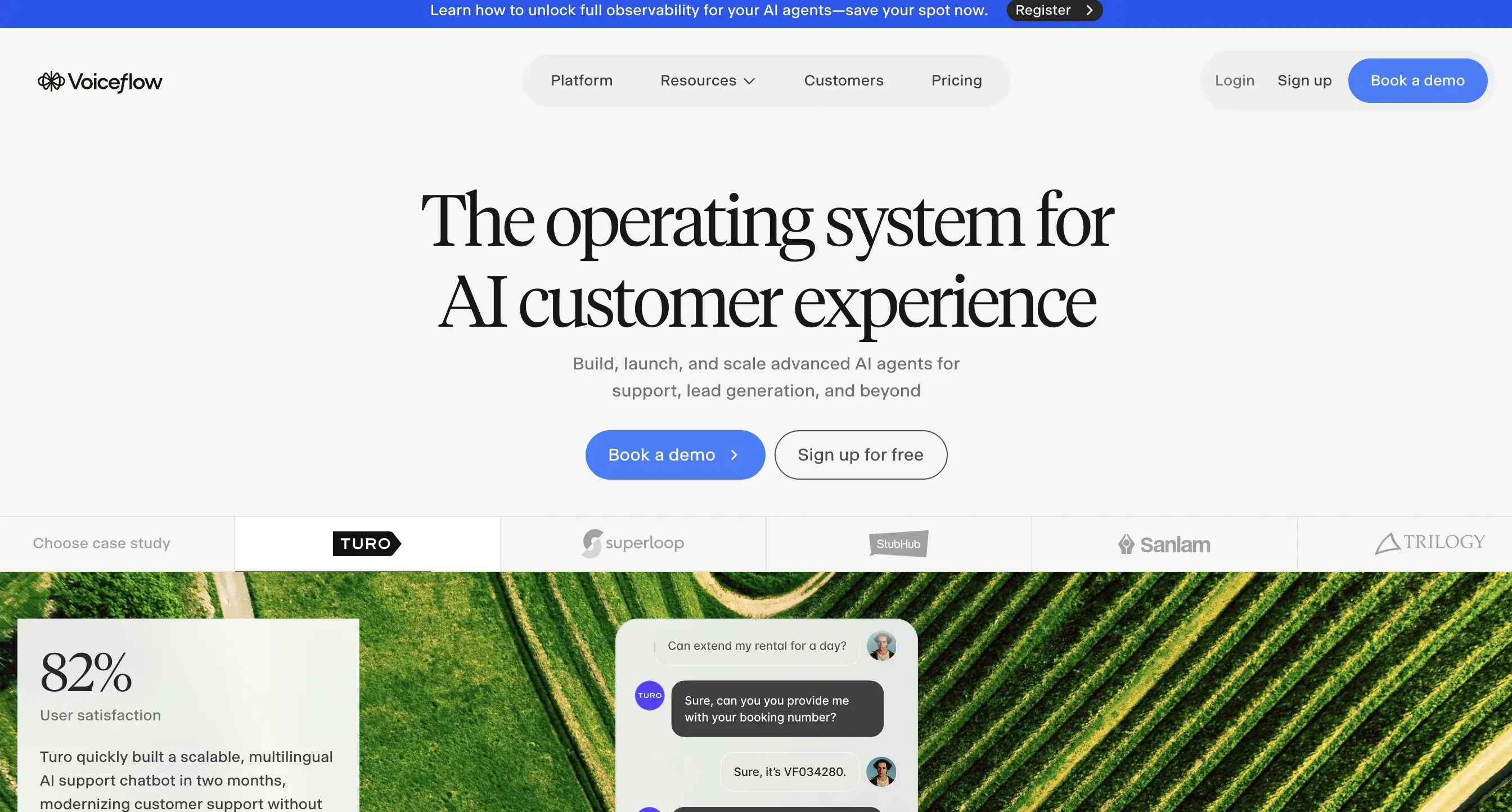
Voiceflow is a collaborative platform for designing, building, and deploying AI agents — primarily chat agents and voice-based conversational flows. Founded in 2019, the company started as a tool for building Alexa skills and Google Assistant actions before expanding into a general-purpose AI agent development environment used by over 250,000 users and teams worldwide.¹
The core idea is that product and developer teams can work in the same space. Designers sketch out conversation flows visually while engineers handle the logic, APIs, and integrations — all within one shared canvas. Think of it as the Figma of conversational AI: it gives you a visual workspace, version control, and team features, but you're still the one building the product from scratch.
Where Voiceflow sits in 2026 is firmly in the "build your own AI agent" category. It's not an out-of-the-box solution you drop onto a website in ten minutes. It's a development platform — and understanding that framing is the most important thing to get right before committing.
Voiceflow at a glance
Before getting into the details, here's a quick overview of how Voiceflow rates across the dimensions that matter most for teams evaluating it:
Voiceflow's key features
Voiceflow covers a wide surface area. Here's what's actually included and what each piece does.
Agent canvas
The canvas is Voiceflow's main workspace — a drag-and-drop flow builder where you map out how a conversation unfolds. Each step in the dialogue is a block: a response the agent gives, a condition it checks, a variable it captures, or an API call it makes. Connecting these blocks defines the conversation paths. Teams familiar with flowcharting tools will feel at home from day one, and you can prototype a full conversation in minutes before any code is written.
Knowledge base (RAG)
Voiceflow has a built-in knowledge base that lets your agent pull answers from uploaded documents, URLs, or plain text. Rather than scripting every possible response manually, you feed the agent source material — a product FAQ, support documentation, internal policies — and it retrieves relevant answers at runtime. This approach reduces hallucinations compared to purely generative responses and makes the agent easier to maintain as your content changes.
LLM flexibility
The platform is model-agnostic. You can connect OpenAI's GPT-4o, Anthropic's Claude models, or others via API, and even route different parts of a conversation to different models depending on what the task requires. For teams that want to optimize cost and performance across different agent use cases, this is a genuine advantage.
Multi-channel deployment
Agents built in Voiceflow can be deployed across different channels — web chat, WhatsApp, SMS, voice interfaces, and custom API connections. The same underlying conversation logic powers multiple surfaces, avoiding the need to rebuild flows separately for each channel. Agencies managing client work across different touchpoints save meaningful time this way.
Team collaboration tools
Multiple users can work on the same agent project simultaneously, leave comments directly on the canvas, tag team members, and roll back to earlier versions if something breaks. The experience is comparable to working in a shared Figma file or Google Doc. This is one of the areas where Voiceflow genuinely outperforms single-user or developer-only tools.
Developer handoff and API
A "Code Step" block lets engineers write JavaScript mid-flow to handle complex logic or connect to external APIs. This bridges the no-code design layer with pro-code execution — useful when an agent needs to look up a record, trigger a downstream action, or apply conditional logic that goes beyond what the visual builder handles natively. Voiceflow also exposes platform APIs for controlling agent state, managing knowledge base content, and pulling transcripts programmatically.
Analytics and transcripts
Once deployed, Voiceflow captures conversation transcripts and surfaces basic usage analytics: message volume, drop-off points, and intent coverage. These help teams identify where an agent underperforms. The analytics are functional, though users frequently note they're more limited than what enterprise-grade platforms offer — and transcript export has known reliability issues on some plan tiers.¹
Beyond these core areas, the platform also supports:
- Reusable components — save chunks of conversation logic and share them across multiple agent projects
- Version control and .vf file export — works with Git for DevOps-style agent management
- White-label options — available at enterprise tiers for agencies building client-facing products
- Security compliance — Voiceflow holds ISO/IEC 27001:2022 and SOC 2 certifications, with GDPR compliance¹
Voiceflow pros and cons
What works well:
- Visual canvas that lets designers and engineers collaborate in the same environment
- Fast for prototyping — a simple bot can be live in an afternoon
- Flexible LLM configuration, including the option to bring your own models
- Multi-channel deployment from a single set of conversation flows
- Strong team features: comments, versioning, real-time multi-user editing
- Reusable components save significant time across large or multi-project workloads
- Enterprise-grade security with ISO 27001 and SOC 2 certifications
Where it falls short:
- Non-technical users hit limits quickly — anything beyond a basic FAQ bot requires developer involvement
- Credits deplete fast with advanced models like Claude Sonnet 4, making monthly costs hard to predict¹
- Voice calling requires a third-party telephony provider (typically Twilio) — it's not native to the platform
- No built-in appointment booking; scheduling requires an external calendar integration via API
- No native contact management— post-call data logging needs a separate integration
- Transcript export has known reliability issues when pushing to third-party tools¹
- Direct customer support can be slow and inconsistent, particularly on lower plan tiers
Voiceflow pricing: What does it actually cost?
Operating on a seat-based pricing model combined with AI usage credits, the plans break down as follows:²
Sandbox — Free. One editor seat, up to 2 agents, and access to the core canvas and knowledge base. Solid for exploring the platform, but limited to basic features.
Pro — $60/editor/month. The entry point for teams doing production work. Adds unlimited agents, priority support, and expanded usage limits.
Teams — $150/editor/month. Includes the full collaboration feature set: shared component libraries, advanced analytics, version control, and team-level organization.
Enterprise — Custom pricing. For organizations needing SSO, SLAs, dedicated support, custom data retention, and white-label deployment.
One thing worth flagging: Voiceflow also charges based on AI tokens consumed when your agents run. Every plan includes a token allowance, and higher usage requires purchasing additional credits on top of the plan fee. Users running advanced models like Claude Sonnet 4 have reported that credits deplete considerably faster than expected,¹ making the total bill harder to forecast compared to platforms with per-minute pricing.
To put this in practical terms: a team of three editors on the Pro plan is looking at $180/month in seat costs alone, before token overage, telephony integrations, or any external CRM and scheduling tools they'd need to make the full workflow function.
What users say about Voiceflow
Across G2 and Capterra, Voiceflow carries solid ratings — around 4.6 to 4.7 out of 5 on both platforms.³ The pattern in the feedback is fairly consistent.
The visual canvas comes up repeatedly as a genuine strength. Users describe it as intuitive once past the initial orientation, and the ability to have designers and engineers in the same environment is consistently highlighted as a differentiator for agencies and product teams. The reusable components and white-label options also attract positive mentions from teams managing multiple client projects.
On the flip side, a recurring theme in reviews is the gap between what the platform can do and what non-technical users can access independently. Building anything beyond a basic FAQ bot requires developer involvement, and users with smaller or non-technical teams often find that expectation frustrating. The token-based billing model draws criticism for unpredictability — particularly when running more capable LLMs — and transcript logging reliability issues come up more than once.¹ Support response times get mixed reviews on lower plan tiers.
Security and compliance
Voiceflow holds ISO/IEC 27001:2022 certification and is SOC 2 compliant, covering the core requirements for enterprise procurement in most industries. GDPR compliance is included.¹
One area worth checking before signing up is data residency. For teams operating in or with EU customers, verifying where data is hosted and whether that aligns with your regulatory requirements is worth doing before committing — the platform doesn't publish granular data residency details publicly. Organizations with strict European data requirements should confirm this directly with Voiceflow's sales team.
Voiceflow use cases: Where it makes sense
The tool works well for some teams and is a poor match for others. Being upfront about this saves time.
Product and UX teams prototyping AI agents — if you need to mock up a conversational experience, test it with stakeholders, and hand it off to engineering for a production build, the canvas workflow is well-suited for this. Rapid iteration is genuinely fast here.
Agencies building client-facing agents — white-label options, reusable components, and multi-user collaboration make Voiceflow practical for agencies managing multiple client projects simultaneously.
Enterprise teams with developer resources — organizations needing highly customized agents integrated with proprietary backends or complex internal systems benefit from Voiceflow's Code Step and platform API.
Support and FAQ automation — the knowledge base feature makes it accessible for teams that want to automate repetitive customer questions from existing documentation without scripting every response.
For businesses that need AI-powered phone calls — inbound calls that qualify a caller and book a meeting — Voiceflow isn't purpose-built for that use case. Voice calling requires a third-party telephony provider like Twilio, and appointment scheduling requires connecting an external calendar tool via API and building that logic manually. That's a significant extra investment for teams whose actual goal is just answering calls and filling a calendar. Non-technical teams without developer support will also struggle to get meaningful value beyond simple FAQ bots.
Voiceflow vs. Zeeg: A different approach to AI-powered conversations
If your main goal is handling inbound calls, qualifying the caller, and booking a meeting, Voiceflow and Zeeg aren't really competing for the same use case.
Zeeg is a platform for AI voice agents and advanced appointment scheduling with native contact management features built directly into the platform. When someone calls your Zeeg number, the agent holds a real back-and-forth conversation, captures the caller's details, applies your routing rules, and books the right meeting — all in one step, with everything landing automatically in the Zeeg dashboard. No telephony provider account to manage, no external calendar integration to configure, no API logic to write and maintain.
Here's how the two platforms compare on the dimensions that matter most for sales and service teams:
Setup complexity: Voiceflow requires designing conversation flows on the canvas, configuring variables and logic, connecting integrations, and testing before going live — which typically means developer involvement for anything production-grade. Zeeg's agent is configured with a plain-language prompt: describe how the agent should behave, define routing rules in natural language, and test it from your browser before publishing.
Phone calls: Voiceflow can support voice channels via Twilio integration. Zeeg handles inbound and outbound calls natively, with a phone number purchased directly in the platform or imported via SIP — so your existing business number comes with you.
Appointment booking: Voiceflow has no native scheduling. Zeeg books the meeting during the call itself, directly into the calendar, without any external tools. For a deeper look at how AI voice agents handle scheduling end-to-end, that seamless flow from call to confirmed appointment is exactly what the technology was built for.
Contact management: Voiceflow doesn't include contact management functionalities. Every call handled by Zeeg's agent is automatically logged — call type, date, inbound number, booking outcome, full transcript with timestamps — and the contact profile is created or updated without any manual steps.
Pricing transparency: Voiceflow's token model makes it difficult to forecast costs without production data. Zeeg uses a credits model where every call shows its exact cost in the dashboard. Inbound calls run at approximately €0.07/min, outbound at around €0.19/min, with no end-of-month billing surprises.
That said, Voiceflow holds a real advantage for teams that need deeply customized agent logic. A highly tailored conversational experience integrated with proprietary systems, with complex branching logic across many topics, deployed simultaneously across multiple channels — Voiceflow's canvas gives you that level of control. The trade-off is the time and expertise required to get there.
Zeeg: When calls need to end in a booked meeting
Most businesses evaluating AI voice agent platforms have a straightforward goal: someone calls, the agent handles the conversation, and a meeting lands on the calendar. Voiceflow can get there, but assembling the pieces — telephony provider, calendar integration, contact management connection, and the logic to tie it all together — is a project in itself.
Zeeg handles all of that from one platform. The voice agent holds a genuine back-and-forth conversation, not a press-1 phone tree — captures the caller's details, applies your routing rules, and books the meeting directly into the calendar. The transcript, caller profile, and booking outcome land automatically in the system, with no manual steps required.
Setup runs through a plain-text prompt builder. You describe the agent's behavior, pick a template (Appointment Booker, Sales Qualifier, Support Callback), define routing rules in plain language, and test the agent from your browser before going live. Most teams have a working agent in under an hour. If you've also been looking at developer-oriented platforms like Vapi or Synthflow, the AI voice agent pricing guide breaks down the full cost picture across 11 platforms in a way that makes side-by-side comparison straightforward.
Zeeg pricing
- Starter — Free forever. A solid entry point for solo users getting started with scheduling.
- Professional — $10/user/month (billed annually) or $12/month billed monthly. AI agents available from this tier, alongside advanced scheduling, multiple calendar connections, and custom branding.
- Business — $16/user/month (billed annually) or $20/month billed monthly. Adds team scheduling, round-robin distribution, routing forms, and analytics.
- Scale — $30/user/month (billed annually) or $40/month billed monthly.
AI call minutes run on a pay-as-you-go credits model: approximately €0.07/min for inbound calls and €0.19/min for outbound. Each call's cost is visible directly in the Zeeg dashboard. For a broader look at how this fits within the AI call center software landscape, per-minute transparency is one of the features users consistently call out as an advantage over platforms with opaque token billing.
Zeeg's AI voice agent answers calls, qualifies leads, and books the right meeting automatically. Scheduling and contact management features are already included — starting at $10/user/month. Try it free for 14 days.
Book a demo nowThe verdict: Is Voiceflow worth it in 2026?
Voiceflow is a capable platform for the teams it's designed for — product and development teams building custom AI agents who have the technical resources to use what the canvas offers. The collaboration features, multi-channel deployment, knowledge base, and LLM flexibility all hold up well. For agencies building client-facing AI products, the white-label options and reusable components add real value.
The limitation is that Voiceflow isn't built for the "answer calls and book meetings" use case out of the box. Getting there requires stitching together external telephony, a booking tool, and a CRM — each adding setup time, ongoing cost, and maintenance overhead. That's a meaningful ask for a non-technical team that just needs something working soon.
There's also the cost dimension. At $60/editor/month for the Pro plan, plus token overage costs, plus whatever you spend on third-party tools to make the full workflow function, the total bill for a small team climbs quickly. Compare that to Zeeg's Professional plan at $10/user/month covering voice agent, scheduling, and contact management under one subscription — and the gap is significant for most practical use cases.
For product or agency teams with developers who want a highly customizable agent builder, Voiceflow is worth evaluating. For businesses that need calls answered, leads qualified, and meetings booked without a multi-week setup, it's not the most direct path. In that case, exploring the best AI voice agents for scheduling — or just starting with Zeeg directly — is a more practical starting point.
Read more:
Sources
1. Dograh — Voiceflow Review 2026
2. Voiceflow Pricing
3. G2 — Voiceflow Reviews
Zeeg is Europe's leading AI voice agent and appointment scheduling software in one solution — GDPR-compliant, made in Germany. Start for free →
Frequently Asked Questions
What's a good Voiceflow alternative for call handling and booking?
Zeeg is a strong option for teams that want AI-powered calls and appointment booking combined. The voice agent handles inbound and outbound calls conversationally, books the right meeting during the call, and logs everything automatically in the built-in contact management — with no developer setup required.
Can Voiceflow book appointments?
No — not on its own. Voiceflow has no native scheduling functionality. Booking an appointment through a Voiceflow agent requires connecting an external calendar tool via API and building that integration logic into the conversation flow manually.
Does Voiceflow support phone calls?
Yes, but not natively. Voice channel support requires integrating a third-party telephony provider like Twilio. If phone call automation is your primary goal, purpose-built AI voice bots will be faster to configure and maintain than Voiceflow.
Is Voiceflow good for non-technical users?
Only to a point. The visual canvas is accessible for simple prototypes, but production-grade agents typically require developer involvement. Non-technical users building anything beyond a basic FAQ bot will generally need someone technical in the loop.
How much does Voiceflow cost?
Voiceflow has a free Sandbox tier for up to one editor and two agents. The Pro plan is $60/editor/month. The Teams plan runs $150/editor/month. Enterprise pricing is custom. All paid plans also incur AI token usage costs on top of the seat fee — which can add meaningfully to the total bill, depending on the models and volume you're running.
What does Voiceflow do?
Voiceflow is a platform for building and deploying conversational AI agents — primarily chat agents and voice-based flows. Teams use it to design dialogue logic visually, connect external APIs and knowledge bases, and deploy agents across channels including web chat, WhatsApp, SMS, and voice interfaces via telephony integrations.