What is Lead Management: Definition, Strategy, Best Practices


If you’re reading this, you’re probably looking for ways to improve your sales process. Did we get that right? And yes—lead management might be the missing piece in your business puzzle. Because, when done right, an effective lead management process can change a lot how you attract and convert potential customers. Ideally, it will allow you to focus on high-quality prospects while automating repetitive tasks.
In this article, we'll just explore what a CRM lead management is, why it matters for your business, what steps you can take to implement a strategy that works, and how a CRM lead management workflow can improve your sales operations and boost conversion rates. We'll also cover how Zeeg's appointment booking CRM will help you increase your leads and manage them easily.
Stay tuned.
What is lead management?
Lead management is the process of capturing, tracking, qualifying, nurturing, and distributing your potential customers through the sales funnel, until they convert into buyers. That’s the simple definition. It should mix good planning, a good CRM, and customer-focused communication.
So, basically, sales lead management helps marketing and sales teams work together to manage leads efficiently. In theory, such systems can organize all interactions with potential customers, making it easier to guide them through their buying journey.
Why lead management is important
As we pointed out already, managing sales leads well is not just nice to do—it's actually something essential for business growth. Here's a few reasons why lead management is important:
- Focuses on quality prospects: Not all leads are created equal. A proper sales lead management system helps you identify and prioritize high-value opportunities, allowing your sales team to concentrate their efforts where they're most likely to pay off.
- Improves conversion rates: When you understand where leads are in their buying journey, you can provide exactly what they need to move forward. Better targeting, better chances of succeeding.
- Eliminates wasted resources: Because without a proper process, sales teams end up wasting time pursuing unqualified leads or duplicate efforts. Thus the need of a good lead management CRM.
- Creates consistent customer experiences: By managing leads systematically, you deliver a coherent experience across all touchpoints, building trust and brand loyalty.
And here's another perspective the benefits. You'll probably get:
- Time savings: No more time-consuming manual tasks like data entry, lead assignment, and basic follow-ups
- Consistency: Every lead receives the same type of treatment
- Improved response times: You can respond to leads instantly, regardless of time of day
- Better lead nurturing: Sophisticated nurturing sequences that would be hard to do mannually
- Better analytics: This will give you insights about every lead interaction, and you'll know what works and what doesn't
- Scalability: As your lead volume grows, automation ensures you can maintain quality without proportionally increasing headcount
The lead management process flow
Now let's look with more detail at the flow you should aim of with a lead management CRM.
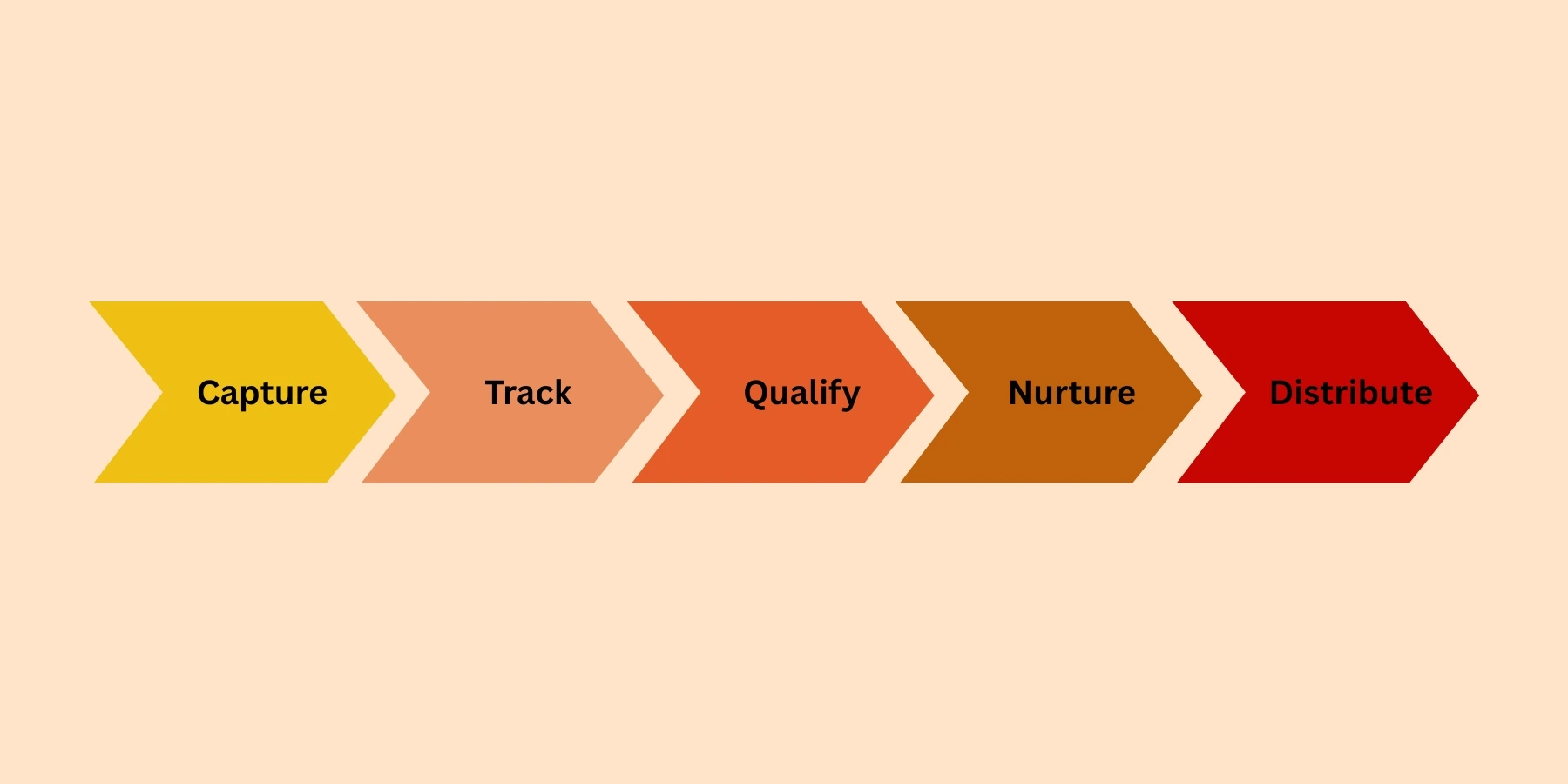
A well-designed lead management workflow creates a clear path for prospects to follow, from their first interaction with your brand to becoming loyal customers. This way you won’t miss prospects or deals, and all potential customers receive the attention they at whichever stage of the journey they’re at.
But let's check it step by step:
1. Lead capture
The foundation of any effective lead management system. It involves collecting contact information and relevant details about potential customers who have shown interest in your business. This crucial first step transforms anonymous visitors into identified leads that your marketing and sales teams can nurture.
But this also asks for a strategic balance – you should ask for enough information to qualify leads, but without creating barriers that discourage submission. The most successful lead capture strategies provide immediate value to potential customers in exchange for their information, such as useful content, special offers, or solutions to their problems.
Sources for capturing leads include:
- Website forms and landing pages
- Social media campaigns
- Email marketing
- Content downloads (ebooks, whitepapers, case studies)
- Events and webinars
- Paid advertising
- Referrals
Nowadays, modern CRM lead management systems can collect information from these channels automatically. The goal is to gather essential contact details along with any relevant information about the lead's interests and needs. Just remember that, for optimal results, your lead capture process should be seamless and provide value to the prospect, like offering a helpful ebook in exchange for contact information.
2. Lead tracking
Lead tracking is the ongoing monitoring of how leads interact with your business across multiple touchpoints. It's what gives visibility into the customer journey, and how you understand each lead's level of interest and readiness to purchase. So, having a lead tracking system can turn random interactions into patterns that will inform your sales leads management strategies.
Let's put it this way: good lead tracking lets you choose your marketing startegy, backing it up with data. You'll be allocating resources more efficiently, and can personalize your communications based on demonstrated interests and behaviors.
After you've captured your leads, the next step is tracking their interactions with your brand. This includes monitoring:
- Website visits and page views
- Email opens and clicks
- Content downloads
- Social media engagement
- Form submissions
- Phone calls and meetings
Basically, if the tracking is well done you'll know how your leads engage with your marketing campaigns. You'll understand your audience's interests and readiness to buy. For instance, a lead who visits your pricing page many times might be closer to making a purchase decision than someone who only read one informational blog post. Right? CRMs and lead management tools can be used to automate the process.
3. Lead qualification
This is another one where you evaluate your leads to determine which ones are most likely to become valuable customers. The point is to prevent your sales team from wasting time on opportunities that aren't ready to buy or don't fit your ideal customer profile. With some consistent qualification criteria, you can focus your resources on the sales leads with the highest potential return.
Effective qualification will be more than just demographic information to understand a lead's true buying intent, authority, and timeline. It's a deeper assessment, so that you can create personalized follow-up strategies that address specific pain points. You should look at criteria like:
- Fit with your ideal customer profile
- Budget and authority to make purchasing decisions
- Need for your solution
- Timeline for implementation
- Engagement level with your content
There are several frameworks for qualifying leads, including:
- BANT: Budget, Authority, Need, Timeline
- CHAMP: Challenges, Authority, Money, Prioritization
- MEDDIC: Metrics, Economic Buyer, Decision Criteria, Decision Process, Identify Pain, Champion
- ANUM: Authority, Need, Urgency, Money
- FAINT: Funds, Authority, Interest, Need, Timing
Based on qualification, leads are typically categorized as:
- Marketing Qualified Leads (MQLs): Leads that have engaged with your marketing efforts and fit your target profile
- Sales Qualified Leads (SQLs): Leads that have been vetted by the sales team and are ready for direct sales outreach
Learn here about the best tools to qualify leads.
4. Lead nurturing
Trust is key. Lead nurturing, just as it sounds, is when you develop relationships with buyers—and it can happen at any stage of the sales funnel. But rather than pushing for an immediate sale, nurturing focuses on understanding a lead's needs, so that you can give them value. This patient, educational approach builds trust and positions your company as a partner, rather than just "another vendor".
To have success, you should try to combine relevant and timely communication with personalized interactions, preferably in different channels. A consistent and helpful engagement will keep your brand top-of-mind until leads are ready to make a decision. Yes, it can be a a long-term strategy; but it often results in higher conversion rates, larger deal sizes, and stronger customer relationships.
Some types of marketing lead management and nurturing strategies can be:
- Segmented email campaigns: Sending targeted content based on lead interests and behaviors
- Personalized communication: Tailoring messages to address specific needs and pain points
- Multi-channel engagement: Reaching potential customers through their preferred channels (email, social media, phone)
- Educational content: Providing information that helps leads make informed decisions
- Automated workflows: Setting up trigger-based communications that respond to lead actions
5. Lead distribution
When you want to allocate your qualified leads to the most appropriate sales representatives, that's when you "distribute" them. It ensures that potential customers are matched with the right salesperson based on factors like expertise, territory, or capacity. Good lead distribution will then maximize conversion potential by pairing leads with the reps best equipped to address their specific needs and challenges.
But make no mistake - this is not just a simple opportunity assigment. A sophisticated lead distribution system considers timing, workload balancing, and accountability. Like a good round robin feature. By implementing clear rules and automated routing, you can minimize response times and avoid confusion about who owns what.
Summing it up, the lead distribution process involves:
- Matching potential customers with sales reps based on territory, industry expertise, or product specialization
- Ensuring leads are followed up promptly
- Tracking sales activities and outcomes
- Providing sales teams with relevant information
And why this is good? Because automated lead distribution will make sure that leads are assigned quickly and fairly, maximizing the chances of conversion. Here's some ways to do this:
- Round-robin: Distributing opportunities evenly among sales reps
- Territory-based: Assigning leads based on geographic location
- Skill-based: Matching potential customers with reps who have relevant expertise
- Response time: Assigning opportunities to reps who can respond fastest
Types of leads in the sales process
Understanding the different types of leads in your sales process will help tailor your lead management the best way possible. Each lead type represents a different level of engagement and sales readiness, requiring specific handling and nurturing strategies.
By temperature
Leads can be categorized based on their level of engagement and readiness to purchase:
Cold leads have had little to no prior interaction with your business. They match your target audience criteria but haven't really shown interest in your products or services. Probably they need more educational content and brand awareness campaigns before moving further in the sales process.
Warm leads already showed some level of interest. Maybe they visited your website multiple times, downloaded content, or engaged with your social media posts. These leads are more receptive to direct outreach.
Hot leads, you've guesses right, are the ones showing strong buying intent. You know they're considering your solution. Perhaps they already requested pricing information, attended a product demo, or somehow got in touch with your sales team. These leads deserve your immediate attention.
By qualification status
But as your leads progress through the sales funnel, they can also be classified based on the qualification level:
Information Qualified Leads (IQLs) have provided basic contact information but require further qualification. They're early in the buying journey and need nurturing to determine their fit and interest level.
Marketing Qualified Leads (MQLs) are engaging with your marketing, so you know that they meet some criteria, suggesting they align with your target audience and show potential to become customers.
Sales Qualified Leads (SQLs) have been vetted by the sales team and deemed ready for direct sales engagement. Usually, this type of lead have expressed clear interest in purchasing, and meets your qualification criteria for budget, authority, need, and timeline.
Product Qualified Leads (PQLs) are perhaps the strongest case, as they've experienced your product firsthand, usually through a free trial or freemium model; also, they demonstrated engagement that suggests buying potential. Their qualification is based on actual product usage patterns.
By acquisition source
If you know where your leads come from, you should know how to optimize your marketing efforts:
Inbound leads will initiate contact with your business by responding to whatever marketing you do. Maybe they might fill out a form after reading a blog post, request more info after finding your website through search, or sign up for your newsletter. Promising.
Outbound leads come directly from you; these leads are generated through proactive prospecting efforts like cold calling, email outreach, or targeted advertising campaigns. They might require more work (or nurturing), since they didn't initially seek out your business.
Referral leads come from recommendations by existing customers, partners, or any other stakeholders. They're potential buyers that can convert at higher rates because they come with an implicit endorsement from a trusted source.
CRM and lead management: A perfect match

Customer Relationship Management (CRM), as you know by now, are the central hubs for efficient lead management. Therefore, a lead management CRM creates a seamless connection between your marketing efforts and sales activities.
Modern tools, like Salesforce, Hubspot, Zoho, Pipedrive or Zeeg can offer great features for tracking, organizing, and nurturing leads throughout their journey. And by centralizing lead data and automating key processes, CRM systems enable more efficient, consistent lead management while providing valuable insights for continuous improvement.
Here's why CRMs are a powerful tool for lead management:
Unified data storage
CRM systems provide a centralized database for all lead information, eliminating silos between marketing and sales. This ensures everyone has access to the same up-to-date information about each lead's interactions, preferences, and status.
Having a single source of truth prevents duplicate efforts, mixed messages, and inconsistent experiences. It also creates a complete view of each lead's journey, enabling more informed decision-making about how to engage with them.
Automated workflows
Modern CRM lead management systems include automation capabilities that streamline the lead management process. These include:
- Automatic lead scoring based on engagement and profile data
- Triggered email sequences based on lead actions
- Task creation and assignment for sales follow-up
- Notification systems that alert teams to important lead activities
These automations reduce manual work, ensure timely follow-up, and create consistent experiences for leads. They also allow your team to focus on high-value activities rather than administrative tasks.
Better visibility
CRM lead management offers comprehensive dashboards and reporting that provide visibility into:
- Pipeline status and forecasts
- Lead source performance
- Conversion rates at each stage
- Sales team performance metrics
- ROI of marketing campaigns
This visibility helps identify bottlenecks in your sales process and opportunities for improvement. It also enables data-driven decisions about where to invest resources for maximum impact.
Improved collaboration
CRM systems facilitate better collaboration between marketing and sales teams by:
- Providing a shared view of lead information
- Clarifying hand-off processes between teams
- Enabling feedback loops to improve lead quality
- Supporting consistent messaging across all customer touchpoints
With CRM and lead management working together, businesses can create a seamless experience for prospects while maximizing internal efficiency.
Lead scoring: Prioritizing your prospects
Lead scoring is a methodology for ranking prospects based on their perceived value to your organization. This systematic approach helps sales and marketing teams prioritize leads, determine appropriate follow-up actions, and allocate resources efficiently. By assigning point values to various lead attributes and behaviors, you create an objective framework for identifying your most promising opportunities.
How lead scoring works
Lead scoring typically combines two types of criteria:
Explicit scoring is based on information that leads directly provide or demographic data that matches your ideal customer profile. This includes:
- Company size or revenue
- Industry or vertical
- Job title or decision-making authority
- Budget availability
- Geographic location
Implicit scoring reflects engagement levels and buying intent through observed behaviors, such as:
- Website visits and page views
- Email opens and clicks
- Content downloads
- Webinar attendance
- Form submissions
- Social media interactions
Each attribute and action is assigned a point value based on its relative importance to your sales process. For example, visiting a pricing page might earn more points than reading a blog post, while a C-level executive might score higher than a mid-level manager.
Implementing a lead scoring model
To create a lead scoring system that works for your business:
- Collaborate across departments: Bring together marketing and sales teams to define what makes a qualified lead based on past conversion patterns.
- Identify your ideal customer profile: Analyze your most successful customers to determine common characteristics that indicate good fit.
- Map the buying journey: Understand typical paths to purchase and which actions signal increasing interest or readiness to buy.
- Assign point values: Create a scoring rubric that weights different attributes and behaviors based on their correlation with sales readiness.
- Set threshold scores: Determine score levels that trigger specific actions, such as moving from marketing to sales ownership.
- Test and refine: Regularly evaluate your scoring model against actual conversion data and adjust as needed.
Benefits of lead scoring
Implementing a robust lead scoring system offers numerous advantages:
- Increased sales efficiency: Sales teams focus on the most promising leads rather than pursuing every prospect equally.
- Better lead nurturing: Marketing can tailor content and approaches based on score ranges and specific criteria.
- Improved marketing and sales alignment: Shared scoring criteria create a common language for lead quality.
- Higher conversion rates: Properly timed follow-up with sales-ready leads improves close ratios.
- Reduced sales cycle: Identifying ready-to-buy prospects accelerates the path to purchase.
Lead scoring transforms subjective judgments about lead quality into a data, which essentially can improves the prospect experience and conversion chances.
Lead management best practices
To get the most from your lead management efforts, follow these proven best practices:
1. Define clear lead qualification criteria
Establish specific criteria for what constitutes a qualified lead. This should be based on your ideal customer profile and include both demographic information (company size, industry, location) and behavioral indicators (engagement level, expressed interest).
Clearly documented qualification criteria ensure consistent evaluation across your organization and provide a framework for ongoing refinement based on conversion data. Without these guidelines, lead quality assessment becomes subjective and inconsistent.
2. Implement lead scoring
Develop a lead scoring system that assigns points based on prospect attributes and behaviors. This helps prioritize leads for follow-up and determines when they're ready to move from marketing to sales.
A basic lead scoring model might award points for:
- Visiting high-intent pages (pricing, product demos)
- Downloading valuable content
- Opening and clicking on emails
- Attending webinars
- Requesting information
Lead scoring transforms subjective quality assessments into a systematic process that helps you focus resources on your most promising opportunities.
3. Create targeted content for each stage
Develop content specifically designed for each stage of the buyer's journey:
- Awareness stage: Educational blog posts, infographics, social media content
- Consideration stage: Case studies, webinars, product comparisons
- Decision stage: Demos, free trials, testimonials, pricing information
This ensures you're providing relevant information that addresses leads' needs as they move through the sales funnel. Targeted content helps nurture leads more and moves them closer to purchase decisions.
4. Establish clear hand-off protocols
Define exactly when and how leads should transition from marketing to sales. This should include:
- Specific qualification thresholds
- Required information to be gathered
- Process for transferring lead ownership
- Feedback mechanisms for sales to report on lead quality
Clear protocols prevent leads from falling through the cracks during transitions and ensure both marketing and sales teams understand their responsibilities throughout the lead management process.
5. Maintain data hygiene
Regularly clean and update your lead database to ensure accuracy. This includes:
- Removing duplicate records
- Updating contact information
- Enriching lead profiles with additional data
- Archiving or removing inactive leads
Clean data is essential for good lead management and accurate reporting. Poor data quality undermines trust in your system and can lead to wasted efforts and missed opportunities.
6. Use automation strategically
Identify repetitive, time-consuming tasks in your lead management workflow and automate them. However, maintain a human touch for high-value interactions. Areas for lead management automation are:
- Lead capture and data entry
- Initial response emails
- Lead scoring and qualification
- Routine nurturing communications
- Task assignments and reminders
Strategic automation improves efficiency without sacrificing the personal connection that's crucial for building relationships with prospects.
7. Continuously analyze and optimize
Regularly review your lead management metrics to identify opportunities for improvement:
- Conversion rates at each stage
- Lead source performance
- Sales cycle length
- Cost per lead and cost per acquisition
- Lead quality by source
Use these insights to refine your strategies, reallocate resources, and improve results over time. Continuous optimization ensures your lead management process evolves with changing market conditions and customer preferences.
Lead nurturing strategies that work
Lead nurturing is, as we saw already, an important component of everyhing we've talking. When implemented thoughtfully, nurturing campaigns guide prospects through their buying journey, providing value at each stage and building trust in your brand. These strategies help maintain engagement with leads who aren't yet ready to purchase, keeping your company top-of-mind until they're prepared to make a decision.
Email segmentation and personalization
One of the best nurturing strategies is sending targeted, personalized email content to different segments of your lead database. Rather than blasting the same message to everyone, segment your leads based on:
- Industry or vertical
- Company size
- Job role or title
- Stage in the buying process
- Content interests
- Previous interactions
For each segment, craft messages that address their specific challenges, priorities, and information needs. Personalized emails generate 6x higher transaction rates than generic messages.
Drip campaigns
Drip campaigns are pre-planned sequences of emails delivered at specific intervals or triggered by certain actions. These automated sequences maintain consistent contact with leads while providing increasingly detailed information about your solutions.
Drip campaigns follow a logical progression that aligns with the buyer's journey:
- Initial emails focus on education and problem awareness
- Middle-stage emails introduce your solution and its benefits
- Later emails present case studies and more detailed product information
- Final emails may include special offers or direct calls to action
By gradually building knowledge and trust, drip campaigns guide leads toward purchase readiness without overwhelming them with information.
Multi-channel nurturing
While email remains a powerful nurturing channel, today's buyers engage across multiple platforms. A comprehensive nurturing strategy incorporates various touchpoints:
- Social media engagement and targeted ads
- Personalized website experiences
- Direct mail for high-value prospects
- SMS messages for time-sensitive communications
- Phone calls at decision points
- Webinars and virtual events
This diversified approach increases your chances of connecting with leads through their preferred channels and reinforces your message across multiple touchpoints.
Educational content marketing
Providing valuable, non-promotional content establishes your company as a trusted advisor rather than just a vendor. This approach works especially well for complex B2B sales with longer decision cycles.
Develop a content strategy that addresses common questions, challenges, and information needs at each stage of the buying process. Useful formats include:
- Blog posts and articles
- Whitepapers and ebooks
- Video tutorials and webinars
- Case studies and success stories
- Industry research and reports
- Interactive tools and calculators
By helping leads solve problems and make informed decisions, you position your company as a valuable resource they'll turn to when ready to buy.
Behavioral triggers
Behavioral triggering involves sending specific communications based on actions a lead takes (or doesn't take). These real-time responses to lead behavior create highly relevant interactions.
Examples of behavioral triggers include:
- Following up with additional information after a lead downloads content
- Sending a special offer when someone visits your pricing page multiple times
- Reaching out personally when a lead shows high engagement across channels
- Re-engaging with leads who have been inactive for a specified period
This responsive approach ensures your communications match the lead's current interests and level of engagement, significantly improving response rates.
Choosing the right lead management system
Selecting the right lead management system is crucial for implementation success. The ideal solution should align with your business processes, integrate with your existing tech stack, and scale with your growth. Take time to thoroughly evaluate options based on your specific requirements rather than simply choosing the most popular or feature-rich platform.
Here are key factors to consider when selecting a sales lead management system:
Integration capabilities
Your lead management software should integrate seamlessly with:
- Your existing CRM (if separate)
- Marketing automation platforms
- Email marketing tools
- Website and landing page builders
- Social media advertising platforms
- Analytics and reporting solutions
Smooth integration ensures data flows freely between systems without manual transfers. This creates a unified view of your leads across all touchpoints and prevents information silos that can undermine your lead management efforts.
Scalability
Choose a system that can grow with your business. Consider:
- User limits and pricing tiers
- Maximum lead capacity
- Performance with large databases
- Available add-ons and extensions
A scalable lead management solution prevents the need to switch systems as your business expands. It should accommodate increasing lead volumes, additional users, and more complex workflows without sacrificing performance or requiring significant reconfiguration.
User-friendliness
The best lead management system is one that your team will actually use. Look for:
- Intuitive interface
- Customizable dashboards
- Mobile accessibility
- Comprehensive training resources
- Responsive customer support
User adoption is relevant for realizing the full benefits of your lead management investment. Even the most powerful system will fail if your team finds it too complex or cumbersome to use consistently.
Automation features
Evaluate the automation capabilities that match your needs:
- Lead scoring and grading
- Email sequence automation
- Task creation and assignment
- Follow-up reminders
- Data enrichment
Robust automation features save time and ensure consistent processes. They eliminate manual tasks, reduce human error, and enable your team to focus on high-value activities that require personal attention.
Reporting and analytics
Comprehensive reporting helps you measure success and identify improvement areas:
- Customizable dashboards
- Pipeline visualization
- Conversion metrics
- ROI calculation
- Forecasting capabilities
Look for systems that provide actionable insights, not just data dumps. Complete reporting tools should help you understand what's working, what isn't, and where to focus your improvement efforts.
Cost considerations
Evaluate the total cost of ownership, including:
- Base subscription fees
- Per-user costs
- Implementation expenses
- Training requirements
- Potential customization needs
Balance cost against features to find the best value for your specific needs. Remember that the cheapest option isn't always the most cost-effective in the long run, especially if it lacks important functionality or requires extensive workarounds.
How to implement a lead management strategy
Implementing an effective lead management strategy will need careful planning and execution. A successful implementation goes beyond simply purchasing software—it involves aligning people, processes, and technology around a shared vision of how leads should be handled throughout their journey. This comprehensive approach ensures that your lead management system delivers real business value rather than becoming another underutilized tool.
Follow these steps for successful implementation of your lead management plan:
1. Assess your current process
Start by mapping your existing lead management workflow:
- How are leads currently captured and processed?
- What tools are already in use?
- Where are the bottlenecks and pain points?
- What metrics do you currently track?
This assessment provides a baseline for improvement and helps identify priority areas. It also helps you understand current strengths that should be preserved and weaknesses that need to be addressed in your new approach.
2. Define your objectives
Establish clear goals for your lead management initiative:
- Increase conversion rates by X%
- Reduce lead response time to Y minutes
- Improve lead quality scores
- Shorten sales cycles by Z days
- Increase revenue per lead
Specific, measurable objectives help guide your implementation and evaluate success. They also provide a compelling case for organizational change and investment in new processes or technology.
3. Align sales and marketing teams
Bring sales and marketing together to create shared definitions and processes:
- What constitutes a qualified lead?
- When should leads transfer from marketing to sales?
- What information needs to be collected at each stage?
- How will lead quality be measured?
This alignment is essential for smooth hand-offs and collaborative success. When both teams work from the same playbook and share common goals, there will be less conflits, therefore increasing your team's efficiency.
4. Select and implement technology
Based on your requirements, choose and deploy the appropriate lead management tools:
- CRM system
- Marketing automation platform
- Lead scoring and qualification tools
- Analytics and reporting solutions
Ensure proper integration between systems and thorough testing before full deployment. Focus on configuring the technology to support your defined processes rather than adapting your processes to fit the technology.
5. Develop content and workflows
Create the assets and processes needed to support your lead management:
- Lead capture forms and landing pages
- Email templates and nurturing sequences
- Qualification criteria and scoring rules
- Assignment and routing rules
- Follow-up protocols and scripts
These elements form the operational backbone of your lead management process. They should be designed with both efficiency and customer experience in mind, creating a smooth journey for leads while optimizing internal workflows.
6. Train your team
Provide comprehensive training on:
- New systems and tools
- Updated processes and workflows
- Lead qualification criteria
- Reporting and analytics
Having good training in place will ensure consistent adoption or your lead management style. It should cover not just how to use the tools but also why these processes are important and how they contribute to broader business goals.
7. Measure, analyze, and refine
After implementation, continuously monitor performance:
- Track key metrics against your objectives
- Gather feedback from sales and marketing teams
- Identify process bottlenecks or technology issues
- Make data-driven adjustments to improve results
Regular review cycles ensure your lead management process evolves and improves over time. Treat your initial implementation as a foundation to build upon rather than a finished product, allowing for continuous refinement based on results and feedback.
Measuring lead management success
Some time after you've implemented your strategy, you'll want to evaluate if your lead management efforts are paying off. So, in order to know how well you manage sales leads, you should have a framework that tracks key performance indicators across the entire lead lifecycle. Focus on some key metrics:
Lead quality metrics
- Lead-to-MQL conversion rate: Percentage of leads that qualify for marketing nurturing
- MQL-to-SQL conversion rate: Percentage of marketing qualified leads that become sales qualified
- SQL-to-opportunity conversion rate: Percentage of sales qualified leads that become actual opportunities
- Average lead score: Trend in the quality of leads based on your scoring system
These metrics help you understand if you're attracting the right leads and qualifying them properly. Declining conversion rates between stages may indicate problems with lead quality, qualification criteria, or nurturing processes.
Efficiency metrics
- Lead response time: Average time between lead submission and first contact
- Lead processing time: Time required to qualify and route leads
- Cost per lead: Total marketing spend divided by number of leads generated
- Cost per qualified lead: Total spend divided by number of qualified leads
Efficiency metrics show how well your lead management system handles leads from initial capture through qualification and follow-up. Improvements in these metrics often translate directly to better conversion rates and lower acquisition costs.
Sales performance metrics
- Lead-to-customer conversion rate: Percentage of leads that become customers
- Average deal size: Average revenue from converted leads
- Sales cycle length: Time from lead capture to closed deal
- Revenue per lead: Average revenue generated per lead
These metrics connect your lead management efforts to actual business outcomes. They help demonstrate the financial impact of your lead management process and identify opportunities to increase revenue through improved conversion or larger deal sizes.
ROI metrics
- Customer acquisition cost (CAC): Total cost to acquire a new customer
- Customer lifetime value (CLV): Projected revenue from a customer over time
- CLV:CAC ratio: Relationship between customer value and acquisition cost
- Marketing ROI: Return on investment for lead generation campaigns
ROI metrics provide the big-picture view of your lead management process. They help you understand if you're investing the right amount in lead acquisition and management relative to the value those customers bring to your business.
Regular analysis of these metrics helps identify strengths and weaknesses in your lead management process and guides continuous improvement efforts. Look for trends over time rather than focusing on point-in-time measurements, and segment your analysis by lead source, product line, or sales team to uncover more specific insights.
Meet Zeeg: Lead management from the first meeting

Good lead management needs a tool that capture leads at their most engaged moment - when they book an appointment. But sometimes this is not an easy thing to do. You write too many emails finding a good time, people take long replying to emails, the prospect is sent to the wrong sales person, and the list of possible issues goes on and on.
Zeeg was created to solve this. The tool integrates appointment scheduling directly with CRM, creating a seamless lead management system that prevents your team to miss out on any prospects.
Unlike most CRMs, which usually treat scheduling as an afterthought, Zeeg places booking at the center of your lead management process. Appointment setting is automated and optimized, and it becomes becomes a qualified lead in your CRM automatically. With conversation notes permanently linked and follow-up automation running.
From booking to customer in four simple steps
1. Effortless scheduling - Your potential customers will book appointments through your customized scheduling pages, which are available 24/7 and reflect your real-time availability as Zeeg integrates with your calendar tools. They can book directly from your website, email signature, social media profiles, or custom links—wherever your prospects finds your business.
2. Intelligent qualification & routing - As appointments are booked, Zeeg will qualify your leads based on your predefined criteria. Then, it routes them to the most appropriate team member. Our smart routing ensures the right specialist handles each appointment, whether based on expertise, location, language, or any custom parameter you define.
3. Seamless CRM integration - The moment an appointment is booked, all information is instantly captured in your CRM without any manual entry. Contact details, meeting notes, and all future interactions remain permanently linked in our system, giving you complete visibility of your customers' journey.
4. Automated Nurturing - After the meetings, Zeeg's automation takes over with personalized follow-ups, reminders, and nurturing sequences that aim to keep prospects engaged. Track progress through your sales pipeline, identify conversion opportunities, and never let a potential customer fall through the cracks.
Data sovereignty and full GDPR compliance
For businesses concerned about compliance, Zeeg offers unmatched data protection with servers exclusively located in Europe. This ensures complete GDPR compliance without compromises, giving you peace of mind that your lead data meets the strictest European standards. Ideal for businesses all over the world
that are worried with security and data control.
Conclusion
For businesses seeking sustainable growth, knowing how to manage leads is not an option. A well-designed process can get you better leads, well as how you deal with them afterwards. Because a lead is not a conversion.
BIf you do implement the strategies and best practices outlined in this guide, you can transform your approach to sales leads, and create a more predictable, scalable revenue system. Remember—lead management is not a set-it-and-forget-it solution, but rather an ongoing process that needs constant optimization. That way you'll be in a much better position to beat your competitors.
Ready to take your lead management to the next level? Start by assessing your current process, defining clear objectives, and exploring the CRM and lead management tools that can help you achieve them. The investment in better lead management will pay dividends in improved sales performance and business growth.
And if you want a flow that manages leads from the very first interaction, try Zeeg: get more leads and better qualified leads, and increase your customer base.
FAQs about Lead Management
What is the difference between lead management and CRM?
Lead management focuses specifically on capturing, nurturing, and converting prospects into customers. CRM (Customer Relationship Management) is broader, encompassing the entire customer relationship from lead to long-term customer. Most modern CRM systems include lead management capabilities, making CRM lead management an integrated solution for the entire customer lifecycle.
While lead management concentrates on the pre-purchase journey, CRM extends to customer onboarding, support, retention, and growth. The two are complementary, with lead management typically functioning as a component within a comprehensive CRM strategy.
How do I know if my business needs a lead management system?
You likely need a sales lead management system if you're experiencing any of these challenges:
- Losing track of leads
- Slow follow-up with new prospects
- Inconsistent lead qualification
- Difficulty prioritizing sales efforts
- Poor conversion rates
- Limited visibility into your sales pipeline
Even small businesses can benefit from basic lead management tools as they help organize sales efforts and improve customer acquisition. As your lead volume increases and your sales process becomes more complex, the need for a structured lead management system becomes even more critical.
What's the role of marketing automation in lead management?
Marketing automation complements lead management by handling repetitive tasks like email follow-ups, lead scoring, and content delivery. It enables scalable lead nurturing through triggered communications based on prospect behavior. When integrated with your lead management process, marketing automation ensures consistent, timely engagement with leads while freeing your team to focus on high-value interactions.
Automation tools can deliver personalized content at scale, track engagement across multiple channels, and provide detailed analytics on campaign performance. This data helps refine your lead management strategies and improve conversion rates over time.
How can I improve my lead qualification process?
To improve how you qualify leads:
- Define your ideal customer profile with clarity
- Implement a structured qualification framework (BANT, MEDDIC, etc.)
- Use behavior-based scoring alongside demographic criteria
- Gather feedback from sales on lead quality
- Regularly review and refine qualification criteria based on conversion data
- Consider predictive analytics for more sophisticated qualification
Having good qualification can lead ythat your sales team focuses on prospects who are most likely to convert, increasing efficiency and improving close rates. It also creates a better experience for leads who receive more relevant communications based on their actual needs and interests.
What are common mistakes in lead management?
Common mistakes in managing sales leads include:
- Focusing on quantity over quality of leads
- Slow follow-up with new prospects
- Inconsistent lead nurturing
- Poor data hygiene and duplicate records
- Lack of alignment between sales and marketing
- Inadequate tracking and measurement
- Failing to optimize based on performance data
Avoiding these pitfalls requires clear processes, appropriate technology, and a commitment to continuous improvement. Regular training and open communication between departments also help maintain a well laid-out lead management system.
How often should I review and update my lead management process?
Your lead management process should be reviewed quarterly at minimum, with more frequent monitoring of key performance metrics. This regular assessment allows you to identify trends, address issues promptly, and adapt to changing market conditions or customer behaviors.
Major reviews should involve both marketing and sales teams to ensure alignment and gather diverse perspectives. Look for opportunities to improve efficiency, enhance the customer experience, and increase conversion rates at each stage of the funnel.
Can small businesses benefit from lead management?
Absolutely. While small businesses may not need enterprise-level systems, even basic lead management processes can significantly improve sales outcomes. Small businesses can start with simpler tools and manual processes, then gradually implement more sophisticated sales lead management solutions as they grow.
The key benefits for small businesses include:
- Not losing track of potential customers
- Consistent follow-up with prospects
- Better prioritization of limited sales resources
- Improved customer experience during the buying process
- Optimized marketing spend through better tracking
Many CRM platforms offer affordable options specifically designed for small businesses, making lead management accessible to organizations of all sizes.
How does lead management differ for B2B versus B2C businesses?
B2B lead management typically involves:
- Longer sales cycles
- Multiple decision-makers
- More complex qualification criteria
- Higher emphasis on relationship building
- More extensive nurturing requirements
- Greater focus on account-based approaches
B2C lead management usually features:
- Shorter sales cycles
- Individual decision-makers
- Simpler qualification process
- Greater emphasis on volume and speed
- More direct path to purchase
- Higher focus on emotional triggers and immediate offers
While the fundamental principles remain the same, the specific implementation of lead management processes should be tailored to your business model and customer buying patterns.
What role does content play in lead management?
Your content strategy can have different to functions in lead management:
- It attracts new leads through search, social, and other channels
- Helps qualify leads based on content consumption patterns
- Nurtures leads by addressing questions and concerns
- Builds trust and establishes authority
- Moves prospects through the buying journey
- Overcomes objections and facilitates decisions
A good content strategy aligned with your lead management process ensures prospects receive the right information at the right time, increasing engagement and improving conversion rates.
How do I choose between different lead management software options?
If you're not sure which lead management solution you want, do the following:
- Start with a clear understanding of your specific requirements
- Consider your existing tech stack and integration needs
- Evaluate user-friendliness and adoption potential
- Assess scalability relative to your growth plans
- Compare pricing structures against your budget
- Request demos and free trials before committing
- Check reviews and ask for references from similar businesses
The best solution isn't necessarily the one with the most features, but rather the one that best fits your particular business needs, processes, and team capabilities.
Zeeg is Europe's leading AI voice agent and appointment scheduling software in one solution — GDPR-compliant, made in Germany. Start for free →