What is Lead Qualification: Frameworks, Checklist, Best Practices


Lead qualification is an important part of any sales strategy that aspires to success. With sales teams spending just a part of their week on actual selling activities, managing your leads and qualifying them have a lot to it. You should know which prospects are really worth pursuing, if you really want the most conversion rates and revenue possible.
That’s why we’ve decided to make this guide. We’ll explore everything you need to know about lead qualification—you’ll understand the fundamentals, know about advanced frameworks to implement, and have see the best practices to follow and have better results.
We'll also cover Zeeg, and how you can use this advanced scheduling CRM to qualify leads and improve conversion rates.
What is lead qualification?

Lead qualification is the process of determining whether a prospect is a good fit for your product or service—based on criteria that you and your team should define, of course. Essentially, lead qualification helps your sales and marketing teams identify which leads have the highest potential to become paying customers. That way, you can prioritize things better..
Having said that, a qualified lead meets two essential conditions:
- Your product or service can fulfill their needs
- They have the financial capacity to make a purchase
This is the foundation of any qualification. But the process actually involves other criteria that comes from your business goals and ideal customer profile.
So, without a well-designed lead qualification, your team risks wasting time and resources pursuing prospects who are unlikely to convert. And, in fact, things should go like this: a prospect engages with your content, interacts with your sales team, and reveals more information about their case and needs. With that, they’ll have a qualification status (that you’ll try to move the closest possible to the conversion state).
Read more about the best lead management platforms.
Why is lead qualification important?
There are many reasons why lead qualification is important:
- Optimized resource allocation: By focusing your efforts on prospects with the highest conversion potential, you maximize the return on your sales and marketing investments. Easy to understand, and especially important for small and medium-sized businesses.
- Increased conversion rates: When you target qualified leads, your conversion rates improve, since you're engaging with prospects who need your solution the most, and can actually afford it.
- Shorter sales cycles: These qualified leads will move through the sales process more quickly, reducing the time from initial contact to closing. They already understand their needs and how your solution addresses them.
- Better customer retention: If they’re well-qualified, they might become more satisfied customers, as your solution solves their problems. This leads to higher lifetime value, better word of mouth, referrals, etc.
- Improved sales forecasting: Having a well structured lead qualification process gives more data for sales predictions and business planning. Because once you know what leads are truly qualified, you can make reliable projections.
- Reduced customer acquisition costs: By focusing on prospects with the highest probability of conversion, you spend less money acquiring each new customer. That means more revenue/profit.
The three levels of lead qualification
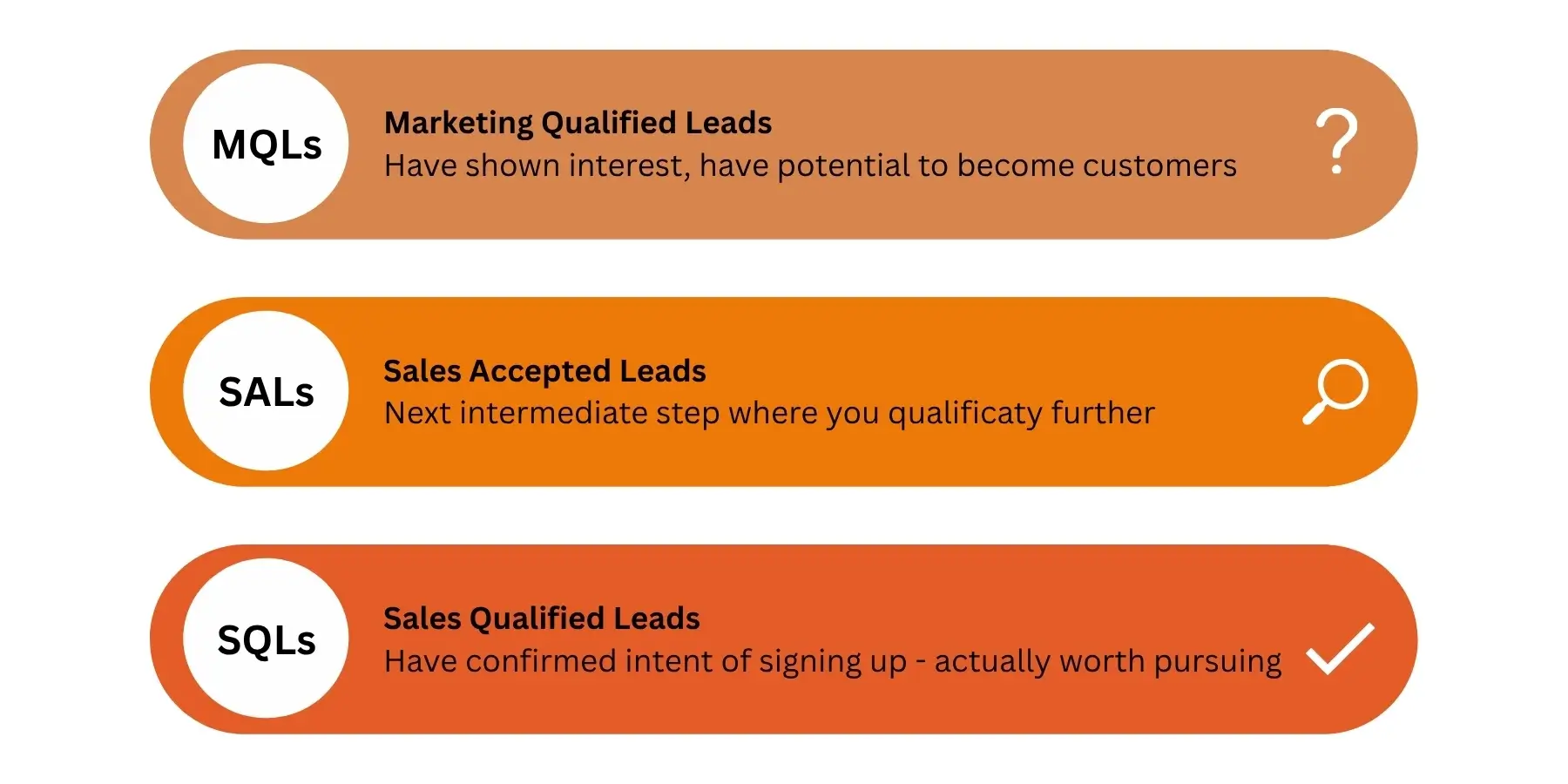
Your lead qualification process can involve three progressive stages that help filter prospects as they move through your sales funnel:
1. Marketing Qualified Leads (MQLs)
An MQL has demonstrated enough interest in your offerings to be considered a potential customer. At this stage, marketing teams should analyze their leads based on their engagement with marketing content and campaigns. And how have they shown that interest? For example, by:
- Downloading whitepapers or e-books
- Signing up for newsletters
- Engaging with multiple blog posts
- Attending webinars
- Visiting high-intent pages like pricing
- Spending significant time on your website
- Engaging with email campaigns
- Following your company on social media platforms
According to each business, certain activities might be more important than others. That’s why your team can use lead scoring systems to determine when a lead reaches MQL status. By assigning point values to different activities, with leads qualifying as MQLs when they reach a predetermined threshold.
2. Sales Accepted Leads (SALs)
Once marketing has identified an MQL, the lead moves to the SAL stage, where the sales team can do some additional qualification. It’s like an intermediate step, that serves as a bridge to align marketing and sales teams. You make sure that your leads meet baseline sales criteria, before going full on into investing.
During this stage, sales representatives might:
- Verify basic company information
- Conduct preliminary research on the company and contact
- Have initial conversations to gauge interest level
- Determine if the prospect has a genuine need for your solution
- Assess the prospect's timeline and budget constraints
- Confirm the contact's role in the decision-making process
The SAL stage helps prevent premature handoffs to sales. This is especially important for B2B complex sales cycles in bigger companies.
3. Sales Qualified Leads (SQLs)
A lead becomes an SQL when the sales team confirms they are a genuine sales opportunity worth pursuing. These leads have passed through both marketing and initial sales qualification filters and show clear indicators of purchasing intent.
SQLs usually:
- Have explicitly stated their need for your solution
- Possess the budget to make a purchase
- Have decision-making authority or direct access to decision-makers
- Are working with a clear timeline for implementation
- Have shared specific pain points that your solution addresses
- Have engaged in detailed discussions about how your product or service works
- Have requested pricing information or a formal proposal
- Have agreed to next steps in the sales process
This way you can have smooth handoffs between marketing and sales teams, and you’ll mitigate missed opportunities.
Understanding qualified vs. unqualified leads
Not all leads that enter your funnel will be worth pursuing. Understanding the distinction between qualified and unqualified leads is crucial for efficient resource allocation.
Characteristics of qualified leads
Qualified leads exhibit several common characteristics:
- Clear need: They have explicitly articulated problems or challenges that your solution can address.
- Budget authority: They have the financial resources to purchase your product or service, or they can easily access those resources.
- Decision-making power: They either make purchasing decisions themselves or have significant influence over those who do.
- Timeline alignment: Their implementation timeline aligns with your sales cycle and delivery capabilities.
- Organizational fit: Their company size, industry, and structure match your ideal customer profile.
- Technical compatibility: Their existing systems and processes are compatible with your solution.
- Good engagement level: They consistently engage with your content and communications.
Signs of unqualified leads
Conversely, unqualified leads often display these warning signs:
- Vague or misaligned needs: They can't clearly articulate their challenges or are looking for solutions that don't match your offerings.
- Budget constraints: They lack the financial resources to purchase your solution or are unwilling to invest at market rates.
- No decision authority: They have no influence over purchasing decisions and cannot connect you with decision-makers.
- Unrealistic timelines: Their expectations for implementation don't align with what's realistically possible.
- Poor organizational fit: Their company size, industry, or structure makes them unlikely to succeed with your solution.
- Technical incompatibility: Their existing systems would require excessive customization to work with your offering.
- Low engagement: They show minimal interest in your communications or educational content.
Lead qualification frameworks for better results
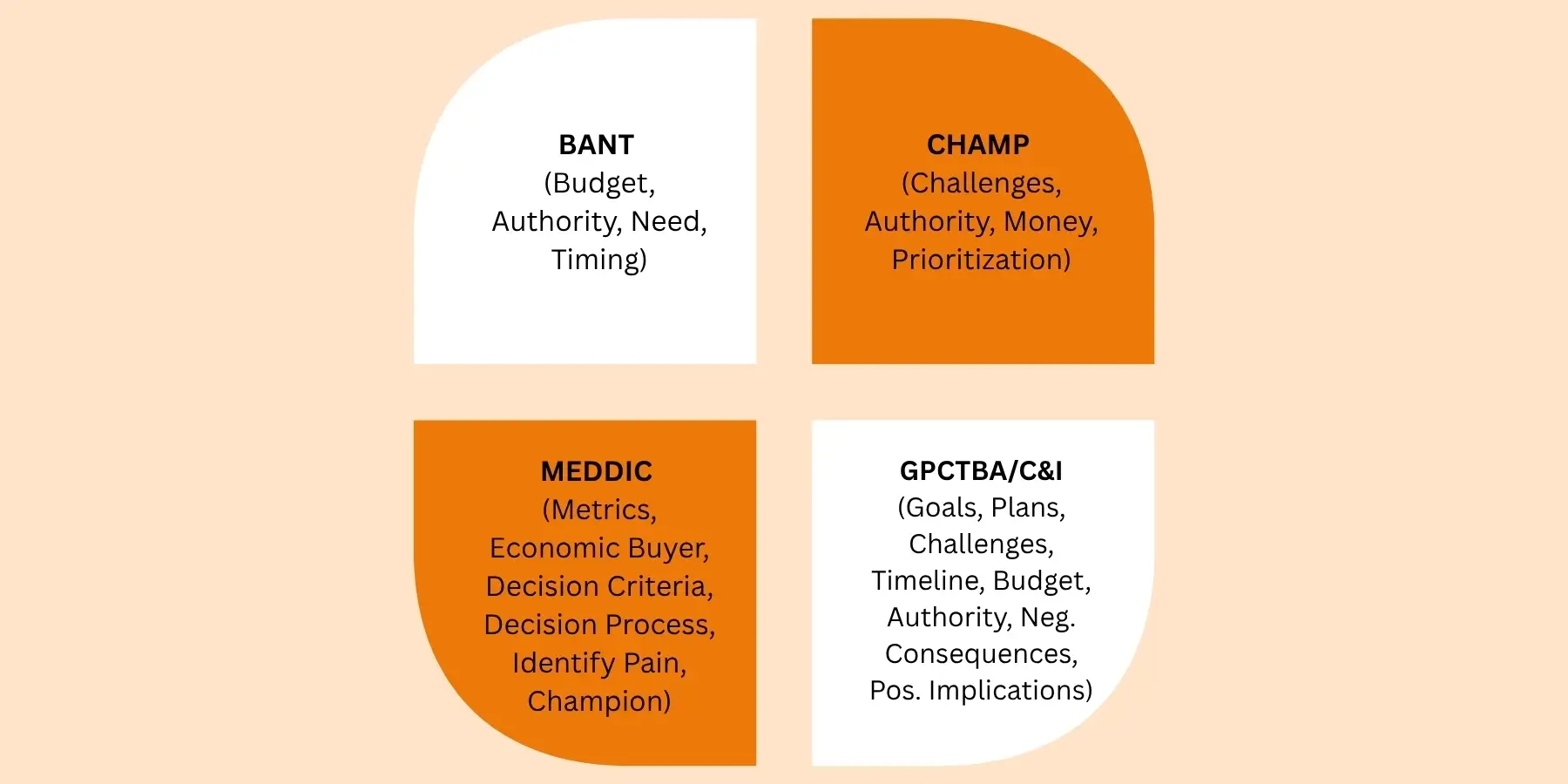
There are different frameworks to help you structure the lead qualification process of your company. And each has its strengths and ideal use cases, so you’ll have to understand which fits your business better:
BANT (Budget, Authority, Need, Timing)
Developed by IBM, BANT remains one of the most widely used qualification frameworks:
- Budget: Does the prospect have the financial resources to purchase your solution?
- Authority: Is your contact the decision-maker, or do they have influence over purchasing decisions?
- Need: Does the prospect have a clear need that your product or service can address?
- Timing: What is the prospect's timeline for implementing a solution?
BANT works well for high-ticket B2B sales where budgetary constraints and decision-making processes are critical factors. However, some people argue that by putting budget first, sales teams might prematurely disqualify leads that could find budget if the value proposition is strong enough.
Sample BANT questions:
- "Have you allocated a budget for this type of solution?"
- "Who else is involved in making purchasing decisions for your department?"
- "What specific challenges are you trying to address with our solution?"
- "When are you looking to implement a new solution?"
CHAMP (Challenges, Authority, Money, Prioritization)
CHAMP flips BANT's priorities, putting the prospect's challenges first:
- Challenges: What problems is the prospect trying to solve?
- Authority: Who has decision-making power?
- Money: Is there budget available for a solution?
- Prioritization: How urgent is addressing this challenge compared to other business priorities?
This framework works well for when you need to establish value before even discussing price, as it focuses first on understanding the prospect's pain points. By starting with challenges, sales representatives can build rapport and demonstrate expertise before addressing potentially sensitive topics like budget.
Sample CHAMP questions:
- "What are your biggest obstacles to achieving your goals right now?"
- "Besides yourself, who else would be involved in evaluating a solution like ours?"
- "What kind of investment are you prepared to make to solve these challenges?"
- "Where does solving this problem rank among your current priorities?"
MEDDIC (Metrics, Economic Buyer, Decision Criteria, Decision Process, Identify Pain, Champion)
MEDDIC is for complex enterprise sales, with multiple stakeholders:
- Metrics: What metrics will measure the success of implementing your solution?
- Economic Buyer: Who controls the budget?
- Decision Criteria: What criteria will be used to evaluate potential solutions?
- Decision Process: What steps are involved in making a purchase decision?
- Identify Pain: What specific pain points is the prospect experiencing?
- Champion: Who within the organization will advocate for your solution?
MEDDIC can work best for environments with lengthy sales cycles and multiple decision-makers.
Some sample MEDDIC questions:
- "How will you measure the success of this project?"
- "Who ultimately approves the budget for initiatives like this?"
- "What specific criteria will you use to evaluate different solutions?"
- "Can you walk me through your typical procurement process?"
- "What happens if you don't solve this problem in the next six months?"
- "Who within your organization is most passionate about addressing this issue?"
GPCTBA/C&I (Goals, Plans, Challenges, Timeline, Budget, Authority, Negative Consequences, and Positive Implications)
More complex, this one addresses modern buying behaviors:
- Goals: What are the prospect's objectives?
- Plans: How do they plan to achieve these goals?
- Challenges: What obstacles stand in their way?
- Timeline: When do they need a solution?
- Budget: What financial resources are available?
- Authority: Who makes the final decision?
- Consequences & Implications: What happens if they succeed or fail?
This framework is quite a good fit for solution-oriented sales where understanding the broader business context is crucial. By exploring both negative consequences and positive implications, sales representatives can build a compelling case for change.
Sample GPCTBA/C&I questions:
- "What are your primary business objectives for the coming year?"
- "What strategies have you already put in place to achieve these goals?"
- "What obstacles have prevented you from achieving these goals so far?"
- "When do you need to start seeing results?"
- "How do you typically fund initiatives like this?"
- "Who needs to approve this type of purchase?"
- "What happens if you don't address this issue soon?"
- "How would successfully implementing this solution impact your personal and professional goals?"
How to qualify your leads: Step-by-step
Creating a lead qualification process involves several key steps:
1. Define your ideal customer profile (ICP)
Before you can qualify leads, you need to know what makes a perfect customer for your business. Your ICP should include:
- Firmographic data (company size, industry, revenue)
- Decision-maker profiles (job titles, responsibilities)
- Common pain points and challenges
- Typical buying triggers
- Budget ranges and purchasing processes
- Technology stack and integration requirements
- Organizational structure and decision-making patterns
- Geographical considerations
- Growth stage and market position
Your ICP serves as the foundation for all qualification activities, helping you quickly identify which prospects are worth pursuing. Develop your ICP by analyzing your current customer base, particularly your most successful and profitable customers.
2. Develop qualification criteria
Based on your ICP and chosen framework, establish clear criteria for what constitutes a qualified lead. These might include:
- Minimum company size or revenue
- Specific industries or verticals
- Current technology stack
- Immediate business needs
- Available budget range
- Decision-making timeline
- Level of engagement with your content
- Previous purchasing patterns
- Organizational growth stage
- Competitive landscape
These criteria should be specific enough to meaningfully filter prospects but flexible enough to accommodate various potential customers. Document these criteria clearly and ensure that all sales and marketing team members understand how to apply them consistently.
3. Implement lead scoring
Lead scoring assigns numeric values to various lead attributes and behaviors, creating an objective system for measuring qualification. A comprehensive lead scoring model includes:
- Demographic scoring: Points for how well the prospect's profile matches your ICP
- Behavioral scoring: Points for engagement activities like email opens, content downloads, and website visits
- Timing indicators: Points for urgency signals or readiness to buy
- Negative scoring: Point deductions for disqualifying factors
- Recency weighting: Higher values for recent engagement versus older activities
- Channel weighting: Different point values based on the engagement channel
- Content-type scoring: Higher values for engagement with bottom-funnel content
Modern CRM systems, which usually include pretty good lead qualification services, might allow you to automate this scoring process, updating lead scores in real-time as new data becomes available. Regular analysis of your scoring model's will get you better predictions.
4. Create a lead qualification checklist
A standardized checklist ensures consistency in your qualification process. Your checklist might include questions like:
- Does the prospect have a clearly defined need for our solution?
- Do they have budget authority or access to decision-makers?
- Is their timeline aligned with our sales cycle?
- Does their company fit our ideal customer profile?
- Have they shown engagement with our high-value content?
- Do they have the technical capabilities to implement our solution?
- Are there any red flags or disqualifying factors present?
- Have they expressed explicit interest in our solution?
- Do they have realistic expectations about implementation and results?
This checklist serves as a practical tool for sales representatives during qualification calls or meetings. It can be incorporated into your CRM system as a series of fields or tasks to ensure complete documentation of the qualification process.
5. Develop qualification questions
The questions you ask prospects can make or break your qualification process. Effective qualification questions are:
- Open-ended to encourage detailed responses
- Focused on uncovering genuine needs rather than just confirming assumptions
- Designed to reveal decision-making processes
- Tactful when addressing sensitive topics like budget
- Sequenced to build naturally on previous responses
- Customized to the prospect's industry and role
Examples of strong qualification questions include:
- "What's your biggest priority right now?"
- "What has prevented you from solving this problem until now?"
- "Who else would be involved in making this decision?"
- "What's your timeline for implementing a solution?"
- "How would you measure the success of this project?"
- "What's your process for evaluating new solutions like ours?"
- "How is this challenge affecting your team's productivity or results?"
- "What would happen if you didn't address this issue in the next six months?"
Train your sales team to listen actively and ask thoughtful follow-up questions based on the prospect's responses. The goal isn't just to collect information but to build a meaningful understanding of the prospect's situation.
6. Establish a follow-up strategy
Not all qualified leads are ready to buy immediately. Create a structured follow-up process that:
- Segments leads based on their qualification level
- Provides value through relevant content and insights
- Maintains consistent communication without being pushy
- Identifies trigger events that might accelerate the buying process
- Re-qualifies leads at appropriate intervals
- Personalizes communication based on previous interactions
- Escalates engagement for leads showing increased interest
- Systematically nurtures leads until they're ready to purchase
This approach ensures you maintain relationships with prospects until they're ready to make a purchase decision. Document your follow-up cadence for different types of leads and implement it consistently across your sales team.
Lead qualification checklist: Identify your best prospects
How to use this lead qualification checklist
Qualification Scoring Guide
To determine overall lead qualification status, evaluate the prospect against each section of the checklist:
- Basic Qualification: These are foundational criteria. If a prospect doesn't meet most of these requirements, they should generally be disqualified or placed in a long-term nurturing program.
- Budget, Authority, Timing, Solution Fit: These categories represent the core BANT framework. A qualified lead should satisfy most criteria in each section, with particular emphasis on the areas most relevant to your sales process.
- Engagement Qualification: Strong engagement signals typically indicate higher qualification and conversion potential. Low engagement may require additional nurturing before advancing the prospect.
- Red Flags & Disqualifiers: These warning signs should prompt careful evaluation. While a single red flag may not automatically disqualify a lead, multiple red flags typically indicate a poor fit.
Recommended Qualification Thresholds
- Sales Qualified Lead (SQL): Meets 80% or more of criteria across all categories with no critical red flags
- Sales Accepted Lead (SAL): Meets 60-80% of criteria with limited red flags
- Marketing Qualified Lead (MQL): Meets 40-60% of criteria but shows strong engagement
- Nurture Lead: Meets less than 40% of criteria but has potential for future qualification
- Disqualified Lead: Multiple red flags or critical disqualification factors present
Implementation Tips
- Customize for Your Business: Adjust the checklist criteria to align with your specific industry, sales process, and ideal customer profile.
- Document Qualification Status: Record qualification assessment results in your CRM to track progression through the sales funnel.
- Regular Reassessment: Lead qualification isn't static—reevaluate leads as new information becomes available or circumstances change.
- Team Calibration: Regularly review qualification assessments as a team to ensure consistent application of criteria across different sales representatives.
- Automation Integration: Where possible, incorporate automated scoring from your CRM or lead qualification tools to supplement manual assessment.
- Qualification Questions Library: Develop a set of specific questions for each checklist item to ensure consistent information gathering during prospect conversations.
- Progressive Qualification: Not all information will be available immediately—focus on critical qualification factors early, then gather additional details as the relationship develops.
- Feedback Loop: Track which qualified leads convert to customers and which don't, then refine your qualification criteria based on these outcomes.
By systematically applying this comprehensive lead qualification checklist, your sales team can focus their valuable time and resources on the prospects most likely to become successful customers, dramatically improving conversion rates and sales efficiency.
Three levels of prospect qualification
Beyond the standard MQL, SAL, and SQL stages, it's useful to understand the three dimensions of prospect qualification that sales professionals assess:
1. Organization-level qualification
This foundational level of qualification focuses on whether the prospect's company matches your target market profile:
- Industry alignment: Does the company operate in an industry you serve?
- Size compatibility: Is the company within your target size range (employees, revenue)?
- Geographic fit: Is the company located in regions where you operate?
- Technological compatibility: Does their tech stack align with your integration requirements?
- Cultural fit: Do their business values and approach match well with yours?
Organization-level qualification helps sales teams quickly determine if a prospect is worth researching further. This assessment often happens before any direct contact.
2. Opportunity-level qualification
This intermediate level focuses on the specific problem or opportunity the prospect is trying to address:
- Need validation: Does the prospect have a genuine need that your solution addresses?
- Solution awareness: Is the prospect familiar with solutions like yours?
- Implementation capability: Does the prospect have the resources to successfully implement your solution?
- Business case viability: Can a clear ROI be established for your solution?
- Competitive positioning: How does your solution compare to alternatives the prospect is considering?
Opportunity-level qualification helps determine if there's a genuine fit between your offering and the prospect's needs, regardless of who you're speaking with at the company.
3. Stakeholder-level qualification
The final level focuses on the specific individuals you're engaging with and their role in the purchasing process:
- Decision authority: Does your contact have purchasing power or influence?
- Personal motivation: What's at stake for your contact personally in solving this problem?
- Internal support: Does your contact have backing from other stakeholders?
- Buying stage: Where is your contact in their decision-making process?
- Communication style: How does your contact prefer to receive information?
Stakeholder-level qualification helps you navigate the human elements of the sales process, ensuring you're working with the right people and addressing their specific concerns.
Lead qualification process across inbound and outbound strategies
The lead qualification process varies depending on whether you're dealing with inbound or outbound leads. Each approach requires slightly different tactics:
Inbound lead qualification
Qualifying inbound leads is important, because these leads have already shown some interest in your company by engaging with your content or submitting forms. So, your process should focus on:
- Immediate engagement: Responding quickly to inbound inquiries (ideally within 5 minutes)
- Intent assessment: Determining why the prospect reached out and what specific needs they have
- Fit evaluation: Assessing how well the prospect matches your ICP
- Engagement analysis: Reviewing their previous interactions with your content
- Qualification calls: Scheduling brief conversations to gather additional qualification information
With inbound leads, you already have some indication of interest, so the qualification process centers on determining if that interest is genuine and if the prospect is a good fit for your offering.
👉 Read more to know how to increase your inbound leads.
Outbound lead qualification
Outbound leads haven't expressed interest in your company yet—you're reaching out to them based on your targeting criteria. The qualification process for these leads includes:
- Pre-qualification research: Identifying prospects that match your ICP before making contact
- Initial outreach: Crafting personalized messages that establish relevance and value
- Response analysis: Evaluating how prospects respond to your outreach attempts
- Progressive qualification: Gradually gathering qualification information across multiple touchpoints
- Disqualification efficiency: Quickly moving on from prospects who show disqualifying characteristics
With outbound leads, the qualification process is more gradual and often requires multiple interactions to gather sufficient information. Efficient disqualification is particularly important to avoid wasting resources on poor-fit prospects.
Lead qualification tools that drive efficiency
There are many great lead qualification tools that can help you improve your sales processes. Here's some ideas:
1. Zeeg for smart lead routing
Zeeg combines AI voice agents and appointment scheduling with intelligent lead qualification. The platform's phone assistants and routing forms automatically direct leads to the right team members based on qualification criteria, ensuring that high-value prospects connect with the appropriate specialists.
With Zeeg, you can:
- Create custom qualification forms that gather critical information
- Set up conditional routing rules based on prospect responses
- Automate scheduling for qualified leads
- Track lead sources and conversion rates
- Enable round-robin distribution for fair lead allocation
- Implement team scheduling for complex sales processes
- Analyze your qualification process through comprehensive reporting
Learn more about the lead routing best practices.
2. CRM-based qualification
Modern CRM systems like Salesforce, HubSpot, and Pipedrive offer built-in lead qualification features, including:
- Automated lead scoring
- Workflow automation for lead routing
- Activity tracking and engagement monitoring
- Qualification stage visualization
- Email template libraries for qualification communications
- Task automation for follow-up activities
- Lead assignment rules based on qualification criteria
- Custom field creation for tracking qualification data
These tools integrate qualification directly into your sales process, creating a seamless experience for both sales teams and prospects.
3. Dedicated lead qualification software
Specialized tools like Chili Piper, Drift, and Instantly focus specifically on qualifying and routing leads:
- Chili Piper offers form concierge features that qualify leads as they submit information
- Drift uses conversational AI to qualify website visitors in real-time
- Instantly provides behavior-driven insights from cold outreach for qualification
These purpose-built tools often deliver more sophisticated qualification capabilities than general-purpose CRMs.
Lead qualification best practices
To streamline your lead qualification efforts, follow these best practices:
1. Align sales and marketing teams
Successful lead qualification requires close collaboration between marketing and sales:
- Develop shared definitions for MQLs, SALs, and SQLs
- Create service-level agreements for lead handoffs
- Implement regular feedback loops to refine qualification criteria
- Share insights about which leads convert and why
- Conduct joint training sessions on qualification processes
- Use unified technology platforms for seamless data sharing
- Establish clear accountability for lead qualification results
This alignment ensures a smooth transition as leads move through the qualification process. Regular communication between teams allows for continuous improvement of qualification criteria and processes.
2. Balance automation with human judgment
While AI and automation improve efficiency, human insight remains valuable:
- Use technology for initial scoring and filtering
- Have sales representatives conduct qualification calls for high-potential leads
- Incorporate qualitative feedback into your qualification systems
- Allow for exceptions when leads show unusual but promising characteristics
- Use automation to handle routine tasks while focusing human effort on complex decisions
- Regularly audit automated qualification decisions
- Combine data-driven insights with relationship-building skills
The most effective qualification processes blend technological efficiency with human expertise. This hybrid approach leverages the strengths of both automation and personal interaction.
3. Continuously refine your qualification criteria
Lead qualification isn't a "set it and forget it" process:
- Regularly analyze which qualified leads convert to customers
- Identify patterns in deals that close successfully
- Update your ICP and qualification criteria based on market changes
- Test different qualification questions to see which yield the most accurate results
- Monitor industry trends that might affect qualification standards
- Adjust scoring models based on conversion data
- Incorporate feedback from sales representatives about qualification accuracy
4. Prioritize quick response times
Research consistently shows that responding quickly to inbound leads dramatically increases conversion rates:
- Implement automated initial responses for all new leads
- Use lead qualification tools that provide real-time alerts for high-scoring prospects
- Establish clear SLAs for follow-up times based on lead qualification level
- Create templated responses for common qualification scenarios
- Leverage scheduling automation to reduce coordination time
- Implement chat solutions for immediate engagement
- Track and measure response times as a key performance indicator
Fast, relevant follow-up demonstrates professionalism and increases the likelihood of engagement. The highest conversion rates occur when leads are contacted within five minutes of their initial inquiry.
5. Don't disqualify prematurely
While efficiency is important, avoid rigid qualification processes that might exclude valuable prospects:
- Consider potential future value, not just immediate fit
- Create nurturing paths for leads that aren't quite ready
- Look for unexpected indicators of potential that might not fit your standard criteria
- Periodically review disqualified leads to identify missed opportunities
- Allow for qualification score improvement over time
- Recognize that qualification is often contextual and situational
- Implement "second chance" programs for borderline leads
Sometimes the best customers don't perfectly match your initial qualification profile. Building flexibility into your qualification process allows you to capture unconventional opportunities.
Stop losing qualified leads with Zeeg

Zeeg offers the only platform built specifically around appointment scheduling with AI voice agents and native contact management features, and makes sure that every qualified lead flows automatically into your sales pipeline without any manual data entry or lost opportunities. How, you might ask? Through features like:
- Custom routing forms that qualify prospects before they even book their meetings, directing high-value leads to senior team members
- AI voice agents that take incoming calls and qualify leads as well as making outbound calls
- Conditional logic routes prospects based on company size, budget, and specific needs
- Round-robin feature ensures a fair distribution following your custom criteria
- 24/7 scheduling tool that you can share via link, email signature, social media, website widget, etc.
- Seamless integration with different tools, like calendars apps (Google, Apple, Microsoft), video conferencing tools (Zoom, Teams, Meet), other CRMs (Pipedrive, Hubspot, Salesforce), and many more
Full security and GDPR compliance - if you’re a company that worries about meeting the highest standards of security and privacy, you should know Zeeg meets the strictest data protection standards.
Unlike traditional tools that treat scheduling as an afterthought, Zeeg's appointment-centric approach means qualified leads automatically become trackable opportunities with full attribution from initial booking to deal closure.
Conclusion: Improve your sales process through lead qualification
As we’ve seen above, lead qualification is no longer optional—it's essential for sales success. By implementing a structured qualification process, leveraging the right tools, and continuously refining your approach, you can dramatically improve your team's efficiency and conversion rates.
Remember that the ultimate goal of lead qualification isn't just to filter out poor-fit prospects—it's also to identify the leads that represent the best opportunity for mutual success. When your solution truly addresses a prospect's needs, qualification becomes the first step in building a valuable, long-term customer relationship.
Frequently Asked Questions (FAQ)
What's the difference between MQLs, SALs, and SQLs?
- MQLs (Marketing Qualified Leads) have shown interest through marketing engagement and meet basic criteria
- SALs (Sales Accepted Leads) have been vetted by sales as worth pursuing
- SQLs (Sales Qualified Leads) show clear buying intent and have passed thorough sales qualification
- This progression helps filter prospects through your funnel efficiently
What is a marketing qualified lead?
A marketing qualified lead (MQL) is a prospect who has engaged meaningfully with your marketing efforts—downloading content, attending webinars, or visiting high-intent pages. They match your ideal customer profile demographically but haven't yet demonstrated immediate purchase intent. Marketing teams identify MQLs based on engagement scores before handing them to sales for further qualification.
What is a product qualified lead?
A product qualified lead (PQL) has experienced value from your product through a free trial or freemium model before becoming a paying customer. Unlike other lead types, PQLs have hands-on product experience, making them particularly valuable. Qualification typically involves analyzing usage metrics, feature adoption, and engagement with support resources—especially important for SaaS companies where product experience drives conversion.
Which lead qualification framework is best?
No single framework works best for everyone—each offers unique advantages depending on your sales context. BANT excels for high-ticket B2B sales, while CHAMP prioritizes understanding customer challenges first. MEDDIC works well for complex enterprise deals with multiple stakeholders. The ideal approach typically blends elements from different frameworks to match your specific sales process and customer journey.
How do you qualify a lead in a CRM?
To qualify leads in your CRM:
- Set up custom fields tracking qualification criteria (BANT, MEDDIC, etc.)
- Create lead scoring rules assigning points for fit and engagement
- Establish qualification stages aligned with your sales process
- Implement workflows to route leads at qualification thresholds
- Use reporting to track conversion between qualification stages
- Regularly refine criteria based on which leads actually convert
What are the most important lead qualification criteria?
The most critical qualification factors include:
- Clear need for your solution addressing specific pain points
- Available budget or funding access for purchase
- Decision-making authority or direct influence
- Realistic implementation timeline
- Organizational fit with your ideal customer profile
- Consistent engagement with your company
- Absence of major red flags or blockers
What is the difference between lead generation and lead qualification?
Lead generation focuses on attracting prospects and capturing their contact information through marketing activities like content offers, events, and advertising. It emphasizes volume and initial interest. Lead qualification happens after generation, evaluating those leads against specific criteria to determine sales readiness. Generation fills your funnel with opportunities; qualification ensures only viable prospects receive sales attention.
How can lead qualification software improve the process?
Lead qualification software automates scoring, tracks behaviors across channels, and standardizes qualification workflows. These tools analyze thousands of data points to generate accurate assessments, route leads appropriately, and provide analytics for continuous improvement. Advanced platforms include AI that predicts conversion likelihood based on historical patterns, allowing teams to qualify leads consistently while scaling efficiently as volume grows.
How do lead qualification bots work?
Lead qualification bots use conversational AI to interact with website visitors through automated dialogues. They ask qualification questions based on your framework, use natural language processing to interpret answers, and adjust subsequent questions accordingly. These bots score leads in real-time, route qualified prospects to sales representatives, and integrate with CRMs to personalize conversations based on contact history—all while providing 24/7 qualification capability.
How do inbound and outbound lead qualification differ?
Inbound qualification evaluates prospects who've already shown interest through content engagement or form submissions. It focuses on determining genuine interest and sales readiness among those who've initiated contact. Outbound qualification targets potential customers matching your ideal profile who haven't expressed interest yet, gradually qualifying them through personalized outreach and value-focused engagement over multiple touchpoints.
How do chatbots qualify leads?
Chatbots qualify leads through interactive conversations collecting key qualification data in a conversational format. They ask structured questions about needs, budget, timeline, and decision authority, then assign qualification scores based on responses. Modern qualification chatbots personalize dialogues based on visitor behavior, qualify leads outside business hours, and continuously improve through machine learning that analyzes which qualified leads ultimately convert.
How do you use intent data to identify sales qualified leads?
To leverage intent data for identifying qualified leads, you should:
- Define relevant buying signals for your business
- Implement tracking across owned and third-party sites
- Integrate intent signals with your qualification framework
- Set up alerts for significant intent spikes from key accounts
- Combine intent with fit data to prioritize high-value opportunities
- Tailor outreach based on specific research topics
- Continually refine which intent signals best predict conversion
Zeeg is Europe's leading AI voice agent and appointment scheduling software in one solution — GDPR-compliant, made in Germany. Start for free →