
Zoho CRM Pricing: Complete Guide to Plans and Costs (2026)


Choosing the right CRM isn’t as hard as many think: It’s all about finding the right balance (for your business) between features and budget. Zoho CRM has built a reputation as one of the most affordable customer relationship management platforms on the market, with pricing plans that scale from free to enterprise-level solutions.
In this guide, we’ll have a look at every aspect of Zoho CRM's pricing, from the free tier to the premium Plus edition, to help you understand exactly what you get for your investment. Plus, we'll show you how Zeeg's scheduling features can complement your CRM setup at a fraction of the cost of traditional booking solutions. Zeeg is Europes leading AI voice agent and appointment scheduling system that is made in Germany for complete GDPR-compliance.
See how Zeeg handles your actual workflow—from booking to customer—in one integrated platform. Start with our free plan or try any paid tier risk-free for 14 days.
Try Zeeg freeUnderstanding Zoho CRM's pricing structure
Zoho CRM revolves around a simple per-user, per-month pricing model that makes it easy to calculate costs as your team grows. The platform has six distinct tiers for different business needs and budgets. Unlike some competitors that lock you into complex contracts or hidden fees, Zoho's pricing is quite transparent and predictable.
The company structures its costs around annual versus monthly billing, with noteworthy savings available for those willing to commit to yearly contracts. This approach helps businesses plan their software expenses more effectively while rewarding longer-term commitments with lower monthly rates.
What makes Zoho better than many CRM providers is its genuine free tier that actually is quite useful for small teams. While most "free" CRM solutions offer little more than contact storage, Zoho's free plan includes all the basic features like lead management, basic automation, and reporting capabilities.
👉🏻 Before we get started, here are more articles on Zoho in case you need more information:
- Zoho GDPR Compliance: A Complete User Guide in 2025
- Zoho Meeting Review: Features, Pricing & Alternatives
- Pipedrive vs Zoho: Full Comparison
- Zoho vs HubSpot
Zoho CRM pricing plans, summarized
Zoho CRM pricing plans breakdown
Free plan: Getting started without spending
The Zoho CRM free plan supports up to three users and includes core CRM functionality that many small businesses find sufficient for their most basic needs. You'll get access to lead, contact, and account management tools, along with basic workflow automation and customizable dashboards. The plan also includes email integration and mobile access, which makes it a legitimate option for startups and very small teams.
Storage limitations keep the free plan realistic for its intended audience, with 10MB of organizational storage and basic reporting capabilities. While you won't get advanced features like custom modules or extensive automation, the free tier gives you enough functionality to help you understand whether Zoho CRM fits your business processes.
The free plan includes integration with other Zoho applications to create a mini-cyberspace of business tools without any extra cost. This makes it especially attractive for businesses that already use Zoho's other products such as Zoho Mail or Zoho Projects.
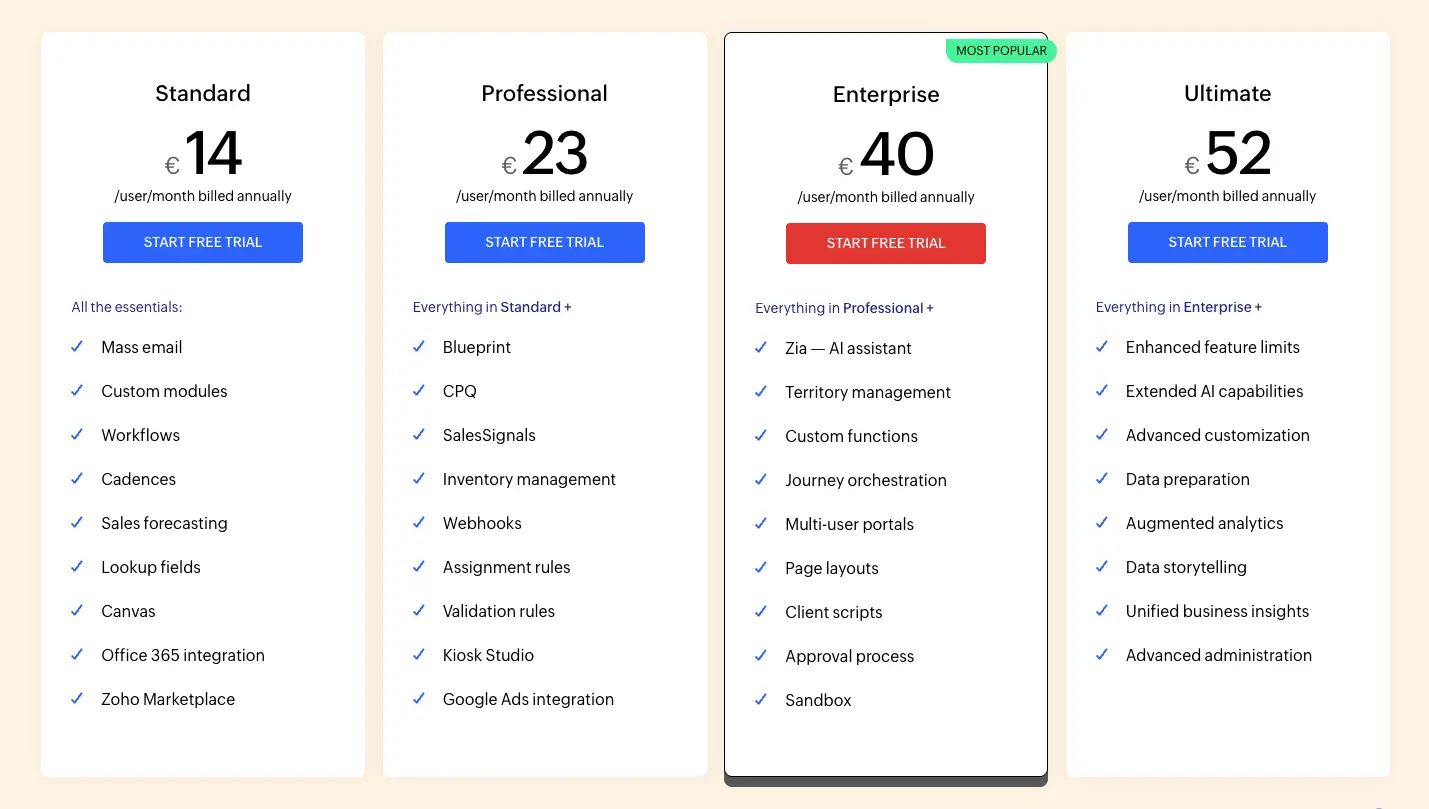
Standard plan: Essential features for growing teams
At $14 per user per month (billed annually) or $20 per user per month (billed monthly), the Standard plan is Zoho's lowest entry-level paid offering. This tier removes the three-user limitation and expands storage to 200MB for your organization, along with enhanced email integration and workflow automation capabilities.
The Standard plan gives you features like territory management, custom fields, and advanced reporting options that help businesses organize their sales processes more effectively. You'll also gain access to web forms for lead capture, email insights to track engagement, and basic sales forecasting tools.
For teams that are upgrading from the free plan, the Standard tier gives you a natural progression without overwhelming new users with complex features. The pricing remains competitive compared to other CRM platforms, which makes it accessible for small businesses ready to invest in stronger customer management tools.
Professional plan: Advanced automation and customization
The Professional plan costs $23 per user per month (billed annually) or $35 per user per month (billed monthly), and is Zoho's most popular tier for growing businesses. This plan expands automation capabilities and introduces Blueprint,which is Zoho's process management feature that helps standardize workflows across your team.
Storage increases to 10GB for organizations with unlimited individual user storage up to 20MB each. The Professional plan also includes advanced customization options, allowing you to create custom modules, fields, and page layouts that match your specific business processes.
Just the Blueprint functionality alone justifies the price increase for many businesses, as it gives visual workflow management that makes sure that your sales team sees processes consistently. When you combine it with enhanced automation features, email scheduling, and advanced reporting, it is safe to say that the Professional plan offers tons of value for businesses ready to scale their operations.
Enterprise plan: More features for larger organizations
Zoho's Enterprise plan costs $40 per user per month (billed annually) or $50 per user per month (billed monthly), and targets mid-sized businesses with more complex CRM requirements than smaller businesses. This tier includes everything from lower plans plus advanced security features, custom modules, and more customization capabilities.
The Enterprise plan provides 10GB of organizational storage (15GB for organizations with more than 200 users) and 50MB per user for individual storage needs. You'll also gain access to multi-user portals, advanced analytics, and data backup and recovery features that become crucial as your business grows.
Security features receive significant attention at the Enterprise level, with data encryption, audit trails, and enhanced user permission controls. The plan also includes Zia, Zoho's AI assistant, which provides intelligent suggestions and automates routine tasks to help your team work more efficiently.
Ultimate plan: Maximum capabilities for complex needs
The Ultimate plan is Zoho's premium offering at $52 per user per month, available only with annual billing. This tier is designed for bigger organizations with even more CRM features and includes improved versions of all features from lower plans.
Storage increases with the Ultimate plan with a whooping 10GB of organizational storage for smaller teams and 30GB for organizations with more than 200 users. Individual users get 100MB of personal storage to accommodate larger file attachments and more extensive data needs.
The Ultimate plan focuses on advanced customization, more automation as well as support options. You'll get access to advanced Canvas design tools, enhanced Blueprint capabilities, and priority support that makes sure that your team gets immediate help when needed.
Plus plan: Complete communication integration
At $57 per user per month (billed annually), the Plus plan includes everything from the Ultimate tier plus more communication tools. This plan integrates live chat, Facebook Messenger, Twitter DMs, and website chatbots directly into your CRM workflow.
The Plus plan addresses the need for multi-channel customer communication by providing up to 10 chatbots, website visitor tracking, and integration between social media interactions and your CRM records. This paves the way for a unified view of customer interactions across all communication channels.
For businesses that rely heavily on social media engagement or need sophisticated chat capabilities, the Plus plan's communication features justify the modest price increase over the Ultimate tier. The ability to manage all customer touchpoints within a single platform eliminates the need for separate communication tools.
👉 Want to calculate actual prices? Check our CRM pricing calculator
Bigin by Zoho: Simplified CRM for micro-businesses
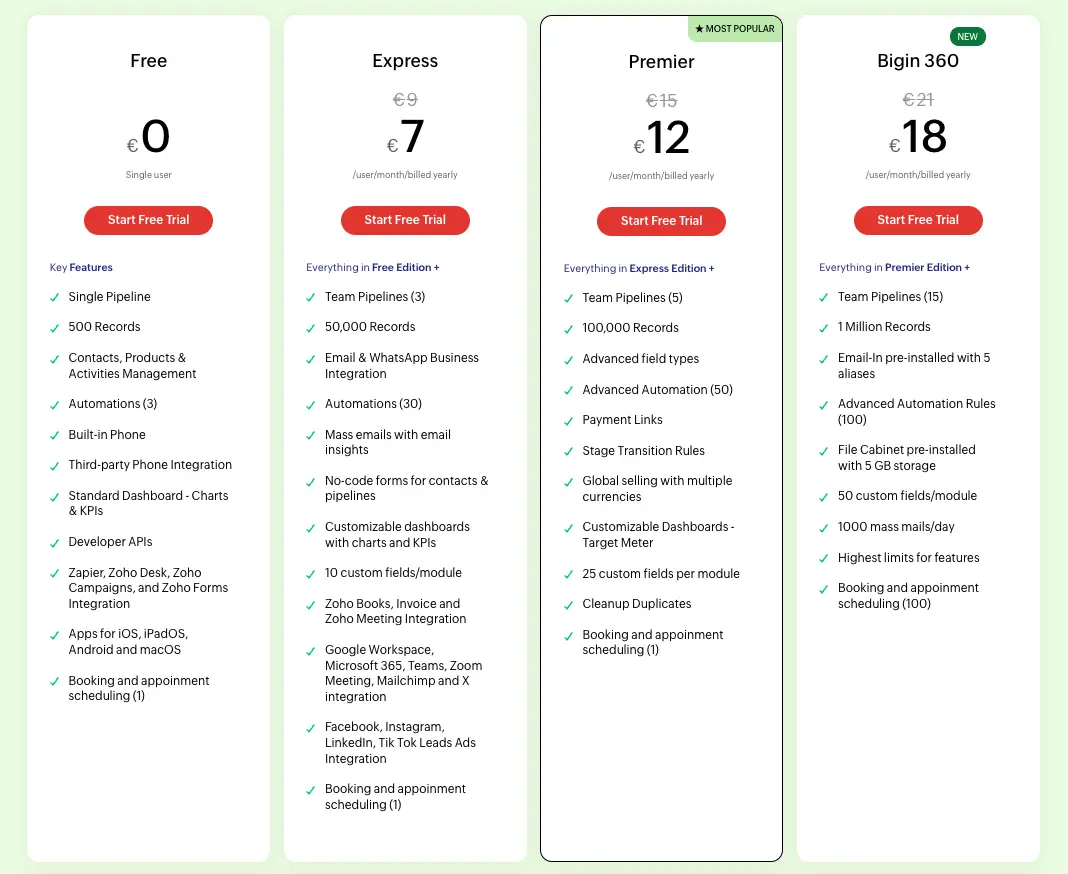
Zoho understands that some businesses need even simpler CRM solutions, which is why they created Bigin: a simplified version designed specifically for very small teams. Bigin pricing starts at just $7 per user per month (billed annually), which makes it one of the most affordable CRM options available.
The platform focuses on essential CRM functions without the complexity of the full Zoho CRM suite. You'll get pipeline management, contact organization, and basic automation features in an interface designed for teams that need immediate productivity without extensive training.
Bigin offers three tiers: Express ($7/month), Premier ($12/month), and Bigin 360 ($18/month). Each plan includes core features like custom fields, email integration, and mobile access, with higher tiers adding more pipelines, advanced automation, and additional customization options.
The Express plan supports unlimited contacts and deals with basic reporting, while the Premier plan adds advanced filters, email templates, and workflow automation. Bigin 360 includes everything plus team collaboration features and advanced reporting capabilities.
Annual vs monthly billing: Maximizing value
Zoho CRM offer you lots of discounts if you commit to the plans annually: you can usually save 20-30% compared to monthly billing. For example, the Standard plan costs $14 per user per month annually versus $20 per user per month when billed monthly. This means $72 annual savings per user, which adds up quickly for larger teams.
You save even more with higher-tier plans. The Professional plan saves $144 per user annually ($23 vs $35 monthly), while the Enterprise plan saves $120 per user annually ($40 vs $50 monthly). For a team of 10 users on the Professional plan, annual billing saves $1,440 compared to monthly payments.
These savings can be reinvested in other business tools or used to upgrade to higher-tier plans with more features. The annual commitment also means budget predictability and removes the administrative overhead of monthly payments.
Hidden costs and additional fees to consider
While Zoho CRM’s pricing plans are quite transparent, some additional costs may come up depending on your needs. Data migration services, while not required, come often handy for businesses that switch from other CRM platforms. Zoho does offer you migration assistance, but more complex transfers may require professional services.
Training and onboarding are another potential cost area. While Zoho provides you with detailed documentation and free training resources, some organizations prefer professional training sessions or dedicated onboarding assistance. These services typically cost extra but can accelerate adoption and maximize ROI.
Third-party integrations may mean extra costs beyond Zoho's base pricing. While the platform includes many native integrations, specialized tools or custom connections might require separate subscriptions or development work. Businesses should audit their current tool stack to identify potential integration expenses.
Advanced customization needs might require developer assistance or custom development work. Zoho has extensive customization options, but highly specialized requirements may exceed the platform's built-in capabilities.
When to upgrade your Zoho CRM plan
Knowing when to upgrade your Zoho CRM plan helps you optimize both functionality and costs. User limitations are usually the most obvious upgrade trigger, as teams quickly outgrow the free plan's three-user limit. But feature limitations also prompt upgrades before user limits become constraining.
Storage constraints often drive upgrades, especially for businesses with large document libraries or contact databases. The free plan's 10MB storage limit restricts document attachments and file storage, while the Standard plan's 200MB allowance may be too less for growing businesses.
Automation needs often justify upgrades to Professional or higher tiers. Teams spending significant time on manual tasks benefit from advanced workflow automation, custom triggers, and process standardization features available in higher-tier plans. The time savings typically justify the additional cost within months.
Reporting and analytics requirements may also lead you to plan upgrades. While basic plans include standard reports, businesses that need custom dashboards, advanced analytics, or detailed forecasting tools need Professional or Enterprise plans.
Zoho CRM cost comparison with competitors
When evaluating Zoho CRM’s cost against other popular platforms, the value proposition becomes clear. Salesforce, often considered the industry standard, starts at $25 per user per month, while HubSpot's paid plans begin at $15 per user per month. Microsoft Dynamics 365 charges $65 per user per month for its basic sales functionality.
Zoho's pricing advantage increases even more when you consider the features included at each tier. While competitors often reserve essential features for higher-priced plans, Zoho gives you functionality even in its Standard plan. This makes Zoho CRM pricing particularly attractive for small and medium-sized businesses.
The free plan comparison reveals Zoho's commitment to accessibility. While HubSpot offers a free tier, it limits users to basic contact management with minimal automation. Salesforce has no free option, and Microsoft's offerings require existing Office 365 subscriptions.
Why Zeeg makes more sense than Zoho for appointment-heavy businesses
Here's what we've learned from talking to hundreds of businesses: the cheapest CRM isn't always the most cost-effective. While Zoho has excellent value for traditional sales processes, appointment-based businesses often find themselves cobbling together multiple tools to handle their actual workflow.
The hidden cost of tool sprawl
You start with a solid CRM foundation - let's say Zoho's Standard plan at €14 per user monthly. But then, you also need proper scheduling functionality; so you add Calendly at €8 per user. You want those appointments to sync with your CRM, so you add Zapier at €20 monthly. Before you know it, your “streamlined” solution costs you €40+ per user and still requires manual work to keep everything connected.
Your team ends up copying appointment details between systems, manually updating lead statuses, and watching potential customers slip through the cracks. It's not that these tools are bad - they're just not designed to work together.
Why we built our system around appointments
Zeeg takes a different approach. We started with the reality that most B2B businesses run on appointments and built everything around that workflow. When someone books a meeting, whether it's through your booking page or your AI voice agents, they automatically become a record. When the meeting ends, follow-up sequences trigger without manual setup. When they become a customer, you can trace their entire journey from first click to signed contract.
Our Professional plan at €10 per user monthly delivers what typically requires multiple subscriptions. But the real value isn't in the cost savings: it's in the smooth experience. No data copying, no manual updates, no wondering if leads are falling through the gaps.
The European advantage that matters
For European businesses, there's another consideration: data sovereignty. While many excellent platforms operate globally, Zeeg keeps your customer data in Germany, under German law. This means full GDPR compliance and no need to explain data jurisdiction decisions to compliance teams.
When you tell prospects their information is handled according to European standards, it adds credibility. When you can guarantee data protection from day one, it removes barriers that can slow down your sales process.
One platform, complete workflow
The question isn't whether you need contact management functionality: you do. The question is whether you want to manage that workflow across multiple disconnected tools or within a single platform designed for how appointment-based businesses actually run.
Book a free demo to see how Zeeg handles your appointment workflow from booking to customer conversion.
Book a demoMaking the right Zoho CRM plan decision
Choosing the right Zoho CRM plan doesn't have to be complicated. Most businesses start with the free plan to test the waters, then move to Standard ($14/month per user) when they need more storage and users. The Professional plan ($23/month per user) hits the sweet spot for most growing companies because it includes Blueprint workflow management and better automation.
Think about where your team will be in six months, not just today. If you're hiring salespeople soon, factor those users into your budget now. Upgrading mid-year often costs more than starting with the right plan from the beginning.
Here's a simple way to decide: If you're just tracking contacts and basic deals, Standard works fine. If you need custom workflows, automated follow-ups, or detailed sales processes, go with Professional. Save Enterprise and Ultimate for when you have complex security needs or large teams.
Don't skip the free trial. Use those 30 days to test how your team actually works with the system. Upload your real contact data, set up your sales pipeline, and see which features you actually use daily. This hands-on experience beats any feature comparison chart.
The annual billing discount is real money back in your pocket - about 25-30% savings compared to monthly payments. For a five-person team on Professional, that's over $1,000 saved per year. Those savings can pay for other tools your business needs or fund an upgrade to higher-tier features.
Zeeg is Europe's leading AI voice agent and appointment scheduling software in one solution — GDPR-compliant, made in Germany. Start for free →
Frequently Asked Questions
Is annual billing required for Zoho CRM?
Annual billing isn't required for most Zoho CRM plans, but it offers significant savings of 20-30% compared to monthly billing. The Ultimate and Plus plans are only available with annual billing. For example, the Standard plan costs $14 per user monthly with annual billing versus $20 per user monthly with monthly billing. The savings add up quickly for larger teams, often justifying the annual commitment.
Are there any hidden costs with Zoho CRM?
Zoho CRM pricing is generally transparent, but additional costs may arise for data migration services, professional training, or custom development work. Third-party integrations might require separate subscriptions, and advanced customizations may need developer assistance. While Zoho provides extensive documentation and free training resources, some organizations prefer paid onboarding services to accelerate adoption.
What happens if I exceed my user or storage limits?
If you exceed your user limit, you'll need to upgrade to a higher plan or purchase additional user licenses. Storage overages typically require plan upgrades since Zoho doesn't offer standalone storage add-ons. The free plan's 10MB limit fills quickly with document attachments, making upgrades necessary for most active users. Monitor your usage regularly to avoid service interruptions.
Can I change my Zoho CRM plan later?
Yes, you can upgrade or downgrade your Zoho CRM plan at any time. However, upgrading mid-contract may result in prorated charges, while downgrading might restrict access to certain features. Annual subscribers get better pricing but are locked into yearly commitments. The 30-day free trial lets you test features before committing to a paid plan, helping you choose the right tier from the start.
How does Zoho CRM pricing compare to other CRM platforms?
Zoho CRM typically costs 30-50% less than major competitors while providing similar functionality. Salesforce starts at $25 per user monthly compared to Zoho's $14, while Microsoft Dynamics 365 begins at $65 per user monthly. HubSpot's paid plans start at $15 per user monthly but reserve many features for higher tiers. Zoho includes more features in its lower-tier plans, making it particularly cost-effective for small businesses.
Is Zoho CRM free?
Yes, Zoho CRM has a free plan that includes basic CRM features for up to three users. This plan provides contact management, lead tracking, basic automation, and mobile access with 10MB of storage. While it lacks advanced features like custom fields or extensive reporting, the free plan offers enough functionality for small teams to get started with CRM. You can upgrade to paid plans as your needs grow.
What are the disadvantages of Zoho CRM?
While Zoho CRM offers good value, it has some limitations. The free plan's 10MB storage fills up quickly, and the three-user limit restricts growth. The interface can feel outdated compared to modern alternatives, and some advanced features require higher-tier plans. Customer support quality varies depending on your plan level, with basic plans receiving limited assistance. Additionally, extensive customization may require technical expertise or developer help.
How expensive is Zoho CRM?
Zoho CRM is considered one of the more affordable CRM platforms in the market. Compared to competitors like Salesforce ($25/user/month), HubSpot ($15/user/month), or Microsoft Dynamics 365 ($65/user/month), Zoho's pricing is competitive. The Standard plan at $14 per user monthly provides good value, while the Professional plan at $23 per user monthly offers advanced features that typically cost more with other providers.
Is Zoho CRM actually free?
Yes, Zoho CRM offers a genuinely free plan that supports up to three users with core CRM functionality. You get lead and contact management, basic workflow automation, customizable dashboards, and 10MB of storage. The free plan includes email integration and mobile access, making it a legitimate option for small teams. However, you won't get custom fields, advanced automation, or extensive reporting features.
How much does Zoho CRM cost?
Zoho CRM costs range from free to $57 per user per month, depending on which plan you choose. The Standard plan starts at $14 per user monthly (billed annually), while the Professional plan costs $23 per user monthly. Enterprise and Ultimate plans are $40 and $52 per user monthly respectively. The top-tier Plus plan costs $57 per user monthly and includes advanced communication features.

